Archive for May, 2008

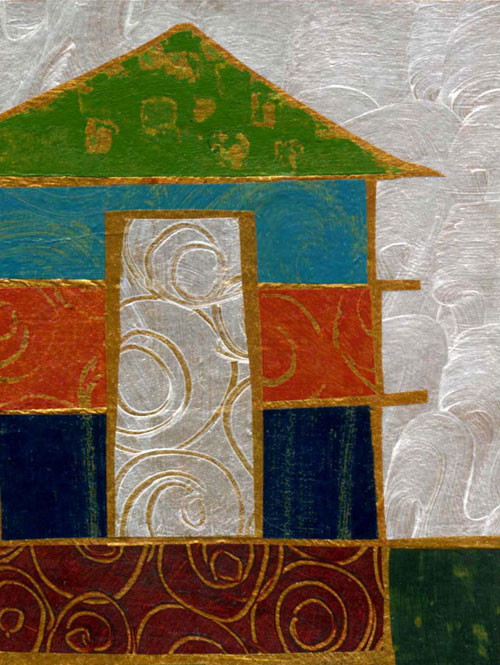
House Dreaming

May 28, 2008


© Jan L. Richardson ◊The Painted Prayerbook◊

When a friend of mine was ready to build a house on the land he had purchased in eastern Kentucky, he sent out a request to some friends. Scott invited us to offer an object, a tangible blessing that he would bury in the ground upon which he would build the house. He recalls that “Folks were amazingly thoughtful—some of the items included tea, Legos and puzzle pieces from my childhood sent by my mother, guitar strings, a bit of climbing rope, a bit of granite from my home town (Lithonia meaning roughly ‘rock place’), a wine chalice from my potter friends, shells from our childhood vacation spot, herbs, bits of plants and dirt from various parts of the country, and chocolate.” After all the gifts arrived, Scott gathered with some friends for a ceremony on his property. Placing the gifts in the ground, they offered a blessing for what would take root in that place. Married now and with young children, Scott and his family flourish in the house built atop the buried blessings.

It was just a few weeks ago, on Easter 5, that we did some reflecting on houses. Pondering Jesus’ words in John 14, where he speaks of the dwelling place he is preparing, we noted how houses are places not only of personal but also collective memory and imagination. Jesus’ words in that passage, as well as in this week’s Gospel lection, underscore the fact that throughout the scriptures, a house is rarely just a physical building. Rather, it evokes a constellation of meanings: a house may refer to a place of worship, the people of Israel, the members of a particular ancestral lineage (as in the house of Jacob), or a group of people who dwell together (a household). Jesus sometimes uses houses to describe the kingdom of God, as in the parable of the woman who sweeps her entire house, looking for her lost coin. Houses also contain a deeply individual meaning, as in this week’s gospel lection, Matthew 7.21-29. Here the image of the house is thoroughly personal, in that it refers to the house that we build with our own particular life, yet it resonates with nearly all the other meanings that house holds. The house that we construct with our life, the house that is our life, is intimately involved with the entire household of God.

In this parable about the wise man who built his house on rock and the foolish man who built his house on sand, Jesus urges us to dig deeper, as it were, into this homely imagery. He challenges us to recognize how the health of a house (and its inhabitants) depends on what we build it upon. The wholeness of the house, he tells us, rests on its foundation. And for Jesus, our tangible response to him forms the foundation of our dwelling with him. Our practices, our searching, our work to live out his call: these acts are blessings that sustain the structure and help its inhabitants flourish.

Jesus makes clear that we can’t cut corners in this kind of house building. There is no shortcut to the kingdom, no substitute for doing the work that’s involved. We are saved by grace alone, but we are called to respond to that grace, to give flesh to our understanding that hospitality is not something we only receive in Christ but that we offer as well. Many of the gospel lections that we’ll journey with during Ordinary Time will speak specifically, and sometimes uncomfortably, to the kind of work that Christ beckons us to do. He emphasizes that it’s not work just for the sake of work (and it’s not constant work, either; rest is one of the ways that we respond to Christ). Rather, our response is for the purpose of relationship. As Jesus highlights in the opening verses of this passage, it’s possible to do really impressive work, work that seems holy on the surface, but is empty because it’s focused on results—on a show of power—rather than on relationship with the one who is the source of true power. “I never knew you” is the lament that Jesus, in Matthew 7.23, predicts he will utter to those who hear but do not respond.

The solidly built house in Jesus’ parable has, like the kingdom of God, a now-and-not-yet quality. The house that he describes is something of a mystical house that stands complete and inhabited, yet which we are also in the process of building. Living together in a house that we are still working on sometimes seems daunting. We can get to feeling like Sisyphus in our perpetual practicing, particularly in those times when we start focusing more on the practices themselves and less on the relationship the practices are designed to cultivate. Too, we don’t always know precisely how the structure will take shape and what it will look like. Our call, however, isn’t always to finish the house but rather to be faithful in laying the groundwork, to discerning and doing the work that’s in front of us, the work that is ours to do.

And here’s a cool thing: don’t gotta do it alone. Aren’t meant, in fact, to do it alone. I think again of my house building friend, how he asked for help and invited others to share in blessing and building the foundation.

What are you building your life on? What are the practices that give wholeness to the house of your life? Are there any places in the foundation that feel shaky? Is there someone you could ask for help as you build? What’s the dream house of your soul look like?

A blessing upon your building.
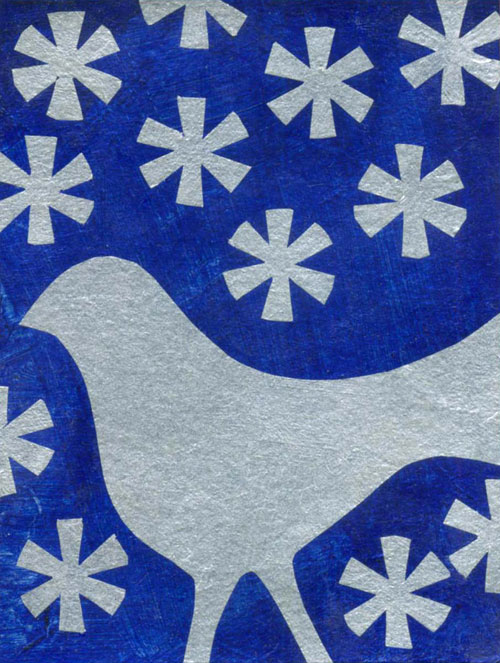
Happy Ordinary Time!

May 24, 2008


© Jan L. Richardson ◊The Painted Prayerbook◊

So, did you sense the shift when we moved into the new season? Did you hit the after-Pentecost sales and send out your “Merry Ordinary Time” cards? No? It tends to sneak up on us, doesn’t it, this new and subtle season of the Christian year. We have spent the past six months swimming in the Big Stories that Advent, Christmas, Epiphany, Lent, Easter, and Pentecost provided for us. These holy days and seasons have offered something approaching an embarrassment of riches with the themes they have brought us: birth, incarnation, the wilderness, suffering, death, resurrection, the life of the community, and the work of the Holy Spirit. It’s been a good and grounding groove.

And now for something completely different.

Ordinary Time officially began with the ending of Pentecost, and with Trinity Sunday now behind us, the new season is upon us in earnest. Stretching out for the next six months, Ordinary Time invites and challenges us to move into a mode that is shaped by something other than the “high seasons” that the past half-year has offered us. I sometimes find this new rhythm a little disorienting at first. Living in Florida, where the natural seasons are present (really, we do have them) but subtle, I rely on the liturgical year to help me tell time. Without the big markers I’ve been living with for the past six months, the days and weeks sometimes seem like they’ve lost their cohesion, that they’re oozing out into a nearly interminable horizon that holds few occasions for liturgical celebration. Plus, it’s a really long stretch of looking at green paraments every Sunday.

This season, however, beckons us to find the sacred in its subtlety. In the introduction to her book The Time Between: Cycles and Rhythms in Ordinary Time, Wendy M. Wright reminds us that the “ordinary” in “Ordinary Time” does not mean “boring, uneventful, undistinguished, everyday.” Rather, it “comes from the word ordinal, to count.” With its being a seemingly in-between time, however, Wright observes that this season holds us in a different way than do the seasons “when the beauty of the faith is etched in high relief.” She writes,

I like to think of the entire spectrum of the liturgical cycle of Ordinary Time with all its varied rhythms—of Sunday observance, daily prayer, the sanctoral cycle, the tapestry of stories that dramatize the call and response of Jesus and the first disciples, the seasons of our own discipleship throughout the life cycle, the ritual practice of the great Christian rites, the dynamics of our inner faith lives—as one greater movement of desire to be face-to-face, heart-to-heart with God. The deep grammar of the church year’s Ordinary Time is perhaps uttered most keenly in our ceaseless longing. By it we are propelled into the future. We pine for it as past. We trace the surface of the present with anxious fingertips. Call our desire awareness, mindfulness, mysticism, aesthetic sensitivity, faithfulness, or whatever. It is the fundamental movement of the Christian life.

Given the intensity of the stories that have accompanied us during the months between Advent and Pentecost, one might be tempted to think that Ordinary Time gives us something of a rest. It offers us a different rhythm, to be certain, but as we move into this season, the lectionary doesn’t let us off the hook. The Gospel lection for this Sunday, Matthew 6.24-34, challenges us with questions that lie at the heart of Christian life: Whom will we serve? Where will we place our trust and our energy?

To pose these questions, Jesus turns, in his typical incarnational way, to a couple of earthy examples at hand: the birds of the air and the lilies of the field. Urging his disciples not to devote themselves to worry and anxiety, he borrows the well-fed birds and well-clad lilies as signs of how God cares for God’s creatures.

I have to say that living without worry seems pretty easy to do if you’re a creature who can get by on worms and water. For the rest of us, giving up anxiety often seems more of a challenge. I’ve been pondering this Gospel passage in the midst of hearing news of the mounting death count from the earthquake in China and the cyclone in Myanmar. And I’ve been contemplating Jesus’ words with an awareness, too, of the daily terrors and suffering that shape the lives of so many on this planet. How is it, I wonder, that God has provided, is providing, will provide for their needs? What do Jesus’ images of birds and lilies look like in places that seem devoid of beauty and care?

I was reflecting on this with a couple of friends at lunch today. We each know how little we have in the way of answers to these kinds of questions, other than a sense that somehow God is present in the rubble, literal or otherwise, that disasters leave behind. One of my friends, a Benedictine, reminded us of St. Benedict’s words in chapter 4 of his Rule. After he has provided his monks with a lengthy list of what he calls “The Tools for Good Works,” Benedict wraps up this chapter by writing, “And finally, never lose hope in God’s mercy” (Rule of Benedict 4.74).

Wrestling with this week’s lection, I find myself wondering not so much how to keep myself from worrying but wondering instead how I might be called to relieve someone else’s worry, to be part of the way that God provides clothing and shelter and solace for someone. How do I live as someone who not only hopes for God’s mercy, for myself and others, but participates in that hope by becoming a sign and a vessel of God’s mercy in this world? As someone whose ministry involves raising my entire income, and who lives with the ordinary causes of worry that so many of us deal with, I’m not unacquainted with anxiety. At the same time, I’m aware of how the presence of persistent worry and anxiety may be a sign that I’ve become too absorbed by my own concerns, too consumed with my own needs, and that I need to allow God to draw my attention beyond myself to attend to those who need something that I can offer. It’s a way of trying to do what Jesus, at the beginning and ending of this Gospel lection, challenges us to do: to choose whom we will serve, and to focus first on the kingdom of God, that all other things in our lives may fall into their rightful places.

As we set out into this season of Ordinary Time, where is your energy going? What—and whom—are you serving? What worries, anxieties, needs, and desires are shaping your days? How might you invite God to transform your anxiety into acts of hope, mercy, and love in this world?

Deep blessings to you in these ordinary days.

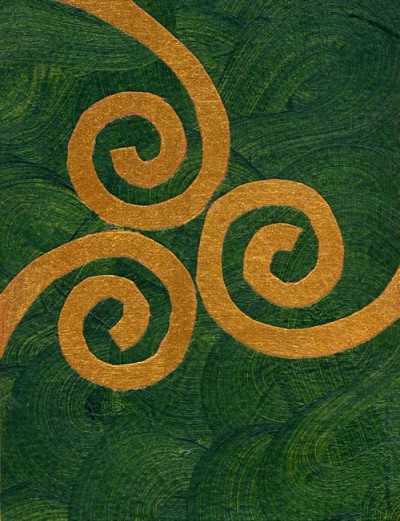
Trinity Sunday: A Spiral-Shaped God

May 12, 2008


A Spiral-Shaped God © Jan L. Richardson

Some years ago, at a retreat center in Ontario, I led a retreat in which we explored some of the riches that come to us from Celtic Christian traditions. When I saw that our meeting room had a smooth linoleum floor, an idea stirred. After tracking down several rolls of masking tape, I returned to the gathering space and got to work. When I finished a couple hours later, the center of our space held a circle with a triple spiral inside, large enough to use for walking prayer and meditation.

The symbol of the triple spiral is particularly prevalent in Celtic lands, where, in Christian times, it came to signify the Trinity. Evoking the energy, interconnection, and mystery of the triune God, the triple spiral graces such works as the remarkable insular Gospel books of the early medieval period, including the Book of Durrow and the Book of Kells.

On Trinity Sunday, we both celebrate God’s triune nature and also acknowledge the great mystery that it holds. Throughout the centuries, theologians have sought to define just how it is that God, Christ, and the Holy Spirit dwell together and with all of creation. Symbols of the Trinity abound, evidence of our desire to describe a being that comprises a community within itself. Attempts to convey the nature of the Trinity in images have occasionally produced some curious artwork, as in this image from a medieval Book of Hours that depicts three fellows sharing a single crown, and this image, added to a medieval English Psalter, that shows Abraham adoring a three-headed Trinity.

In their commentary on Trinity Sunday, the authors of Handbook of the Christian Year counsel us that rather than approaching this day with an emphasis on “the Trinity as an abstract concept, idea, or doctrine,” and seeking to explain or define it, it rather “seems more in keeping with the character of worship and of the Christian Year to treat Trinity Sunday as a day in which we praise and adore the infinitely complex and unfathomable mystery of God’s being to which we point when we speak of the Holy Trinity.” They go on to write,

Because our celebration of the Easter cycle is based upon the mighty acts of the triune God, and because we are entering upon the Sunday-to-Sunday half of the year when the emphasis is wholeheartedly upon each Sunday as the Lord’s Day, whose celebration is also based upon the mighty acts of the triune God, it is appropriate that we pause on this transitional Sunday to give ourselves over to the adoration and praise of the being—as distinct from the acts—of the triune God.

It is sometimes difficult, of course, to separate the doing of the Trinity from the being of the Trinity, for it is part of the nature of the Trinity to be in action, to work in relationship within itself and in cooperation with creation. This is one of the reasons that the Celtic symbol triple spiral speaks to my imagination: it evokes the God who both exists in a dynamic wholeness within itself yet also reaches out (or is it in?) to embrace us.

Historically, Celtic Christians offered no systematic theology by which they sought to define the nature and work of Trinity, but evidence of their experience of the triune God abounds. Beyond their artistic and symbolic depictions of the Trinity, they left a remarkable body of prayers and poetry that offer us an incarnate experience of the Trinity. In their poems and prayers, Celtic Christians moved from the abstract to the actual; for them, the triune deity was not a theological concept but rather was deeply embedded in daily life. In the Celtic imagination, God, Christ, and Spirit are intertwined with one another and with all of creation.

The Carmina Gadelica, a collection of prayers, poems, and blessings that Alexander Carmichael gathered in the Scottish islands and highlands in the 19th century, offers a feast of examples of this rich relationship with the Trinity, as in this prayer for the baptism of a child:

The little drop of the Father
On thy little forehead, beloved one.

The little drop of the Son
On thy little forehead, beloved one.

The little drop of the Spirit
On thy little forehead, beloved one.

To aid thee from the fays,
To guard thee from the host;

To aid thee from the gnome,
To shield thee from the spectre;

To keep thee for the Three,
To shield thee, to surround thee;

To save thee for the Three,
To fill thee with the graces;

The little drop of the Three
To lave thee with the graces.

With an intent both poetic and practical, this baptismal prayer serves as a graceful commentary on, and response to, the gospel reading for Trinity Sunday. In Matthew 28.16-20, we read the words that are, according to Matthew, Jesus’ final words to his disciples. In this passage that we often call the Great Commission, Jesus tells them to “Go therefore and make disciples of all nations, baptizing them in the name of the Father and of the Son and of the Holy Spirit, and teaching them to obey everything that I have commanded you.” Jesus’ words here are about the closest thing we have to an articulation of the Trinity in the scriptures. Jesus never uses the term “Trinity,” and he offers nothing like a doctrine of its nature. His words here, however, perhaps provide doctrine enough: he lets us know that Father, Son, and Holy Spirit exist in an inextricable relationship that propels us to be in relationship with the world, to live in service and to cultivate community. “And remember,” Jesus tells them at the last, “I am with you always, to the end of the age.” I am with you, he says: that being thing again, invariably bound together with the doing of the Trinity, an endless spiral of action and existence in which it dwells, and calls us to dwell as well.

In the Celtic triple spiral, there is a space where the three spirals connect. It is both a place of meeting and of sheer mystery. Its vast, vibrant emptiness reminds me that, in this life, we will never know all the names of God. Even as the Trinity evokes, it conceals. We will never exhaust the images we use to describe the One who holds us and sends us, who enfolds us and impels us in our eternal turning.

This week, as we travel toward Trinity Sunday, I’ll be holding that image of the triple spiral and the community in whose company I walked its path: inward, outward, journeying ever around the mystery at its center. Those walking companions remind me of how we are to be a living sign of the Trinity who dwells in eternal, intertwined relationship within itself and with all creation. As individuals and as communities, we are beckoned to times of spiraling inward, to attend to our own souls. We are propelled, in turn, into times of spiraling outward, to attend to the world beyond us. In all our turnings, the presence of God persists. With you always, Jesus said.

How do you experience the God who exists as a community and invites us to intertwined lives? How does this God become incarnate in the rhythm of your days?

Blessings on your spiral-shaped path.

[To use this image, please visit this page at janrichardsonimages.com. Your use of janrichardsonimages.com helps make the ministry of The Painted Prayerbook possible. Thank you!]

A Postscript to Pentecost

May 11, 2008

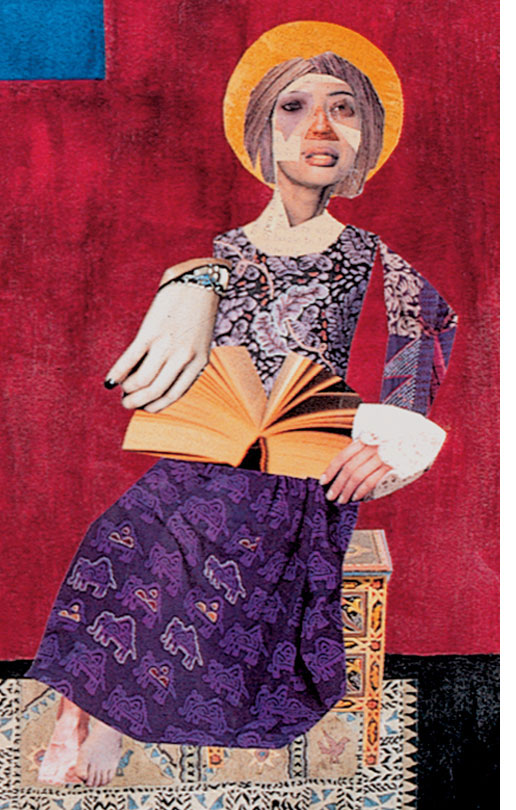
Happy Pentecost to you! On this occasion of Pentecost’s unusual confluence with Mother’s Day, I’ve found myself thinking about the frequency with which Mary, the mother of Jesus, appears front and center in artful depictions of Pentecost. In the first chapter of Acts, the author makes a point of noting that “certain women, including Mary the mother of Jesus,” were among those who gathered in the upper room, devoting themselves to prayer. The text implies her prayerful presence at Pentecost, and artists across the centuries highlighted her among the gathered assembly. Because of her presence and leadership among the disciples, along with her role as the mother of Christ, Mary became known as Queen of the Apostles as well as Mother of the Church.

The artful images of the Pentecostal Mary illuminate an intriguing resonance with the story of the Annunciation. In Luke’s gospel, we read of how the angel Gabriel tells Mary that the Holy Spirit will come upon her, and the power of the Most High will overshadow her. As with the Annunciation, paintings of Pentecost, such as this one in the St Albans Psalter, typically depict a woman open to the Spirit who appears—as so often in Christian iconography—in the form of a dove.

In much the same way that many medieval artists portrayed Mary reading at the Annunciation, they often depicted her in a similar fashion at Pentecost, as in this page from a 15th-century French Book of Hours. Another French Book of Hours depicts Mary kneeling at a prie-dieu as she reads, a motif that often appeared in artwork of the Annunciation.

As a blissfully incurable lover of books, I take great delight in these images of the literary, Pentecostal Mary who remained steeped in the Word throughout her life. These images also challenge me to ponder how I’m opening myself to the God who comes to us as both Word and Spirit. What do they stir in you?

On this day and all the days to come, may the Spirit breathe through the mothers and others who care for the children of the world.

(Artwork: Annunciation to Mary [detail] from The Advent Hours © Jan L. Richardson.)

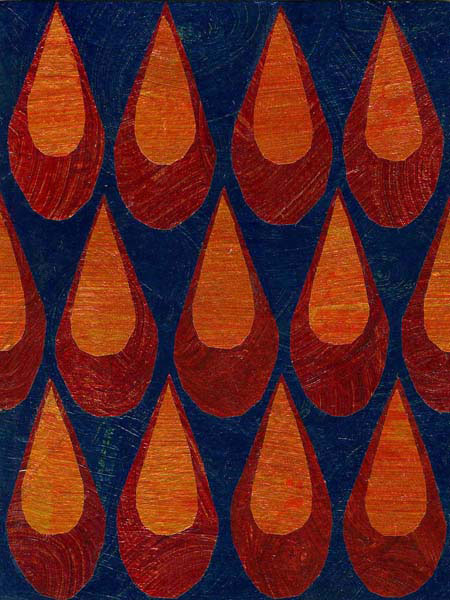
Pentecost: Fire and Breath

May 5, 2008


Fire and Breath © Jan L. Richardson

In my junior year of high school, I landed in the hospital several times because one of my lungs kept collapsing. It wasn’t due to an injury; each collapse was spontaneous, owing to a genetic predisposition not uncommon among tall, skinny girls. (It often comes accessorized with a mild heart murmur, something I didn’t know until a doctor picked it up in a routine exam a few years ago.) Normally a really healthy kid, I was concerned about the inordinate level of excitement it stirred in my doctor’s office. After he had his nurses come and listen to my chest, my doctor explained that I’d have to go to the hospital to get my lung reinflated. I imagined something like a bicycle pump, a quick procedure that would have me out in time to take a major test the next day. Instead, I spent the next five days getting intimately acquainted with a chest tube and the oddities of morphine.

The trip to the hospital provided only a temporary fix for my lung. When a partial collapse the next month was followed by a complete collapse the month after that, I knew the next step would be more drastic. The chest tube was put back in, and this time, they poured tetracycline down it. A recently developed alternative to surgery, tetracycline served to form scar tissue to keep the lung intact and prevent it from collapsing again.

Painkillers and local anesthesia only do so much to dull the sensation of acid flowing over your innards. Mostly I remember unbelievable pressure on my chest, the sensation that I could not breathe, would never do it again, that my body would not remember how. But in the wake of the fire came breath: breath that came without assistance, breath that sustained itself and did not seep out. In time I came to understand the experience as a gift, one marked by the presence of God, who did not inflict it upon me but used it as an occasion of transformation, an experience of initiation. With the fire and the breath came knowledge: I would never be in my body in the same way. It altered how I experienced my own body, and it changed how I would engage people whose bodies are vulnerable. A good gift for a girl who would grow up to be a pastor.

That initiation of fire and breath has been much on my mind as the day of Pentecost approaches. A defining day in the life of the early church, Pentecost finds its roots in the Jewish tradition, where it is called Shavuot or the Festival of Weeks. Falling fifty days after Passover, Shavuot is a harvest festival and also commemorates the giving of the Torah at Mount Sinai. Acts 2.1-21 tells us it is on this festival day that the followers of Jesus are “all together in one place” when the Spirit appears. It arrives as a rushing wind, filling them, in-spiring them, causing them to draw breath and speak. The scene at Pentecost offers a brilliant display of how in Greek, as in Hebrew, the word for Spirit, wind, and breath is the same: pneuma (In Hebrew, ruach).

Along with the wind comes fire, a symbol that stirs our collective memory of the God whose transforming presence has so often been marked by flames. Think of Moses and the burning bush, the column of fire that led the people of Israel through the wilderness, the temple fire that consumed the sacrificial offerings. “For the Lord your God is a devouring fire,” Deuteronomy 4.24 tells us. In contemporary culture, we most often experience fire as a contained, controlled, gentle force. Yet the fires of Pentecost are not the tame flames of birthday candles or a cozy winter’s hearth; the fires of Pentecost are a sign of the God who resists our every attempt to domesticate the divine and to control how the holy will work.

For the followers of Jesus, the day of Pentecost becomes an occasion of profound initiation. With the gift of spirit and flame, the community that Jesus had formed is now fired, prepared, propelled into a new stage of its journey. Like a vessel in the furnace of a kiln, the followers of Jesus receive the transformation they need. They are no longer a group of believers but rather a catalyzed community, a body that, enlivened by the Spirit, will endure and continue the work of Christ.

As those followers knew, we can’t always plan our moments of initiation. If we cannot control God, it follows that we cannot control the ways that God beckons or, sometimes, seemingly flings us across a new threshold. We can work to make ourselves available when it happens, but we don’t always get to choose our initiations.

In her book Reinventing Eve, Kim Chernin describes initiation this way:

Initiation is not a predictable process. It moves forward fitfully, through moments of clear seeing, dramatic episodes of feeling, subtle intuitions, vague contemplative states. Dreams arrive, bringing guidance we frequently cannot accept. Years pass, during which we know that we are involved in something that cannot easily be named. We wake to a sense of confusion, know that we are in dangerous conflict, cannot define the nature of what troubles us. All change is like this. It circles around, leads us a merry chase, starts us out it seems all over again from where we were in the first place. And then suddenly, when we least expect it, something opens a door, discovers a threshold, shoves us across.

At Pentecost, initiation occurred not only at the individual level (“and a tongue rested on each of them”) but also at the corporate level. The outpouring of the Spirit upon the whole community reminds us that we are not on an individual journey but a shared one. God calls us, compels us, to attend to the Spirit in one another.

The celebration of Pentecost beckons us to keep breathing. It challenges us to keep ourselves open to the Spirit who seeks us. The Spirit that, in the beginning, brooded over the chaos and brought forth creation; the Spirit that drenched the community with fire and breath on the day of Pentecost: this same Spirit desires to dwell within us and among us. Amidst the brokenness and chaos and pain that sometimes come with being in community, the Spirit searches for places to breathe in us, to transform us, to knit us together more deeply and wholly as the body of Christ, and to send us forth into the world.

As we approach Pentecost, what occasions of initiation do you remember? Sought or unbidden, how did those experiences alter you, transform you, change who you are in this world? How did they deepen your understanding of yourself, your community, and how God desires to breathe through you? How do you continue to open yourself to the work of the Spirit in you and in those around you?

Blessings to you in these days of celebration. May we keep breathing. May we blaze.

[To use this artwork, please visit this page at janrichardsonimages.com. Your use of janrichardsonimages.com helps make the ministry of The Painted Prayerbook possible. Thank you!]