During the season of Advent, I’ll be posting at The Advent Door instead of here. Please click on The Advent Door, and have a wondrous season!
During the season of Advent, I’ll be posting at The Advent Door instead of here. Please click on The Advent Door, and have a wondrous season!
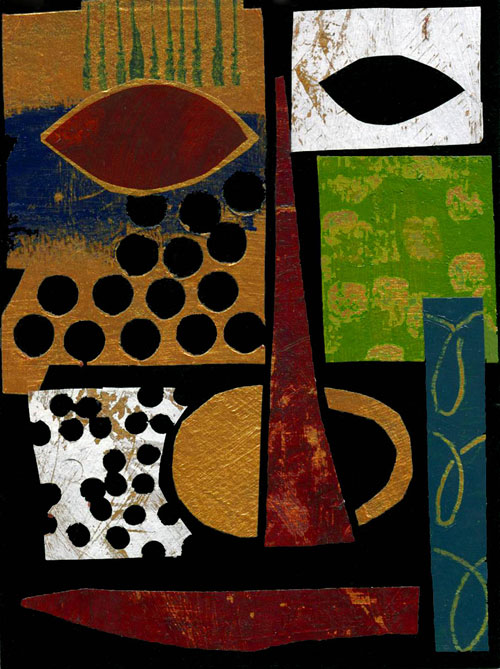
Christ Among the Scraps © Jan L. Richardson
Reading from the Gospels, Christ the King/Reign of Christ Sunday, Year A: Matthew 25.31-46
So I spent last night at the drafting table, pushing pieces of painted papers around. I had made a few sketches as I reflected on this week’s gospel lection. I sat down at the drafting table with those sketches in hand. But then a scrap caught my eye, and another scrap, and another. Owing to an intense travel schedule and natural tendencies, I probably have not cleared off my drafting table since before Ordinary Time began about six months ago. So each week, with every collage, scraps have lingered, gathering and multiplying in a brilliance of colors.
The sketches now abandoned, I played with the painted pieces, picking up, setting aside. I chose scraps that I had tried to use in earlier collages. I chose pieces from which I had previously cut shapes. I chose papers that I’d experimented with as I tried different colors or marking techniques. I chose from the leavings, the left behind. I dug my hands deep into the pile, hitting the bottom of the stack, turning over layers that hadn’t seen the light of day in months. Sorting. Sifting. Choosing.
I thought about this passage in which Jesus speaks of sorting and of sifting, how he describes a day when he will confront us with the choosing we have done: what we embraced, what we rejected. What we failed even to notice. He speaks of those who recognize him and minister to him, and those who don’t. This text from Matthew lies at the deepest core of our call as followers of Christ. And it is, perhaps, the one that most fiercely challenges us, that stretches us the farthest.
When was it that we saw you?
I turn the scraps over in my hands. Sorting, choosing. Finding the pattern. I think of how my deepest regrets—what few I allow myself—are most often attached to occasions when I didn’t see. Didn’t know how to see, didn’t yet have the eyes for seeing. The realization of it—the dawning knowledge of where my vision was lacking—is itself a kind of punishment. But an invitation, too. To learn to look more closely. To take in what I have rushed past.
When was it that we saw you?
A face begins to take shape from the scraps. My initial sketches had to do with doors, entryways—places of hospitality and welcome. But I look into these eyes and wonder what passage they offer. One eye, the crimson, was left over from the collage that I did for my reflection on John 9.1-41 during Lent. Jesus spat on the ground, John tells us, and made mud, and placed it on a man’s unseeing eyes. He told the man to go wash in the pool of Siloam, whose name means Sent. The sent man saw. And he recognized the one who sent him. Jesus tells him that he has come so that those who do not see may see.
When was it that we saw you?
I begin to glue the pieces that I have chosen from the scraps. I find myself thinking of a talk I recently heard in which the speaker seemed to think that evangelism is something that involves our taking Jesus to places he hasn’t already been. And I pray for eyes to see the ways that Christ already inhabits every place. How there is no place it hasn’t already occurred to him to visit, no space in which he isn’t already working to make a home, no person through whom he might not startle me with the blazing of his presence.
When was it that we saw you?
By his words in Matthew 25, Jesus assures us that our greatest sin lies not in having the wrong theology or refusing to believe as others would have us believe or failing to take him to a place he has never gone. Our sin lies in neglecting to recognize and respond to him where he already is.
Jesus gets awfully specific in telling us where we can find him. Each of the habitations he lists here is marked by lack: lack of food, lack of water, lack of hospitality, lack of clothing, lack of health, lack of freedom. Christ chooses these places, inhabits these spaces, waits for us to show up. Waits, too, for us to recognize those places in ourselves. He knows that if we haven’t recognized the poverty within our own souls, and how he dwells there, it’s hard to see him and serve him in others without being patronizing.
When was it that we saw you?
This Sunday is the last in Ordinary Time. Christ the King Sunday, the liturgical calendar tells us. As we prepare to cross the threshold into Advent, I wonder what Christ, this sovereign who came in such a ragged, radical guise, has in store for the season to come. How he’ll show up. Where he’ll invite me to see him.
I rinse my gluey brushes, clean off my palette, call it a night. I gaze at this unexpected face that gazes back at me. Christ among the Scraps, I’ll call it. Making his home.
When was it that we saw you?
That’s question enough for this week. Blessings.
[To use the “Christ Among the Scraps” image, please visit this page at janrichardsonimages.com. Your use of janrichardsonimages.com helps make the ministry of The Painted Prayerbook possible. Thank you!]

Buried © Jan L. Richardson
Reading from the Gospels, Year A, Proper 28/Ordinary 33/Pentecost +22: Matthew 25.14-30
So I’ve flown to Toronto, celebrated my sister’s wedding, enjoyed some quality family time (and some crisp Canadian weather), and am winging my way back home as I write. And still those bridesmaids are traveling with me, the ones from last Sunday’s gospel lection. Maybe it has something to do with the synchronicity of their story popping up in the lectionary during the week of my sister’s wedding, but I suspect the persistence of the bridesmaids’ presence simply means they’re not finished with me yet.
It’s the so-called foolish bridesmaids in particular who have lingered with me, the ones who found themselves lacking the oil reserves that would have granted them admittance to the wedding festivities. They’ve been haunting my imagination as curious twins of the wise, well-provisioned bridesmaids. Embodying that which we are urged to reject, the foolish bridesmaids are the wise bridesmaids’ shadow sisters. They challenge us to ponder the part of ourselves that can’t get it together, that is content to live with lack, that is caught in cycles of procrastination and passivity. Their presence calls us to reckon with our resistance toward looking beyond the obvious options.
The foolish bridesmaids appear willing to accept the groom’s verdict, his denial of entry, without question. Perhaps they have forgotten that God performs miracles with oil, as in the story of the hungry widow of Zarephath, who, in her lack, gave hospitality to Elijah, and whose jar of oil was perpetually replenished (1 Kings 17.8-16). The women of Jesus’ parable seem not to know the occasions when God provided water in the wilderness, or the times when Jesus turned a couple of fish and a few loaves of bread into a feast that fed thousands who neglected to pack a lunch, or the story of the woman who told Jesus that even the dogs ate the crumbs from beneath the master’s table, and who thereby won a healing for her daughter. The foolish bridesmaids haven’t heard the story of the widow who hounded the judge until he gave her justice. They haven’t encountered Jesus’ counsel in Luke 11, where, in teaching about persistence in prayer, Jesus invites his listeners to imagine going to the house of a friend at midnight and asking for three loaves of bread for a guest who has arrived. “I tell you,” Jesus says, “even though he will not get up and give him anything because he is his friend, at least because of his persistence he will get up and give him whatever he needs.” Jesus goes on to say, “Ask, and it will be given you; search, and you will find; knock, and the door will be opened for you” (Luke 11.5-13).
Denied entry, these oil-poor bridesmaids don’t know—or don’t care—that they can knock harder on the door that bars them from the wedding feast, and that God has a fondness for those who, faced with two choices, search for Option C.
The Parable of the Bridesmaids is not merely a prelude to the parable of this week’s gospel lection but a parallel to it; in a sense, Matthew 25.14-30 is a retelling of the bridesmaids’ tale. Jesus emphasizes these parables’ parallel nature in the simile with which he starts his story: “For it is as if,” he says, and launches into his narrative of the man who, “going on a journey, summoned his slaves and entrusted his property to them; to one he gave five talents, to another two, to another one, to each according to his ability.” And thus begins one of Jesus’ most familiar parables.
We likely know the rest of this story, how one slave turns his five talents into ten, how the next turns his two talents into four, and how the third slave buries his single talent in the ground. On the day of reckoning, the two slaves proffer their profits and receive the expected praise, while the third offers this account: “Master, I knew that you were a harsh man, reaping where you did not sow, and gathering where you did not scatter seed; so I was afraid, and I went and hid your talent in the ground. Here you have what is yours.” He receives a thorough castigation for being wicked and lazy. His one talent is given to the man who now has ten, with the master offering this rationale: “For to all those who have, more will be given, and they will have an abundance; but from those who have nothing, even what they have will be taken away.” The parable ends with the master’s command to throw this “worthless slave…into the outer darkness, where there will be weeping and gnashing of teeth.”
Okay, may I just say it? I find myself liking the third servant more than the first two. The entrepreneurial servants of the parable do precisely as expected: they enlarge the master’s fortune in his absence, they follow his plan without question, they perform as he has compelled them to do. The third fellow, however, calls things as he sees them. He knows his master is corrupt, and, with a curious mix of courage and fear, he says so to his face. And thereby reaps the master’s wrath.
So I find myself wondering, why is it that we most often read this passage as a judgment against the third servant and not against the man who has perpetuated an unjust system? Do we really think that the harsh and reportedly corrupt master of this parable represents God, who, after a period of absence, comes back prepared to throw out those who have not performed as expected? Do I really want to be like the first two servants, willing to participate in and perpetuate injustice?
Much like the wise bridesmaids, the two multi-talented men serve as the foil for the one who proves inept and unprepared. One could say they are the suck-ups who provide a contrast to the screwup. We might wonder at a parable that presents a narrative ecosystem in which the only available choices seem to lie either in perpetuating the master’s corrupt business plan or hiding his loot in the ground.
But we might wonder, too, at the servant who perceives these as the only options. He is savvy enough to recognize the system that surrounds him, and, presumably, he has participated in it up to this point. He finally demonstrates a measure of bravery that enables him to, as the phrase goes, speak truth to power. But like the foolish bridesmaids, he possesses a streak of passivity that, within the landscape of the parable, proves his undoing. Perhaps this is what makes each of them—the hapless bridesmaids, the single-talent servant—foolish: ultimately, they prove unwilling to take responsibility for pushing toward another option, looking for another choice. They have forgotten the God who startles with stunning abundance in the midst of the starkest lack.
The servant who buried his sole talent reminds me that when we cannot imagine other possibilities, we tend to hoard what we have, clinging to what is comfortable or at least familiar. And not only to hoard, but to hide. In the absence of eyes to see the wealth that God reveals in the wilderness, we secret away what small measure we have, thinking it will be enough to sustain us, and hoping it will protect us. It’s difficult, however, to draw sustenance from secrets, and it’s hard even for God to bless and multiply that which remains hidden. Darkness has its uses, and its gifts: growth requires gestation, a season of deep shadow, the absence of light for a length of time. But what we leave underground too long grows distorted and becomes decayed. As the third servant discovered, what we hide—our habits, our beliefs, our own selves—has a way of unburying itself.
I take this parable seriously as a profound call to unhide ourselves, to resist accepting the obvious options, to stretch ourselves toward the fullness for which God created us. I recognize how this story, along with the parable of the bridesmaids, warns of the pain that comes from our passivity. Yet I also read this parable in the light of the stories of the God who does miracles with what is most basic and elemental: oil, water, wine, bread, our very selves. This is the stuff in and through which God brings transformation, and the means by which God sustains the world.
This week I find myself wondering, what do I hide, and why? What parts of my created self have I sent underground? Is there anything I’ve left too long in the dark? Do I harbor any passivity that I need to invite God to turn into persistence? As the season of Advent approaches, with its rich play of light and dark, what might God desire to reveal and to transform in my own life?
In these lingering days of Ordinary Time, may God stir our imagination, sharpen our vision, and give us courage to unhide what God desires us to offer. Blessings.
[To use the “Buried” image, please visit this page at janrichardsonimages.com. Your use of janrichardsonimages.com helps make the ministry of The Painted Prayerbook possible. Thank you!]

Midnight Oil © Jan L. Richardson
Well, my suitcase has just barely finished cooling off from my recent trip to Seattle, and already I’m packing again. This week I’m heading to Toronto, with joyous cause: my sister is getting married. I have received official approval from the Canadian government to perform the wedding, learning along the way that the wheels of bureaucracy turn at about the same speed across international borders. I am grateful to the folks who provided support and endorsement in the process, including a couple of officials in The United Church of Canada, the denomination that served as the “governing authority” that, per Canadian requirements, sponsored my application. The wedding will be small and sweet. I’m working to resist the urge to ask my Canadian-transplant sister, when it comes time in the ceremony, “So, you take this man, eh?”
So I have matrimony on my mind, which coincides well with this week’s gospel lection. Matthew 25.1-13 offers the Parable of the Ten Bridesmaids, which has sometimes been referred to as the Parable of the Wise and Foolish Virgins, owing to the pronounced distinction that the parable makes between the two groups. As was the case with the Parable of the Wedding Banquet that we visited just a few weeks ago, this lection offers a setting that calls to mind my wedding anxiety dreams, which generally fixate on some aspect of not being ready for the big event. With its emphasis on being prepared, our story at hand does little, on the surface, to alleviate my lurking anxieties.
This is a tale to leave procrastinators quaking. Jesus’ story provides little solace for those of us who struggle with being prepared and timely. There seems to be no help here for the five bridesmaids who lack the oil necessary to trim their lamps. The five wise bridesmaids certainly don’t offer any aid. These bridesmaids may be well stocked with oil for their lamps but they seem dramatically lacking in grace toward those who find themselves oil-poor.
Fortunately, Jesus has plenty to say elsewhere about grace, and I don’t think that’s the primary issue he’s trying to tackle in this parable, though grace does surface in a roundabout manner. With this story of the bridesmaids, Jesus beckons his hearers to give thought to their own role in their relationship with the divine. He lifts up the necessity of taking personal responsibility, a quality not always embraced these days. The good news in this parable, and in the Christian faith, is that we do not have to look to someone else to mediate our relationship with Jesus, nor does our inclusion in the body depend on access to special secrets. This parable implies that wisdom comes not in having hidden knowledge; even the wise bridesmaids didn’t know what time the bridegroom would show up. Rather, wisdom lies in discerning and cultivating what is ours to offer. The wise bridesmaids may seem graceless, but providing for everybody isn’t the bridesmaids’ job here. It’s one occasion where taking care of everyone else isn’t a woman’s responsibility. The wise women of this story instead call us to attend to that which will deepen our relationship with God and hone our ability to receive God’s ever-present grace.
The wise bridesmaids do what is necessary to provide light. In the context of the teaching that Jesus is doing here about the kingdom of heaven and the end of days, it’s good to remember that, at its Greek root, the word apocalypse means to reveal, to uncover, to unhide. The bridegroom is meant to be seen when he finally arrives (as is the bride, who, though some of the most ancient manuscripts of Matthew include a reference to her, for the most part is curiously absent from this story). The bridesmaids, these women, are the ones who provide the light by which the celebrants may see the groom.
Later in this chapter Jesus will become quite specific about the sorts of actions that provide light for the world—the radical stuff of feeding the hungry, clothing the naked, visiting prisoners. Jesus means for these light-bearing bridesmaids to inspire and model for us what it means to perceive the presence of Christ among us and to minister to him in the infinite and surprising variety of forms that he takes. This parable, in fact, offers a powerful resonance with the gospel stories of the women who, seeing Jesus and recognizing who he is, anoint him with oil in a lavish fashion.
We have to be cautious with this text, however, lest it tempt us to think Jesus’ point is all about work—that our invitation to the party depends on what we do. All ten bridesmaids, after all, were invited to join in the celebration. And all ten fell asleep, so, though Jesus admonishes his hearers to stay awake, it wasn’t solely for somnolence that the unwise bridesmaids were denied entrance. Evidently what makes the wise bridesmaids wise is that they know what it takes to make a party. We need light, that we may see one another and know one another. We need light so that we may recognize the one who beckons us to join in the feast, not because he wants only to put us to work but also because of the sheer fact that he desires our company and delights in our presence.
When I was in seminary, I heard Jim Wallis, one of the founders of the Sojourners community, tell a story about a colleague living in a village in Central America. She worked in a community that was marginalized in all kinds of ways. She poured herself into her work for social justice, laboring with great might to bring change to this village. One day, some of the people of the village came to her, asking her why she worked so hard, why she didn’t join them in their fiestas or sit with them in their porches in the evening.
“There’s too much work to do!” the laboring woman replied. “I don’t have enough time.”
“Oh,” the people of the village said. “You’re one of those.”
“One of who?” the woman asked.
“You are one of those,” they responded, “who come to us and work and work and work. Soon you will grow tired, and you will leave. The ones who stay,” they said, “are the ones who sit with us on our porches in the evening and who come to our fiestas.”
Jim Wallis said that his colleague took the story to heart, that she became a party animal, and that she was still there.
There is work to do: flasks to be filled, lamps to be lighted, long nights ahead that call for labor and readiness instead of rest. Especially with Advent approaching, it’s a good time to ask ourselves what it is we’re getting ready for, and how, and why. It’s a good time, too, to ponder how, and whether, we are seeking sustenance for our own selves. We cannot find or fashion light merely by our own efforts; it comes not solely with labor but by opening ourselves to the light of Christ that we find as we linger with one another.
This is the place where I would normally ask what practices help you cultivate your openness to the God who calls us to the celebration—what are you doing to keep your oil flask full? But I find myself thinking of the fabled story from the desert fathers, the one where Abba Lot goes to Abba Joseph and recites the list of practices by which he’s seeking the presence of God: praying, meditating, fasting, etc. “What else can I do?” he asks. Old Abba Joseph stands up and stretches his hands toward heaven. His fingers, the story says, become like ten lamps of fire. “If you will,” Abba Joseph says to Abba Lot, “you can become all flame.”
And so I want to ask, not just how are we keeping our oil flasks full, not just how we’re taking care of our lamps, but how might we ourselves become all flame? What are we burning for? How do we become people who do not merely carry well-provisioned lamps but who are vessels of living light, illuminated by the one who called himself the Light of the World?
On this dark November night, this prayer: For one another, with one another, may we blaze.
Blessings.
[To use the “Midnight Oil” image, please visit this page at janrichardsonimages.com. Your use of janrichardsonimages.com helps make The Painted Prayerbook possible. Thank you!]
[Abba Joseph story from The Sayings of the Desert Fathers, translated by Benedicta Ward, SLG.]



House of Prayer CD
by Garrison Doles
Sacred Reading:
The Ancient Art
of Lectio Divina
by Michael Casey
The Holy Way:
Practices for a Simple Life
by Paula Huston
To Dance with God:
Family Ritual and
Community Celebration
by Gertrud Mueller Nelson
Treasures Old and New:
Images in the Lectionary
by Gail Ramshaw
The Substance of Things Seen:
Art, Faith, and the
Christian Community
by Robin M. Jensen
Painted Prayers:
The Book of Hours in
Medieval and Renaissance Art
by Roger S. Wieck