Archive for May, 2011

Ascension/Easter 7: Blessing in the Leaving

May 29, 2011


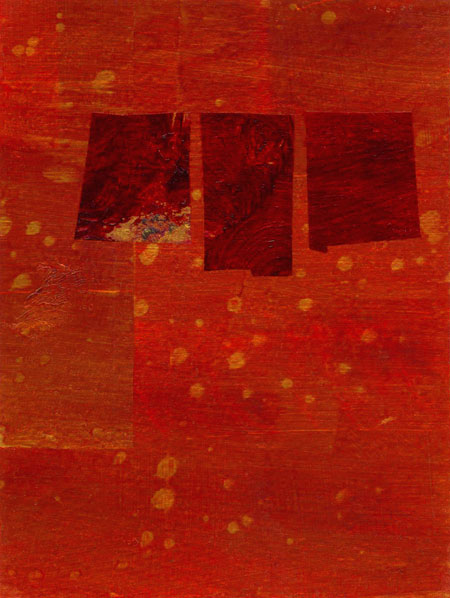
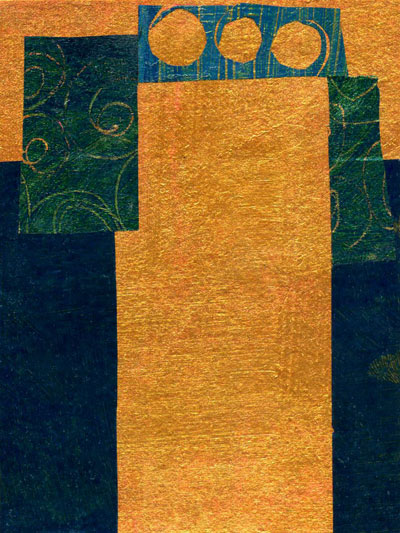
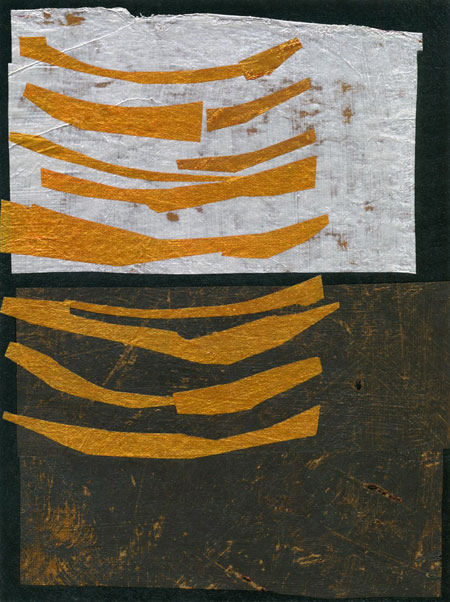
Ascension II © Jan L. Richardson

Reading from the Gospels, Ascension Day (June 2): Luke 24.44-53
Reading from the Gospels, Easter 7, Year A (June 5): John 17.1-11

Throughout this Easter season we have seen how the gospel lections have emphasized the theme of knowing: knowing the risen Christ, knowing what he has done for us and to us, knowing what he desires of us and calls us to do, knowing what he is preparing for us—and preparing us for. The fact that most of the gospel readings for the Easter season take place at a table underscores the intimacy that comes in knowing—in knowing Christ, in knowing God, in knowing one another.

This theme of knowing reaches its stunning apex in the gospel texts for this week. The reading from John’s Gospel draws us once again to the table where Jesus has lingered with his friends on the night before his death. He finishes their final feast by praying for his disciples. In his prayer, Jesus is knowing all over the place: “And this is eternal life,” he says, “that they may know you, the only true God, and Jesus Christ whom you have sent….I have made your name known to those whom you gave me from the world….Now they know that everything you have given me is from you; for the words that you gave to me I have given to them, and they have received them and know in truth that I came from you.” Then Jesus, who knows these friends so well, releases them into the world and into the care and protection of God, who has known them from the beginning.

In the reading from Luke for Ascension Day, we see the risen Christ appearing one last time to his disciples. He opens their minds, as Luke tells us, “to understand the scriptures,” and he impresses upon them that what was written about him, they have seen with their own eyes. Jesus then takes them to Bethany: this place so familiar and dear to Jesus, the place where Mary and Martha and Lazarus lived—his close friends who knew and were known by Jesus. And from this place Jesus leaves, blessing his beloved companions as he ascends.

As we spiral back around these stories this year, what still takes hold of me is this: how Jesus prays for and blesses his friends as he leaves them. How the leaving is part of the blessing. As if the blessing can happen no other way than by his departure, by his letting go of the ones whom he has loved—these ones whom he will never cease to love but must release into their own lives, so that they may enter into the blessing and enact it on this earth.

This week provides a good occasion to remember that the English word bless comes from the Old English word blod—blood, referring to the use of blood in ritual acts of consecration. The blessing that Jesus gives as he goes is one that will infuse the community with his love, his grace, his lifeblood. He gives a blessing that will run in the veins of those he has called to be his body; a blessing that will beat in the hearts of those whom he is sending into the world.

As we prepare to leave the season of Easter and cross into Ordinary Time, what blessing do you need? What word or gesture of grace and love do you need to infuse you and sustain you to be a blessing in this world? Is there a blessing that might depend on your letting go, on releasing something—or seeking to be released from something—so that there will be a space for the blessing to enter?

Ascension Blessing

It is a mystery to me
how as the distance
between us grows,
the larger this blessing
becomes.

As if the shape of it
depends on absence,
as if it finds its form
not by what
it can cling to
but by the space
that arcs
between us.

As this blessing
makes its way,
first it will cease
to measure itself
by time.

Then it will release
how attached it has become
to this place
where we have lived,
where we have learned
to know one another
in proximity and
presence.

Next this blessing
will abandon
the patterns
in which it moved,
the habits that helped it
recognize itself,
the familiar pathways
that it traced.

Finally this blessing
will touch its fingers
to your brow,
to your eyes,
to your mouth;
it will hold
your beloved face
in both its hands

and then
it will let you go,
it will loose you
into your life,
it will leave
each hindering thing
until all that breathes
between us
is blessing
and all that beats
between us
is grace.

P.S. For a previous reflection on this passage, click the image or title below:

Ascension/Easter 7: A Blessing at Bethany

[To use the "Ascension II" image, please visit this page at janrichardsonimages.com. Your use of janrichardsonimages.com helps make the ministry of The Painted Prayerbook possible. Thank you!]

Easter 6: Love and Revelation

May 22, 2011


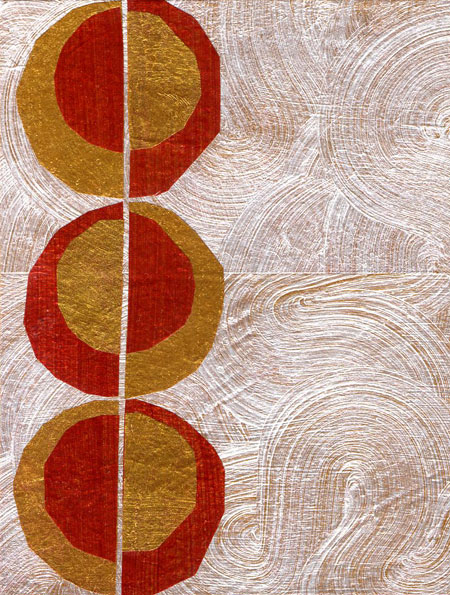
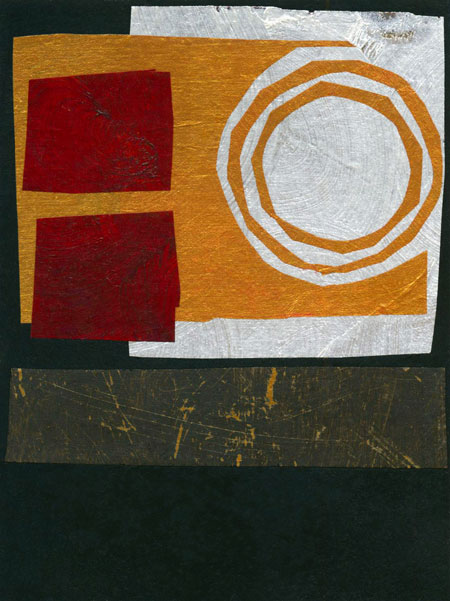
Love and Revelation © Jan L. Richardson

Reading from the Gospels, Easter 6, Year A (May 29): John 14.15-21

On a day more than six hundred years ago, in the English town of Norwich, a woman walked into a cell attached to the parish church. She intended to stay there for the rest of her life. The original name of the woman is unknown, and the cell where she would live as an anchoress—a woman devoted to a life of contemplation and solitude—no longer remains. It is likely that she took her name from the church in whose cell she lived: the Church of St. Julian.

Nearly everything we know about Julian of Norwich comes from a manuscript that she composed in her cell. In it she tells of how, at the age of thirty and a half, she became desperately ill. Just as she thought herself at the point of death, her pain suddenly departed. As Julian continued to pray, she was visited by a series of sixteen visions or revelations—what she called “showings”—in which she came to experience and know God’s love for her.

Julian recorded her visions in a short text, and then, after nearly two decades, she expanded on them in a longer text that incorporates the insights that she gained through years of reflecting on and praying with the visions. Together Julian’s texts became the book known as Showings, or Revelations of Divine Love.

In the final chapter of Showings, as Julian comes to the end of the remarkable work in which she has revealed to us a God whose endless mystery encompasses a deep desire to know and love us in all our human particularity, she writes,

And from the time that it was revealed, I desired to know in what was our Lord’s meaning. And fifteen years after and more, I was answered in spiritual understanding, and it was said: What, do you wish to know your Lord’s meaning in this thing? Know it well, love was his meaning. Who reveals it to you? Love. What did he reveal to you? Love. Why does he reveal it to you? For love. Remain in this, and you will know more of the same. But you will never know different, without end.

From her anchorhold, with her stunning simplicity, Julian echoes and embodies what her beloved Jesus says to his friends in this week’s gospel passage. At the table where he gathers with his disciples on the night before his death, he persists in telling them what he wants them—needs them—to know about who he is, what he has done, what he will yet do, what he is calling them to do after he is physically gone. In this passage, Jesus becomes very clear about why he wants them to know these things, and what underlies and encompasses and is the reason for their knowing.

“They who have my commandments and keep them,” Jesus says, “are those who love me; and those who love me will be loved by my Father, and I will love them and reveal myself to them.”

The knowledge that Jesus shares with his followers is not for the purpose of giving them worldly power. It is not designed to make them feel important, or to initiate them into secrets meant for a select few, or to make their lives easier. He does not intend for them to use the knowledge as a weapon to threaten or diminish others. What Jesus reveals to his friends—his friends at the table that night, his friend in the cell at the Church of St. Julian, his friends throughout the ages—he does for one reason:

For love.

Jesus speaks of love and revelation in the same breath. He wants his friends to understand that loving and knowing are of a piece, that loving draws us deeper into knowing and being known by the one whom we love. Here on the threshold of his death, Jesus cannot go until he assures them that he will not leave them bereft but will, in fact, continue to love and help them. He cannot leave until he tells them that by their loving, they will remain in relationship with him; through their shared love, he will yet reveal himself to them and be known by them.

What knowledge does your loving lead you to? As you stretch yourself into loving others, what becomes revealed to you—of them, of yourself, of God? How has love challenged or changed what you know? How are you opening yourself to its presence in your life?

Blessing that Knows Your Name

Chances are
there will come a day
when you will forget
every last word
of this blessing.

It does not matter.

Let this blessing
slip through
your fingers.
Let it roll from
the smooth plane
of your palm.
Let each line
disappear
and every syllable
fall away.
Let this blessing
return
to where all
blessings begin.

Let it leave you
until all that remains
is the place where
it pierced you—
whether like fire
or like breath
you could not say,
only that you heard
your name as it entered,
then heard its own
as it blew away.

P.S. For a previous reflection on this passage, click the image or title below:

Easter 6: Side Orders

[To use the "Love and Revelation" image, please visit this page at janrichardsonimages.com. Your use of janrichardsonimages.com helps make the ministry of The Painted Prayerbook possible. Thank you!]

Easter 5: Many Rooms

May 15, 2011


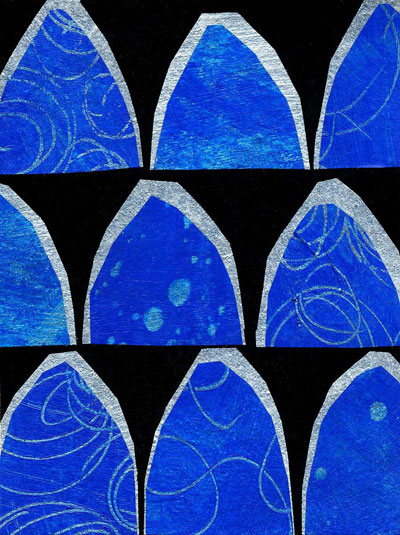
Many Rooms © Jan L. Richardson

Reading from the Gospels, Easter 5, Year A (May 22): John 14.1-14

Many years ago, a recurring dream began to take hold of my nighttime brain. The details shift and change each time it visits, but the essence of the dream remains the same: I am wandering through shops—not a mall, but a series of connected stores. The stores are the kind that I love to browse through, the sort that I find in communities that value artistry. As I wander among the stores that spill into one another, I savor what I see: richly hued artwork, finely crafted jewelry, beautiful pottery that calls out for me to touch it.

In the dream, no matter the changing details, I always find a bookstore. Often it’s a used bookstore, crammed with volumes and with more shelves around each turn. Once the bookstore contained a case of gorgeous hand-bound books, displayed like artwork. I marveled at the colors, textures, and designs, knowing as I touched the books, I want to do this, to create books like these.

Along with the persistent presence of a bookstore, one other detail of the dream never changes: it always begins with my walking down a familiar street. I turn a corner and suddenly find myself among the shops, thinking, Of course—that’s where they were! These treasures were in my neighborhood the whole time, waiting for me to find them.

And you know the way to the place where I am going, Jesus says to his disciples on the night before his death. Here at the table where they share their final meal before his crucifixion, there are many things Jesus wants to tell them. His hunger for them to know—which we see again and again in the gospel texts in this Easter season—becomes particularly acute as Jesus gathers with them just hours before his death. And so he will go on to tell them about the Holy Spirit whom he will send, and how this Spirit will be in them. Jesus will tell them that he is the true vine in which they will abide. He will tell them—command them—to love one another, and how the world will hate them. He will tell them that their sorrow will turn to joy. Jesus is desperate for them to know these things, and more.

But when he tells them, before all this, of the place he is preparing for them—the house with many dwelling places—Jesus tells them that they already know the way. When Thomas—ever the good questioner—asks him how they can know the way, Jesus reminds them that he himself is the way. If they know him, they know the way, and the One who sent him to prepare the way for them.

This text has me wondering if following in this way has less to do with striving and working at it, in the frenetic fashion we sometimes do, than with letting ourselves recognize what we already know; less to do with wrapping our brains around points of belief that grow so contentious than with opening our eyes to the door that has always been there in our soul, our heart, waiting for us to see it and walk through it and find the spacious dwelling place that has been there all along. To be sure, following Christ our Way takes work and effort and focus and sacrifice. Yet I find myself thinking of the poem by the Sufi poet Rumi in which he writes of how he has been living on the “lip of insanity,” as he puts it, knocking incessantly on a door. Finally the door opens, and he realizes, “I’ve been knocking from the inside!”

Here at the table, Jesus wants to make clear that although the place he describes is a someday place, a promised home that he is preparing, it is at the same time a dwelling that his followers can have a glimpse of in this world, a space that even now takes form in our midst. An abiding-place fashioned by—and fashioned of—the Christ who dwells in God, and is a dwelling place for God, and offers his own self to us as both a habitation and a way. A way that we find by opening the door that is already within us.

In this season, where are you making your home? Where are you dwelling? Is there a place in your life where you are pushing and pouring out your energy—something you are trying to wrap your brain around to understand it or to change it—when the way might lie instead in releasing, in finding the doorway that appears in letting go?

Blessing with Many Rooms

As you step inside
this blessing
we wish to tell you
it is large enough
for you to lie down in.

Or
(though it may not look it,
small as it is upon this page)
you can curl up
in this blessing
with a cup of tea
and a good book
beside the window—
here, just behind you—
that faces east.

Likewise it is true,
though you might not have
paused long enough
to notice,
that this blessing
is big enough
for a table—
quite a sizeable one
can be accommodated—
where your guests
will want to linger
far into the night.

And if they desire to stay,
you will find that
through this door—
you did not see it before?—
there are rooms in plenty
where they can
lay their heads
and stretch out with abandon
in their dreaming sleep.

One room,
many rooms—
in this blessing
it is all the same.
The point is that
there is space
enough.

Enough to make
a life, a home;
enough to make
a world.

Enough to make
your way toward
the One who has made
this way for you.

P.S. For a previous reflection on this passage, click the image or title below:

Easter 5: A Place to Dwell

[To use the "Many Rooms" image, please visit this page at janrichardsonimages.com. Your use of janrichardsonimages.com helps make the ministry of The Painted Prayerbook possible. Thank you!]

Easter 4: Blessing of the Gate

May 9, 2011


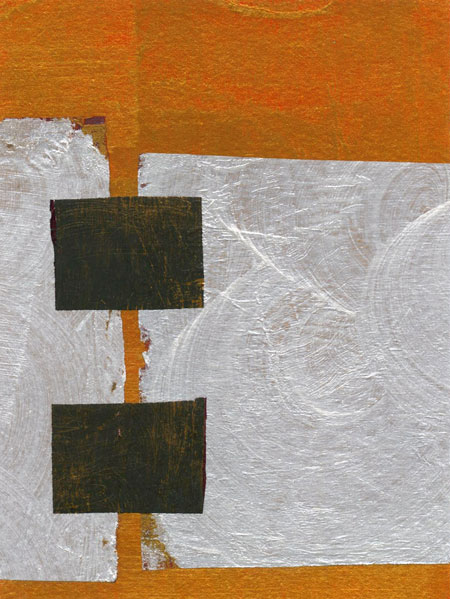
Blessing of the Gate © Jan L. Richardson

Reading from the Gospels, Easter 4, Year A (May 15): John 10.1-10

Once again, for the fourth time in this Easter season, the lectionary turns toward the theme of knowing. Beginning with Easter Sunday, the gospel readings have beckoned us to pay attention to where we pay attention, to how we turn ourselves toward the Christ who comes to us. To the women at the empty tomb, to Thomas in the locked room, to the two at the Emmaus table, Jesus shows himself, inviting others to see and recognize him, even to place their hand within his very flesh so that they may know and trust who he is.

And here again this week the gospel lection impresses upon us how keen Jesus is for us to know him, to follow after the One who first knows us. Knows us by our own name, Jesus tells us in this Sunday’s text from John’s Gospel.

Jesus recognizes, of course, the import of knowing another’s name. Throughout the scriptures as well as in mythology and folklore, we see how knowing someone’s name often means having a kind of power; one’s name holds something of a key to one’s nature. Yet with Christ, this knowing is always steeped in grace, not control. “He calls his own sheep by name and leads them out,” Jesus says in this passage where he describes himself as the good shepherd. The gate of Christ swings toward freedom, not captivity. The shepherd does not assume a role of domination, of power-over that constrains and confines; he is one who pours his power out on our behalf, that we may enter into the places where we can flourish. “…that they may have life, and have it abundantly,” Jesus says.

As the Easter season continues to unfold, this theme of knowing will persist. As we travel through these days of resurrection, how will you open yourself to the Christ who desires to know you and to be known by you? How well do you want to be known? Are there any corners of your heart that you resist being known? Might those very spaces become a place of prayer, a doorway, a gate that opens into freedom?

Blessing of the Gate

Press your hand
to this blessing,
here along
the side
where you can feel
its seam.

Follow the seam
and you will find
the hinges
on which
this blessing turns.

Feel how
your fingers
catch on them—
top,
bottom,
the slightest pressure
sending the gate
gliding open
in a glad welcome.

Wait, did I say
press your hand
to this blessing?

What I meant was
press your hand
to your heart.

Rest it over that
place in your chest
that has grown
closed and tight,
where the rust,
with its talent
for making decay
look artful,
has bitten into
what you once
held dear.

Breathe deep.
Press on the knot
and feel how it
begins to give way,
turning upon
the hinge
of your heart.

Notice how it
opens wide
and wider still
as you exhale,

spilling you out
into a realm
where you never dreamed
to go
but cannot now imagine
living this life
without.

P.S. For a previous reflection on this passage, click the image or title below:

Easter 4: In Which We Do Some Sheep Wrestling.

[To use the "Blessing of the Gate" image, please visit this page at janrichardsonimages.com. Your use of janrichardsonimages.com helps make the ministry of The Painted Prayerbook possible. Thank you!]

Easter 3: Known

May 5, 2011


Emmaus © Jan L. Richardson

Reading from the Gospels, Easter 3 (May 8): Luke 24.13-35

Then they told what had happened on the road, and how he had been made known to them in the breaking of the bread. (Luke 24.35)

Everything in this passage, it seems, can be summed up in this verse, where the two who walked with the risen Christ on the road to Emmaus tell of how they finally recognized him in the breaking of bread. And this is where Christ shows up again and again: at the table where we gather, in the bread that we break. In the feast and in the simple fare, his presence persists and his blessing abides: waiting for us, staying with us, hungering to be known. May we taste and see.

As we travel with Christ in this season of resurrection, how will we approach our tables, our meals, and one another in a way that will open our eyes and help us to see and to know the Christ who lingers with us?

Emmaus Blessing

Already a blessing
in the walking

already a blessing
on the road

already a blessing
drawing near

already a blessing
in the listening

already a blessing
in the burning hearts

already a blessing
in the almost evening

already a blessing
in the staying

already a blessing
at the table

already a blessing
in the bread

already a blessing
in the breaking

already a blessing
finally known

already a blessing
give us eyes

already a blessing
let us see.

P.S. For a previous reflection on this text, see Easter 3: Comfort Food. And for a Mother’s Day reflection and blessing, visit Mother’s Day: Blessing the Mothers.

Bonus round: For a blessing for your ears, click the player below to hear the song “On this Road,” which was inspired by the Emmaus story. It’s by my husband, Garrison Doles, from his CD Draw Us Closer.

[To use the "Emmaus" image, please visit this page at janrichardsonimages.com. Your use of janrichardsonimages.com helps make the ministry of The Painted Prayerbook possible. Thank you!]