Archive for the ‘art’ Category

Looking toward Lent

February 20, 2009

blog-sevenlastwordsframed31

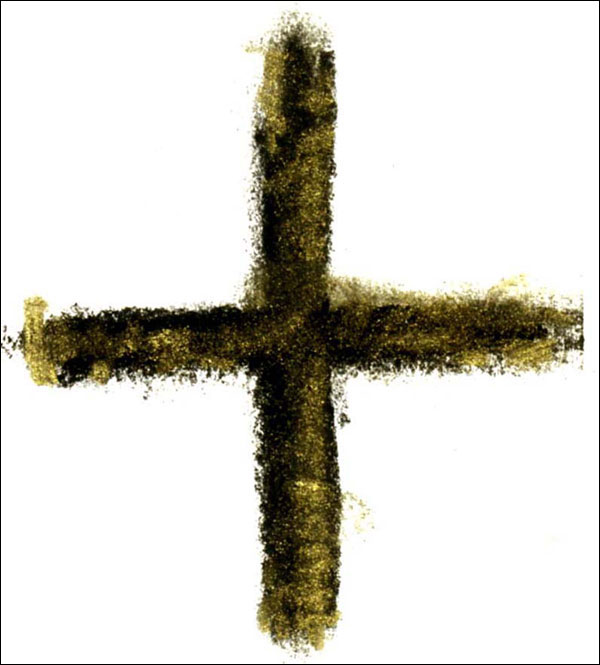
As Ash Wednesday approaches, I thought this would be a good time to do a bit of housekeeping here at The Painted Prayerbook. I have a few artful Lenten offerings I want to let you know about, along with some related news.

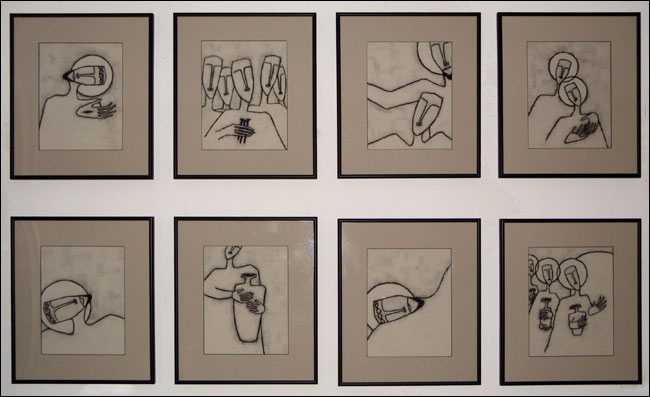
ORIGINAL ART: The artwork above is a series of charcoals that I did several years ago for Peter Storey’s book Listening at Golgotha, which offers a collection of reflections on the Seven Last Words of Jesus. The original artwork is available for sale (as an intact series), beautifully matted and framed. Great for a church, chapel, or other space for devotion/worship, especially during Lent and Holy Week. For more information, visit The Seven Last Words Series. [Update: I’m delighted that this series was acquired by Duke Divinity School, where it is permanently installed.]

MORE ORIGINAL ART: I have a few of the original pieces from The Hours of Mary Magdalene available. For details, visit The Hours of Mary Magdalene and click on the individual images.

ART PRINTS: All of the images from The Seven Last Words Series and The Hours of Mary Magdalene are available as prints; check out the Art Prints page on my website. You can also purchase prints of The Lenten Series (illustrations from my book Garden of Hollows) as well as prints of artwork from my books and my blogs.

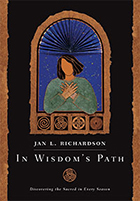
A LITERARY LENT: Published through my small press, Garden of Hollows: Entering the Mysteries of Lent & Easter offers artwork and reflections on the sacred texts and themes of the coming season. You can read excerpts and order at Wanton Gospeller Press. My book In Wisdom’s Path: Discovering the Sacred in Every Season includes a section for Lent and Easter. Visit the Books page on my website for details on this book that includes my full-color artwork.

IMAGES ONLINE: Thanks so much to everyone who has requested permission to use my artwork. In response to the number of requests, I’m working to create a website that will enable congregations and other communities to download high-resolution files of my images for use in worship and educational settings (bulletin covers, PowerPoint, etc.). The artwork will be available for a per-image fee, or, for an annual subscription, churches can have access to all the images for a whole year. I’m aiming to have this ready sometime this spring, and I look forward to having this new service available as a way to share mutual creative support with worshiping communities and other groups. In the meantime, I am always happy to respond to individual requests. Thank you for being mindful that, like most artwork, the images on my blogs, website, and in my books are under copyright. I am really happy for folks to make use of my artwork, but permission must be sought for use of these images in any format. Details and contact info are available at Copyright Permissions. [Update: images for use in worship and related settings are available at Jan Richardson Images.]

eNEWSLETTER: I send out an occasional e-newsletter. It includes a seasonal reflection, artwork, information about current offerings and upcoming events, and whatever else strikes my creative fancy. I would be delighted to include you in my mailing list if you haven’t already subscribed. You can sign up here.

GRATITUDE: Most of all, thank you for visiting The Painted Prayerbook and for the sustenance and companionship you provide along the way. Your comments, emails, prayers, and presence are all tremendous gifts on my path. Please know that I pray for you and that I carry a heap of gratitude for the ways you help make possible my work in this world.

Many blessings to you in these remaining days of Epiphany!

Transfiguration Sunday: Show and (Don’t) Tell

February 15, 2009

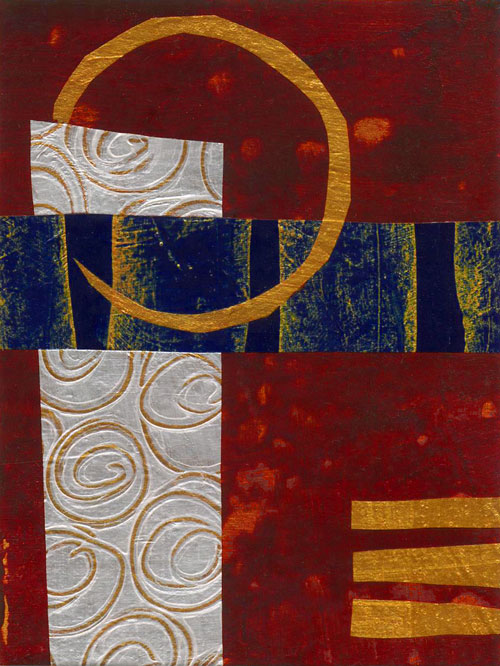
Image: Transfiguration © Jan Richardson

Reading from the Gospels, Transfiguration Sunday, Year B:
Mark 9.2-9

One of the greatest challenges in being a writer—or an artist or a preacher, for that matter—is discerning what to reveal and what to conceal. It’s a tricky thing, figuring out how much of our own experience should make its way into our work in an obvious fashion. There’s no well-defined line, though I find that my gut tends to sound the alert when it senses that something I’m reading or viewing or listening to has tilted toward providing Too Much Information.

The TMI syndrome doesn’t simply involve an overabundance of content; sometimes it’s a matter of timing. I read a book some years ago that the author crafted around a profound experience that had taken place not all that long before she began to write about it. I remember wishing she had waited a while. Clearly the act of telling the story was an integral part of how she processed the experience, but it struck me that both she and the story would have benefited from giving herself more time and space before offering that experience to the public. I find myself wondering what the story feels like to her years later, how the experience of sitting with it, pondering it, reading it over time might have honed and deepened her telling of it.

I’ve been thinking about that elusive line between revelation and concealment as I’ve pondered the gospel lection for next Sunday. It seems we’ve only recently tidied up from Christmas and Epiphany, and we’re already approaching Transfiguration Sunday and the threshold of Lent. Next Sunday’s reading beckons us to pause and gather ourselves for a moment in this space between the seasons of Epiphany and Lent, and to give thought to the questions this passage poses. Mark does the transfigurative honors for us this year with his account of this strange journey that Jesus takes with a trio of his disciples.

The transfiguring of Jesus provides a dazzling, dizzying experience for those who have accompanied him up the mountain. One can well understand that Peter, James, and John would desire to find a form for their experience, some kind of container to help them absorb and define what has taken place. We perceive this in Peter’s impulse to construct dwellings for Jesus, Moses, and Elijah. Faced with an event of overwhelming spiritual import, he responds at a physical level: Let me build something.

Peter’s offer is still on his lips when a bright cloud envelops them, a voice from within it speaking words akin to those that came from heaven at the moment of Jesus’ baptism: “This is my Son, the Beloved; with him I am well pleased; listen to him!” The word for what the cloud does is overshadow, from the Greek word episkiazo. We’ve seen this word before. It appears in the angel Gabriel’s conversation with Mary, when he responds to her question about how it will be possible for her to give birth to the child whom he has asked her to bear. “The Holy Spirit will come upon you,” he tells her, “and the power of the Most High will overshadow you” (Luke 1.35).

In the gospels, the Annunciation is the only occasion besides the Transfiguration that this word appears. The gospel writers’ use of the word draws our attention to the resonance between the story of the Annunciation to Mary and the story of the Transfiguration. Each tale reminds us that we cannot contain or confine God within man-made structures. When God shows up, God often appears in and through people: God goes not for architecture but for anatomy. Or, rather, God makes architecture of our anatomy: God seeks to make of us a dwelling, a habitation for the holy.

This business of being host to the divine is no easy thing, God (literally) knows. So it’s interesting that the soon-to-be-mother Mary and the flat-on-their-faces disciples each receive precisely the same assurance: Do not be afraid. And each goes on their way, carrying something they had not previously known.

In the absence of being able to build physical dwellings, the disciples would have wanted, I suspect, to construct a story about their mountaintop experience: a container of words, at least, that would help them hold and convey what had happened to Jesus and to themselves. Perhaps anticipating this, Jesus enjoins them not to tell what has transpired until after his resurrection. It’s one of the only times that Jesus, a man of action, urges them to wait. This is not for revealing, he tells them; this is for you to carry within you, to ponder, to conceal until the fullness of time.

Perhaps like Mary with the child in her womb.

It was important that Peter, James, and John have that mountaintop experience. It wasn’t important for them to tell the story, not yet; that wasn’t the point of their outing. But the experience would work on them, shape them, and continue to transform and perhaps even transfigure them. The knowledge they carried would alter every future encounter: with Jesus, with their fellow disciples, and with those to whom they ministered.

The story of the Transfiguration calls me to remember that there are times for revealing and times for concealing. There are seasons to tell our story. And there are seasons to hold the story within us so that we can absorb it, reflect on it, and let it (and us) grow into a form that will foster the telling.

As a writer and artist and preacher, I don’t claim to handle that line between revelation and concealment with consistent finesse. But I’ve figured out that one of the core questions in discerning whether to share an experience is this: Whom does the story serve? Does my telling it help you reflect on your life and how God is stirring within it? Or does it merely provide information I think you should know about my own life because I hope it will impress you and induce a response that serves me more than it does you?

How do you discern what and where to share about your life? Whom do your stories serve? Do you have a story of transformation that could help someone else? Is it time to tell it? Is there work that God still needs to do within you so that you can tell the story in the way it needs telling? Whether revealing or concealing, how are you continuing to become a dwelling for the presence of the God who transforms us?

Blessings to you in these threshold days.

[To use the image “Transfiguration,” please visit this page at janrichardsonimages.com. Your use of janrichardsonimages.com helps make the ministry of The Painted Prayerbook possible. Thank you!]
Eat this Book

February 14, 2009

blog-bookbinding21

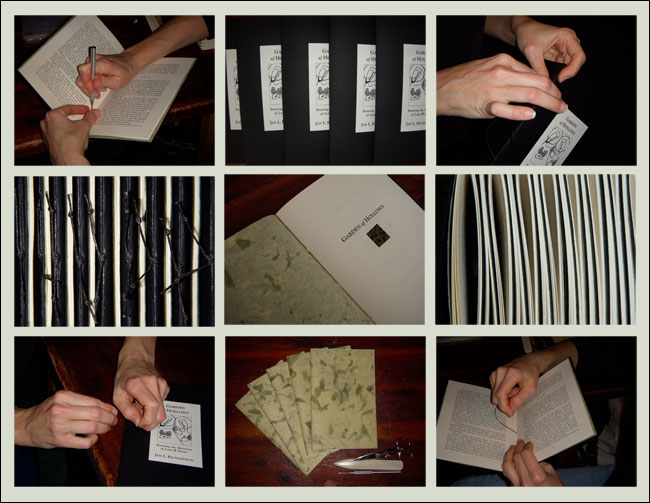
During the past couple of weeks, I’ve spent some time in the bookbindery (a.k.a. my dining/kitchen/studio table), working to replenish the supply of books that I’ve published through my small press. With Lent just around the bend, I’ve been particularly focused on shoring up my stock of my book Garden of Hollows: Entering the Mysteries of Lent & Easter. Drawing on the texts and images that the Lenten season gives us, Garden of Hollows invites readers to contemplate their lives in the light—and shadows—of the stories that lead us toward resurrection.

I established Wanton Gospeller Press in order to create small, intimate, artful books of a sort that traditional publishing houses typically can’t offer. Although I’m continuing to work with publishing houses, I’m grateful to have a pathway that enables me to develop my own vision for a book and handle its production from start to finish. I do virtually the whole shebang myself: writing, artwork, design, making the covers, and binding the books. The process is labor intensive, but I enjoy the rhythm and being engaged in each step of bringing a book into the world.

With this round of book making, I’ve added a couple of new, artful elements, including gorgeous endpapers made of mango papers that come from Thailand. The paper is beautiful, translucent, and has mango leaf inclusions, as you can see in a couple of the photos above. I’ve selected a different mango paper for each of my Wanton Gospeller editions; for Garden of Hollows I chose a lovely pale green.

My sweetheart Gary says using mango paper is a good choice, as readers can eat the endpapers if they start feeling peckish along the way. That’s actually a great image for these books, and for the process of lectio divina (sacred reading) that gave rise to them. The Dominican nun who first taught me about lectio sometimes calls it lectio bovina, in respect of the way that this form of reading invites us to chew and chew on a sacred text until we gain the nourishment it has to offer. Garden of Hollows grew from a long process of ruminating on the sacred stories of the coming season. I pray that this book, in turn, offers some of the sustenance that I have found.

I would love to share these Wanton Gospeller Press books with you! For more information and book excerpts, click on Wanton Gospeller Press, where you can order either from Amazon.com or directly from me.

Happy munching!

The Medium and the Message

February 10, 2009


Testimony © Jan L. Richardson

Reading from the Gospels, Epiphany 6, Year B: Mark 1.40-45

One of the aspects that most engages me about the new book I’m working on (a book of prayer and reflection that draws on the lives of women from the Judeo-Christian tradition) is getting to meet the women who show up along the way. Drawing as I do from several thousand years of history, I encounter these women primarily in fragments they have left behind. Stories, scriptural references, letters, prayers, poetry, visionary literature, journals, biographies, artwork, and more: the sacred texts of these women’s lives take a multitude of forms. Often working amid forces that sought to constrain and circumscribe them, women continually stun me with the persistence and creativity by which they embodied and passed down the Word from generation to generation.

In doing some research recently, I met a woman whose work is stoking my imagination. Born in the southern United States in 1837, Harriet Powers grew up in slavery and spent much of her life near Athens, Georgia. We know a scant handful of facts about her life. She had children, she was emancipated, she and her husband purchased a farm, she worked as a seamstress. We know about her primarily because of two of her stitched creations that survived: a pair of quilts.

Known as Bible quilts, Powers’s creations captivate with their style and with the stories they tell. Most often using the technique of appliqué, and perhaps drawing on the long tradition of appliqué that came from Benin (once known as Dahomey) in West Africa, Powers stitched her quilts with bold, colorful figures of humans, animals, and celestial bodies: sun, moon, stars. Frame by frame, her quilts tell stories that Powers absorbed, pondered, and reconstructed in an intensely personal and artful fashion. Not only did she include biblical stories such as Adam and Eve, Jonah and the Really Big Fish, the crucifixion of Jesus, and John’s vision of the angels with their trumpets and vials; Powers also stitched in local legends and references to astronomical and climatological events that she had heard of or experienced. Her stitched stories included “The independent hog that ran 500 miles from GA to VA,” “the falling of the stars on November 13, 1833,” and “a man frozen at his jug of liquor” on Cold Thursday in 1895. (See the quilts, and a photograph of Harriet Powers, in a brief bio here.)

We know some of Powers’s thoughts about her work through several people who recorded her reflections. Describing her first Bible quilt, now in the Smithsonian Institution (her second quilt resides in the collection of The Museum of Fine Arts in Boston), Powers said it was “a Sermon in Patchwork,” and that she desired to “preach the gospel in patchwork, to show my Lord my humility…”

As experts have pointed out, Powers’s quilts are not the size of typical bed covers; they are significantly wider than they are long. When one takes that together with Powers’s own words about her work, it becomes tantalizing to consider the possibility that she created them primarily as a form of proclamation. With the vibrant vocabulary she had at hand, she bore testimony to the Word who had taken flesh in her own life.

We saw this impulse toward vernacular proclamation in Peter’s mother-in-law last week, who responded and testified to Jesus’ gift in the only way she knew how: the vocabulary of a meal. This week we see the impulse toward testimony in the form of a man who finds healing in the presence and in the touch of Jesus. In this Sunday’s gospel reading, Mark tells us of a man whom Jesus releases from leprosy. Jesus attempts to confine the man’s response. “See that you say nothing to anyone,” he tells the one whom he has healed; “but go, show yourself to the priest, and offer for your cleansing what Moses commanded, as a testimony [Greek marturion, which also means witness] to them.” The man, however, cannot contain himself. His testimony spills over the boundaries that Jesus has set. Mark tells us that the man “went out and began to proclaim [Gk. kerusso, also translated as to make known, to preach] it freely, and to spread the word, so that Jesus could no longer go into a town openly, but stayed out in the country; and people came to him from every quarter.”

Like Harriet Powers, like Peter’s mother-in-law, this healed man offers his testimony with the only vocabulary he has: in this case, his own body, his own flesh, healed and made whole. In this man, the medium is the message. His body proclaims everything he knows about Jesus. Voice lifted up, arms flung wide, he is an open book, a gospel: the good news is embedded in his body, a living testament to the incarnate God who tangles Godself up in the business of our bodies.

Freed from the bondage of slavery, Harriet Powers offered her testimony stitch by artful stitch. Released from the imprisonment of illness, Peter’s mother-in-law gave her testimony through ministering to Jesus and his companions at the table. Set loose from the captivity of leprosy, the healed man proclaimed his testimony with every fiber of his flesh. Each with their own medium, they did what lay in their power to do.

How about us? How do we offer our testimony about the one who has freed us? What medium do we have at hand to proclaim the news of how Christ has worked, and works still, to release all people from every form of captivity and bondage? What is the unique vocabulary that God has given to you to articulate how God takes shape in your life? How willing are you to use that vocabulary in ways that only you can express?

In every word, with every gesture, by every art, through every means, may we be a living gospel, for the life of the world. Blessings.

[Harriet Powers’s “Sermon in Patchwork” quotation is from Harriet Powers’s Bible Quilts by Regenia A. Perry. See also Stitching Stars: The Story Quilts of Harriet Powers by Mary E. Lyons.]

[To use the “Testimony” image, please visit this page at janrichardsonimages.com. Your use of janrichardsonimages.com helps make the ministry of The Painted Prayerbook possible. Thank you!]
The Domestic God

February 4, 2009


The Domestic God © Jan L. Richardson

Reading from the Gospels, Epiphany 5, Year B: Mark 1.29-39

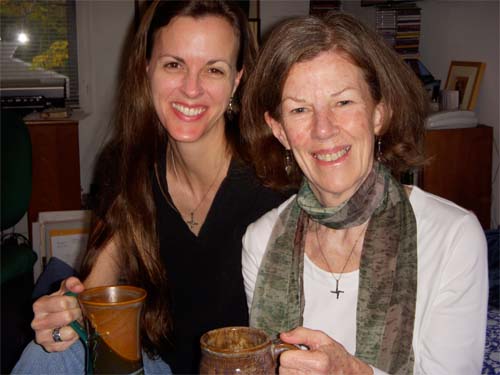
So we had a lovely little celebration on Saint Brigid’s feast day last Sunday. I invited my sweetheart Gary and our friend Linda over for tea that afternoon. Like me, Linda is an oblate of Saint Brigid of Kildare Monastery. We three had time for a cup of jasmine tea, a slice of cappuccino cheesecake (Brigid would’ve loved cheesecake if she’d known of it), and a few strawberries before the next phase of our celebration: a conference call with a bunch of other folks from the Saint Brigid’s community. Scattered across a physical distance that stretches from California to the Dominican Republic, we joined together for a feast day liturgy that brought us close across the miles.

Then Linda and Gary and I had more cheesecake.

I don’t do a huge amount of entertaining. This owes to a combination of factors including my need for copious amounts of solitude (especially with a book deadline coming up this summer) and the fact of my wee living space, which tends to discourage the gathering of more than, say, a half dozen folks at once (and that’s if some of them sit on my futon). My cozy studio apartment has an efficiency kitchen that Gary calls my yoga kitchen, as getting something out of the tiny refrigerator that sits under the sink sometimes involves doing contortions. Since I’m not wildly domestic, my two-burners-and-a-toaster-oven arrangement suits me okay, most days.

Still, when I get my act together to invite even a friend or two over for a cup of tea or a meal, I love sharing my home and receiving the gift of a loved one’s presence in my quiet space. At times such an occasion feels like a miracle. In the cup, in the conversation: sustenance and grace.

I sometimes tend to overlook the ordinary miracles that unfold in the domestic realm. So often do I take it for granted that on a daily basis, several times a day, there will be something to fill my hunger, and that I will be able to reach for it. But this week, with Saint Brigid’s festive tea lingering with me (along with the stories of the domestic provisioning for which she was especially known, including wondrous feats involving bacon and butter and beer) and with this Sunday’s gospel lection on my mind, I’m paying particular attention to what’s going on the everyday sphere of home, looking to see where the mundane gives way to the miraculous.

This Sunday’s gospel leads us straight into a home, that of Simon (Peter) and Andrew (Matthew and Luke refer to it solely as Simon/Peter’s house). Jesus has come straight from the synagogue, where he cast out the unclean spirit of last week’s reading. Once inside the house, he learns that Simon’s mother-in-law is in bed with a fever. He goes to her, takes her by the hand, lifts her up. In his gesture of reaching toward the woman, touching her, Jesus crosses with great intention into her condition, her realm, her world.

Here we see the domestic Jesus, the intimate Jesus. Crossing from the house of worship into the home of Simon, standing at the bed of a woman whose body has been disordered by illness, Jesus conveys with his outstretched hand that there is no sphere that he does not control, no suffering that is beneath him to heal, no place where he does not desire wholeness and peace. He makes clear that his power is present in every realm, the home no less than the synagogue. He extends his healing to all, the woman in the grip of a fever no less than the man in the clutch of an unclean spirit.

There is no place, no person, unworthy of a miracle.

In response to her healing, Simon’s mother-in-law begins to serve Jesus and his companions. Where other stories of healing sometimes end with the recipient offering a verbal testimony to what Jesus has done (as we will see in next week’s gospel), this story does not ascribe any words to the woman. Whatever she may have said, if anything, the act of her serving Jesus and his companions, her ministering to them in this basic, bodily way, provides eloquent testimony in the vocabulary that she has at hand. That her act falls squarely in the realm of what society sometimes, wrongfully, denigrates as “women’s work” does not minimize its grace. Rather, it unveils the holiness present—and sometimes hidden—in the everydayness of domestic life.

In her commentary on this passage in The Women’s Bible Commentary (Carol Newsom and Sharon Ringe, eds.), Mary Ann Tolbert points out that the word denoting the woman’s action, rendered in the NRSV as serve (from the Greek root diakoneo, related to the word for deacon), is the same word used to describe what angels do for Jesus at the end of his forty days in the wilderness. The choices of some translators, however, have elevated the service of the angels over that of the woman; for instance, translating the action of the angels as “ministering” to Jesus—a more overtly sacramental act—and the woman’s action as “serving” him, which gives a subservient cast to her gift. “The author of Mark,” Tolbert observes, “by using the same word for the action of the angels and the action of the healed woman, obviously equated their level of service to Jesus. What the angels were able to do for Jesus in the wilderness, the woman whose fever has fled now does for him in her home.” Tolbert goes on to note that the door of the woman’s house “becomes the threshold for healing for all in the city who are sick.”

What Jesus later says of a woman who blesses his body with an anointing, we can say of this woman who blesses his body with her domestic gesture: she has done what lay in her power (Mark 14.8, New English Bible). Can the same be said of us? In the places in which our lives unfold, what lies in our power to do? What ordinary miracles hide out in the rhythm of our days, beckoning us to see them or to help enact them? What miracles might Christ be inviting our participation in, as a response and witness to his presence? What’s going on in your home, and how might Christ be wanting to show up within it?

Wherever you live, may Christ bless you there.

jan-linda
With Linda on Saint Brigid’s Day

[To use the “Domestic God” image, please visit this page at janrichardsonimages.com. Your use of janrichardsonimages.com helps make the ministry of The Painted Prayerbook possible. Thank you!]

Feast of the Presentation/Candlemas

February 1, 2009

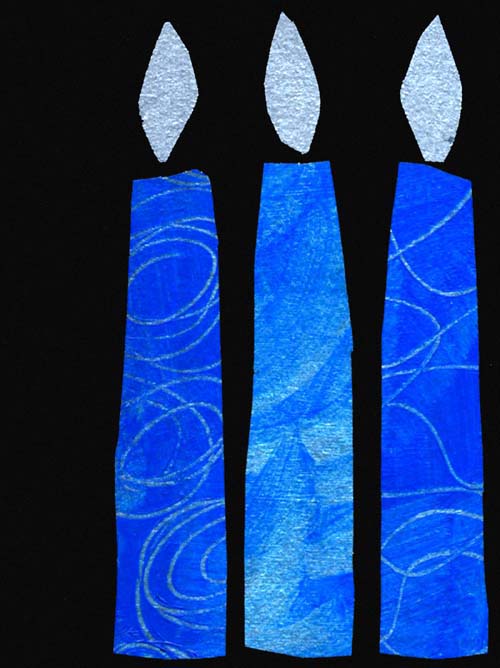
blog-candlemas
Blessing of the Candles © Jan L. Richardson

Reading from the Gospels for Feast of the Presentation: Luke 2.22-40

The beginning of February offers us another lovely feast day on the heels of today’s Feast of St. Brigid. In the rhythm of the Christian liturgical year, tomorrow marks the Feast of the Presentation of Jesus, also called the Feast of the Purification of Mary. This day bids us remember Mary and Joseph’s visit to the Temple to present their child Jesus on the fortieth day following his birth, as Jewish law required, and for Mary to undergo the postpartum rites of cleansing. Luke’s Gospel tells us that a resident prophet named Anna and a man named Simeon immediately recognize and welcome Jesus. Taking the child into his arms, Simeon turns his voice toward God and offers praise for the “light for revelation” that has come into the world.

Taking a cue from Simeon, some churches began, in time, to mark this day with a celebration of light: the Candle Mass, during which priests would bless the candles to be used in the year to come. Coinciding with the turn toward spring and lengthening of light in the Northern Hemisphere, Candlemas offers a liturgical celebration of the renewing of light and life that comes to us in the natural world at this time of year, as well as in the story of Jesus. As we emerge from the deep of winter, the feast reminds us of the perpetual presence of Christ our Light in every season.

With her feast day just next door, and with the abundance of fire in the stories of her life, it’s no surprise that St. Brigid makes an appearance among the Candlemas legends. One of those legends reflects a splendid bit of time warping that happened around Brigid. The stories and prayers of Ireland and its neighbors often refer to Brigid as the midwife to Mary and the foster mother of Christ. Chronologically, this would have been a real stretch (seeing as how Brigid was born in 454 CE), but in a culture in which the bond of fostering was sometimes stronger than the bond of blood, this creative image of Brigid reveals something of the deep esteem that she attracted. In the Carmina Gadelica, a collection of prayers, legends, and songs that Alexander Carmichael gathered in Scotland in the 19th century, he conveys this story of Brigid as an anachronistic acolyte:

It is said in Ireland that Bride [Brigid] walked before Mary with a lighted candle in each hand when she went up to the Temple for purification. The winds were strong on the Temple heights, and the tapers were unprotected, yet they did not flicker nor fail. From this incident Bride is called Bride boillsge (Bride of brightness). This day is occasionally called La Fheill Bride nan Coinnle (the Feast Day of Bride of the Candles), but more generally la Fheill Moire nan Coinnle (the Feast Day of Mary of the Candles)—Candlemas Day.

On this Candlemas Eve, where do we find ourselves in this story? Are we Mary, graced by the light that another sheds on our path? Or are we Brigid, carrying the light for another in need?

A blessed Candlemas to you!

[To use the “Blessing of the Candles” image, please visit this page at janrichardsonimages.com. Your use of the Jan Richardson Images site helps make the ministry of The Painted Prayerbook possible. Thank you!]

[For my other reflection & art related to Luke 2.22-40/The Presentation, visit this post.]

A Habit of the Wildest Bounty: Feast of St. Brigid

January 31, 2009


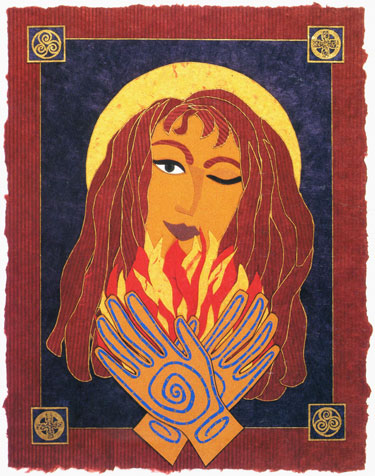
Saint Brigid © Jan L. Richardson

Tomorrow brings one of my favorite days of celebration: the Feast of Saint Brigid of Kildare, beloved holy woman of Ireland. Born in the middle of the fifth century, Brigid became a pivotal figure in the development of Irish Christianity. We know few concrete details of her life, but the surviving stories offer a compelling depiction of a woman renowned for her hospitality and for the monasteries she established, the most famous being the one at Cill Dara (Kildare), the Church of the Oak.

Many of the tales of Brigid’s life read much like those of other female saints: her saintly qualities were evident from an early age; she forsook marriage in order to follow Christ in a monastic way of life (she even caused her eye to burst in order to avoid being married off; don’t try this at home!); she was a wonder-worker who brought healing and justice; she exercised miraculous influence over the weather, animals, and the landscape. “She stilled the rain and wind,” the final line of the Bethu Brigte, a medieval account of Brigid’s life, tells us.

In her charming book St. Brigid of Ireland, Alice Curtayne describes Brigid as someone who found the poor “irresistible” and ministered to them with “a habit of the wildest bounty.” Her lavish generosity sometimes put her at odds with her family and, later, her monastic community, which occasionally had to do without as she gave their bounty to guests and strangers.

There is a strong domestic quality that pervades Brigid’s wonderworking, a homeliness to the miraculous that runs throughout her tales. Most of her recorded miracles are feats of provisioning by which she secures an abundance of fare for daily sustenance as well as for festive occasions. In Brigid’s presence, butter is replenished; the bacon she slips to a dog miraculously reappears in the pot; a stone turns to salt; water becomes milk, or beer, or, in one instance, an aphrodisiac. Her plenitude consciously echoes Christ’s miracles of provisioning—water into wine, a few loaves and fish into a feast—and embodies the abundant generosity of God. There is a gracefulness that shimmers in the utterly mundane quality of the material of Brigid’s miracles, underscoring the dignity of the daily tasks to which the women of her day—and women across centuries—devoted so much of their lives.

Those who wrote Brigid’s Lives, however, were keen to portray her as much more than a wonderworking dairymaid. Within the workaday landscape of her legends, signs of the mystery and power of God flicker and flash with a brilliance that illuminates the saint and sparks the imagination. Fire is a persistent symbol in her stories, and in one of the earliest prayers to Brigid, known as “Ultán’s Hymn,” the writer addresses her as a “golden radiant flame.”

The symbol of fire illuminates and underscores Brigid’s role as not only a worker of domestic miracles but also a woman of transcendent power. In her stories she appears as a charismatic leader who wields influence in monastic, civic, and natural realms; she is ever at ease among kings and bishops; she brings healing to body and soul; she displays gifts of exhortation; she has prophetic dreams and sees far into the hidden reaches of the heart. Brigid possesses a sense of justice that prompts her to secure the freedom of prisoners and slaves.

The Annals of Ulster variously give the date of Brigid’s death as 524, 526, and 528. According to one of her early biographers, Brigid was buried in the abbey church she established at Kildare, and she continued to work miracles after her death. Tradition tells that she was moved from Kildare and laid to rest in Dunpatrick alongside two other great saints of Ireland, Patrick and Columba. Her physical grave remains a mystery, but the landscape of Ireland continues to testify to her presence, with forms of the name Brigid appearing in the names of towns, holy wells, and churches. Legends, prayers, rituals, and celebrations (some of which echo the festivities of Imbolc, a major springtime celebration in the ancient Celtic year) continue to expand and sometimes complicate her story, adding their threads to the mysterious tapestry of Brigid’s legacy.

Brigid lent her name to a modern-day monastery that has been a significant part of my own journey for nearly a decade. Founded at the turn of this millennium by Mary Stamps, a remarkable woman who possesses a wondrous share of the spirit of the groundbreaking Irish saint, St. Brigid of Kildare Monastery draws from both Methodist and Benedictine traditions. For more information about this unique community, visit Saint Brigid of Kildare Monastery.

A blessed Feast of Saint Brigid to you, and may you possess Brigid’s habit of the wildest bounty!

[To use this image, please visit this page at janrichardsonimages.com. Your use of janrichardsonimages.com helps make the ministry of The Painted Prayerbook possible. Thank you!]
Epiphany 4: In the Realm of the Spirits

January 30, 2009


I Know Who You Are © Jan L. Richardson

Reading from the Gospels, Epiphany 4, Year B: Mark 1.21-28

There once was a time when I didn’t give much thought to what it meant to confront evil and suffering in the realm of the spiritual world. I’m mainline Protestant, after all. Spiritual warfare, as some call it, was something best left to the charismatics and others who dealt in such things.

Then I began to live and work within systems and organizations that have given me cause to think again about the notion that evil can cohere as a force, can organize and inflict itself in discrete ways. In my professional ministry and in my personal ecosystem, the years have afforded plenty of occasions to witness the ways in which chaos that exists in the spiritual world can manifest itself in the physical realm. It’s stunning, how a single individual in spiritual disarray can distribute pain and discord among an entire body of people. And the reverse: how the diffuse chaos that often lurks so easily within a system can erupt in acts of harm against particular individuals.

In this Sunday’s gospel lection, Mark tells a story that provides a vivid example of a person who has become overwhelmed by a force that is contrary to the purposes of God. In describing what harbors within the man whom Jesus encounters, Mark uses the Greek term pneumati akatharto: an unclean spirit. The uncleanness that akatharto (from the word akathartos) denotes has to do not with physical untidiness but rather with how the spirit exists in a state actively antagonistic to God, a state that the spirit has inflicted upon the man. Akathartos is the opposite of katharos (related to our word catharsis): ritually pure, clean.

Intriguing, isn’t it, that this encounter takes place in a synagogue? It underscores what I have seen time and again: that places meant for worship and seeking after God often attract the most chaotic folks. That which is opposed to God is often most drawn to those places devoted to God. Such folks are like this man who, amid the chaos, nonetheless experiences a point of vivid clarity: he—or, rather, the spirit in him—recognizes Jesus. “I know who you are,” he cries out, “the Holy One of God.”

Jesus will say, just a few verses later, “Those who are well have no need of a physician, but those who are sick” (Mark 2.17). It’s one thing, however, to know and seek healing for our sickness, and to minister to others who recognize their own need. More challenging to reckon with are those folks living, often without awareness, in the grip of forces opposed to God who are yet drawn toward the holy. It can take a long time before their deep, underlying hunger for God breaks through and overtakes their desire to inflict chaos in the places of sacredness.

In his healing of the man, Jesus offers a model for how we can reckon with the forces that work against God’s desire for wholeness. Jesus responds to the spirit with the calm authority that receives particular comment in this passage, both by Mark and by those who witness Jesus’ teaching and healing in the synagogue. Jesus addresses the spirit from the core of who he is. He is not exhibiting a display of magic or seeking to dazzle the crowd with a show. Rather, Jesus demonstrates his willingness to confront and call out what is contrary to God. Acting from that fiercely calm and centered place, he releases the man from the force that has tormented him.

The healthy spiritual practices of the Christian tradition give us tools to do the necessary work at the level of spirit. These practices cultivate within us the grounded, centered authority that enabled Christ to confront the unclean spirit, they help keep us clear amid chaos, and they deepen our ability to respond to the ways that disorder becomes manifest in the world. These practices, however, are not enough in themselves. As Jesus points out in the gospels, and as Paul addresses in his letters, it’s possible for us to become puffed up about our own spiritual prowess.

The desert mothers and fathers of the early church recognized this. They had a lively understanding of the ways that spiritual disorder takes form in the physical realm. They sometimes described these forms as demons, who particularly loved to hide out in the very practices that these desert folk sometimes became proud of—extreme fasting, prayer, and the like. This story comes from the desert tradition:

[Amma Theodora] also said that neither asceticism, nor vigils nor any kind of suffering are able to save, only true humility can do that. There was an anchorite who was able to banish the demons; and he asked them, ‘What makes you go away? Is it fasting? ’ They replied, ‘We do not eat or drink.’ ‘Is it vigils? ’ They replied, ‘We do not sleep. ’ ‘Is it separation from the world? ’ ‘We live in the deserts.” ‘What power sends you away then?” They said, ‘Nothing can overcome us, but only humility.’ ‘Do you see how humility is victorious over the demons?’

In my own spiritual practice, I have taken to opening my day by offering the prayer known as St. Patrick’s Breastplate, also called Deer’s Cry (for its association with the legend that St. Patrick prayed it when he and his companions were in peril, and the prayer caused them to take on the appearance of deer and thereby elude their attackers). Though the prayer originated sometime after St. Patrick, it is an old, old prayer of encompassing—what the Celtic folk call a lorica—that in a poetic and profound way calls upon God to protect us from the forces that seek to work against God. I’m particularly fond of the version that Malachi McCormick offers in his book Deer’s Cry. Published by his small press, The Stone Street Press, Deer’s Cry offers Malachi’s translation of the prayer (alongside the Old Irish version), handwritten with his charming calligraphy. I gradually committed the prayer to memory some time ago. I pray it not as some kind of magic charm but rather as a reminder that I go into my day, and into the world, in the encompassing of God, who bids me rely completely on the power of God rather than on my own devices. It’s a prayer that, honestly prayed, cultivates humility, an awareness of how we are entirely dependent upon God. It’s this humility that in turn fosters the type of calm, centered authority by which Jesus acted in confronting the unclean spirit.

This gospel story reminds us not to give more power to the presence of evil than is warranted; obsessing over chaos can breed it. Rather, the story challenges us to confront evil where we find it. The demons—by whatever form or name we know the presence of disorder—fight hardest when we, like Jesus, look them in the face. But this is what depletes evil of its power. It cannot bear being named, challenged, called out.

Where do you personally witness the forces that work against God? What do you think about those forces, and how do you reckon with them? How do you seek God’s protection against them? Are there ways you feel called to confront the presence of chaos? What practices help keep you centered in, and reliant upon, the power of God?

May you go with the encompassing of Christ, who does not abandon us to chaos but instead accompanies in every realm. Blessings.

[Amma Theodora story from The Sayings of the Desert Fathers, translated by Benedicta Ward, SLG.]

[To use the “I Know Who You Are” image, please visit this page at janrichardsonimages.com. Your use of janrichardsonimages.com helps make the ministry of The Painted Prayerbook possible. Thank you!]
The Hospitality of the Book

January 28, 2009

blog-womananointsjesus
A Woman Anoints Jesus © Jan L. Richardson

Ooohhhh, you really should check out the January 15 episode of Krista Tippett’s Speaking of Faith radio show. Titled “Preserving Words and Worlds,” the episode highlights the remarkable work of the Hill Museum & Manuscript Library (HMML), which is based at Saint John’s Abbey and University in Collegeville, Minnesota. The HMML is committed to preserving manuscript culture, not only through its work in a variety of locations around the world (including places where texts are in peril because of war), but also through its involvement in the creation of The Saint John’s Bible, the first Bible to be written and illustrated by hand in more than five hundred years. You can listen to the show and take in related features by visiting this delicious page.

At the Speaking of Faith blog, the January 15 entry from online editor Trent Gilliss included a link to a short video about the making of The Saint John’s Bible. A reader of the blog left a comment in response, offering the perspective that “the money would be far better spent feeding the hungry and homeless around the world” and that the Benedictines are “being selfish without realizing it.”

Typically I don’t take that kind of bait in cyberspace, but this was a day I felt drawn to respond to that view, which I encounter frequently in the church—the view that art and justice are two different things and that we have to choose between them (with justice being the “right” choice). What follows is a comment that I left in response. I know it’s longish, but it was a good opportunity to remind myself of why I do what I do, and why people of faith should give a damn about art (and justice, though I can’t conceive of those two being separate).

Comment: Deep thanks for your “Words and Worlds” show and for highlighting the remarkable work of the Hill Museum and Manuscript Library. For a number of years I’ve had occasion to travel to Saint John’s, and have followed with particular interest the HMML. I am fascinated by the crucial work it does both in preserving the sacred texts of many cultures and civilizations and also in supporting the creation of a new manuscript for a new time in the form of The Saint John’s Bible.

I was struck by the comment left by the writer who thought the money would be better spent feeding the homeless and hungry. I’m not certain whether the writer was referring to money spent on The Saint John’s Bible or to the work of the HMML in general, or both together, but the comment illuminates a tension that has long pervaded the church regarding art and justice. I am concerned by how frequently we in the church talk about art and justice as two different things that we have to choose between, rather than as being part of the same impulse: our response to a God of grace and creativity who has placed us in a world that is both broken and beautiful.

The Christian tradition and the Bible itself both developed and survived in large measure because of people across the centuries who gave themselves to transmitting the sacred stories in a variety of creative forms, not just in texts but also in other media including drama, music, and liturgy. In particular, the stunning array of visual art created over the centuries not only helped proclaim the gospel to those who could not read it (as well as those who could) but also was understood to be a gift in return to God: a lavish offering, an act of praise in response to the God who has lavished love, grace, and care upon us.

The fact that we live in the 21st century, when hunger, homelessness, and a host of other injustices continue to inflict deep suffering around the world, does not diminish—and is not separate from—our need for beauty and the sustenance and hope it provides. I find myself thinking of the story in Mark 14.3-9, in which, as Jesus sits at table, a woman comes and anoints him with outrageously expensive oil. Mark tells us that some at the table were angry and said, “Why was the ointment wasted in this way? For this ointment could have been sold for more than three hundred denarii, and the money given to the poor.” Jesus, however, receives her lavish act with grace and gratitude. “Let her alone,” he tells those who scold the woman; “why do you trouble her? She has performed a good service for me. For you always have the poor with you, and you can show kindness to them whenever you wish, but you will not always have me. She has done what she could; she has anointed my body beforehand for its burial. Truly I tell you, wherever the good news is proclaimed in the whole world, what she has done will be told in remembrance of her.”

In saying that we would always have the poor with us, Jesus wasn’t suggesting that we should neglect to work for an end to poverty. Rather, he recognized that lavish acts of generosity, grace, and beauty, such as the woman offered to him, must be part of our response to Christ, alongside our work for justice. Jesus knew that choosing justice at the expense of beauty is just another form of poverty.

I am an ordained minister as well as an artist and writer. I understand my call and my work as a minister to be about feeding people not only in body but also in soul. One kind of feeding cannot long do without the other. I could not work for justice in this world without the creative acts that others have offered across the centuries and in our present time, not only because I could not live without the sustaining hope and beauty they offer, but also because they remind me that God desires us to give lavishly, generously, wantonly from the depths of who we are, and who God has created us to be. Such extravagant acts can seem wasteful. By his response to the anointing woman, however, Jesus reminds us that such gestures of grace bring healing to the body of Christ, and to the whole world.

One of the many gifts of The Saint John’s Bible is that through its related exhibitions, books, prints, cards, and website, not to mention radio and TV shows that have featured it, people are coming into contact with the Bible who might not otherwise encounter it. The Saint John’s Bible also beckons those who think we are oh-so-familiar with the Bible to engage it in a different, deeper, and renewed way. The work of Donald Jackson and his team reminds us that the Bible is not obsolete but rather is a living, dynamic text that invites us to continue not merely to read it but to lavish our attention upon it: to grapple and wrestle with it, to question it, to discern how it still speaks to and challenges us in this time, and to illuminate it, even as it illumines us.

The monks of Saint John’s, and the host of others who participate in the work of the HMML, including the artists, calligraphers, and financial contributors who are making The Saint John’s Bible possible, are offering the world something that is precisely the opposite of selfish. In preserving the sacred texts of the past, in employing ancient methods to offer a sacred text that speaks to us in the present, in drenching us with this audaciously lavish gift, they are offering, in fine Benedictine (and Christian) tradition, a profound act of hospitality.

Amid the brokenness of the world, to which we are called to minister, these folks have given us a rare gift that reminds us that God desires beauty. They bear witness to the fact that recognizing and offering beauty is part of what heals the brokenness. They remind us that God is not yet done with the work of creating, and that God calls us to offer our creative gifts for the healing and feeding of the world.

And that is good news indeed.

Epiphany 3: Hooked

January 24, 2009


The Willing Catch © Jan L. Richardson

Reading from the Gospels, Epiphany 3, Year B: Mark 1.14-20

Thomas Merton, the famed Trappist monk of the 20th century, once took a picture that he titled “The Only Known Photograph of God.”

The picture was of a meat hook.

I keep thinking of this stark image, and Merton’s title, as I ponder this Sunday’s gospel lection, in which Mark offers his version of Jesus’ call to the kindred fishermen Simon and Andrew. “Follow me,” Jesus says, “and I will make you fish for people.” His invitation stirs the unsettling question: if fish are food, a catch intended for consumption, then what is it that we people are to God, once we fall into the net of the divine?

Long before the arrival of Jesus, the Jewish tradition had taken pains, in the form of the story of Abraham’s near-sacrifice of his son Isaac, to make clear that Yahweh doesn’t require human sacrifice. The God of Israel presents other conditions for right relationship, as we read, for instance, in Micah 6, where the question arises: “With what shall I come before the Lord, and bow myself before God on high?…Shall I give my firstborn for my transgression, the fruit of my body for the sin of my soul?” “…and what does the Lord require of you,” comes the response, “but to do justice, and to love kindness, and to walk humbly before your God?”

I wonder if the people of Israel ever wondered if human sacrifice might be easier, after all, than all this justice and kindness stuff.

It can feel consuming, being in relationship with God: it requires so much more of our very selves than simply offering a sacrifice that’s detached from us. And for all that it asks of us, our participation in God doesn’t offer much in the way of earthly security, as Mark reminds us: this lection begins with a mention of the arrest of John the Baptist, who would soon meet his earthly end in the context of a meal.

It’s challenging at times to reconcile the seeming paradox that giving ourselves to a God of love and mercy does not always protect us from heartache and suffering; in fact, it sometimes does just the opposite. Called to engage the world, we find ourselves drawn more deeply into the pain and despair present there—along with (thank God) the delight. In each place Christ calls us to notice and to embody the presence and love of God: to be the living body of Christ, who spoke of his own self as food, as sustenance.

As Merton recognized, it can leave us feeling like we’re on the meat hook of God, the way that God claims and hungers for our deepest selves and sends us into the world to be Christ’s body, to offer his sustenance. Given what a consuming, demanding, and sometimes perilous prospect it can be to share fully in the life of Christ, one might well wonder: what compels us to follow him?

What lures you to Christ? What is it about him that beckons you, calls to you, compels you not only to follow him but also to reach out in invitation to others? What is it about Jesus that hooks you?

In a culture that too often tries to scare and threaten us into a relationship with Christ, may we see clearly who he is and embody his fierce and sustaining love in a desperately hungry world. Blessings.

[To use the “Willing Catch” image, please visit this page at janrichardsonimages.com. Your use of janrichardsonimages.com helps make the ministry of The Painted Prayerbook possible. Thank you!]