Archive for the ‘lectionary’ Category

Epiphany 6: What the Light Shines Through

February 5, 2012


Testimony © Jan L. Richardson

Reading from the Gospels, Epiphany 6, Year B: Mark 1.40-45

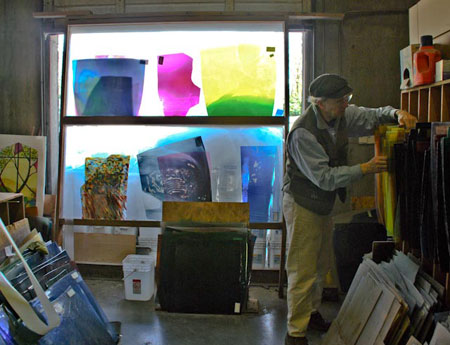
Last week the news came that a friend of mine has been diagnosed with a brain tumor. It is large, and it is grim; the doctors measure his life in months, perhaps weeks. A stained glass artist who has devoted his life to finding beautiful ways to capture light, Joe—making his own path as ever—is finding other ways to measure and mark these remaining days. The threads of community that he has tended across the years in such places as the Grünewald Guild are gathering around him now to support him and to make it possible for him to be in places he loves; friends and family have enabled him to return to his home and studio at the artists’ community where he lives, and folks from the Guild are plotting a trip where they’ll bring Joe back up there.

Living on the other side of the country, I am missing being present for this but am grateful for the words that come across the miles, words that tell of how Joe is entering his dying in much the same way that he has entered his living. The tumor has impacted his speech and visual recognition skills. But a note comes from a friend who writes of how even when Joe struggles with words, “he seems, to me, even more himself than ever. He’s almost translucent with grace. And I have been so moved by the ‘random’ words that, at times, come instead of the one he’s trying for. It’s almost as if the words that he has most often expressed come easily; blessing, blest, grace, friends, church, my voice, your voice…”

I gather up these words as I ponder the words that Mark offers in the reading from his Gospel this week, words about a leper who finds healing in his encounter with Jesus. “If you choose, you can make me clean,” he says to Jesus. Stretching out his hand and touching him, Jesus says, “I do choose. Be made clean!”

It is a mystery to me how Jesus chooses, and where, and why. I cannot fathom how he chooses at times to stretch out his hand, and at other times seems to withhold it; how he chooses against the restoration that he offers with such ease in stories such as this one. Why the leper, and not Joe? Why the mother-in-law of Simon, as we saw last week, and not millions of others across the ages who have lived with illness and pain?

I know, of course, there are few answers to these questions in this lifetime. And I know that it is better to look for the miracles that do come, including the daily wonders of connection in the midst of a world that pushes us toward isolation, the marvels of friendship and community that return to us and gather around us when life breaks us open.

I do not let Christ off the hook for the ways he sometimes chooses. And yet I think about my friend across the country, speaking the words that have come most easily to him. Blessing. Blest. Grace. How in the midst of the tumor that grows and the days that dwindle, there is something in him that is fiercely intact and persistently whole. Friends. Church. That knows still how to capture the light. My voice. Your voice. That rises up to freely proclaim, to offer testimony in the luminous way he has always done and will do until the last breath leaves him.

Joe is having an exhibit at his studio this weekend, wanting to have this chance to share with friends his artwork from across the years. “Bring food. Bring joy,” Joe says in the invitation.

This day. This hour. In each moment given to us, may we bring sustenance. May we bring joy. Whatever illness we bear, whatever wounds we carry, may we be ministers of healing to one another, and may the wholeness that persists within us rise up and shine through, offering testimony in the ways that only we can offer.

What the Light Shines Through
A Healing Blessing

For Joe

Where pain
does not touch you.
Where hurt
does not make its home.
Where despair
does not haunt you.
Where sorrow
does not dwell.

Where disease
does not possess you.
Where death
does not abide.
Where horror
does not hold you.
Where fear
does not raise its head.

Where your wounds
become doorways.
Where your scars
become sacred maps.
Where tears
become pools of gladness.
Where delight
attends your way.

Where every kindness
you have offered
returns to you.
Where each blessing
you have given
makes its way back
to you.
Where every grace
gathers around you.
Where the face of love
mirrors your gaze.

Where you are
what the light
shines through.


Joe in the studio. Photo by Kristen Gilje.

P.S. For a previous reflection on this passage, visit The Medium and the Message.

[To use the “Testimony” image, please visit this page at janrichardsonimages.com. Your use of janrichardsonimages.com helps make the ministry of The Painted Prayerbook possible. Thank you!]

Epiphany 5: Healing and Feasting

January 29, 2012


The Domestic God © Jan L. Richardson

Reading from the Gospels, Epiphany 5, Year B: Mark 1.29-39

In a parallel universe, where there are thirty hours in a day, perhaps my parallel self has completed a new reflection and artwork for this week. In this universe, however, with its mere twenty-four-hour days, I’ve been devoting my studio hours to preparing some Lenten fare to accompany you during the soon-arriving season. I am already, as ever, surprised by where the Lenten texts are taking me, and I look forward to sharing the path through the coming season with you.

My Lenten immersion, along with preparing for some upcoming events, has left me sans new reflection. But I do have a previous reflection on this passage; please visit it here:

The Domestic God

I especially want to recommend Mary Ann Tolbert’s insights into this gospel passage, which have influenced my thinking about this text and which I briefly quote in the reflection.

This week offers two feast days that are good companions to the gospel reading. February 1 brings us the Feast of Saint Brigid, the beloved Celtic saint who was a light for the early church in Ireland and who worked many miracles of healing. February 2 is Candlemas, also known as the Feast of the Presentation or the Feast of the Purification of Mary. For reflections on these days, which are among my favorites of the year, click on the images or titles below.

Provision and Plenitude: Feast of Saint Brigid
(New at my Sanctuary of Women blog)

Feast of the Presentation/Candlemas

Wishing you many blessings and a festive week!

P.S. Speaking of upcoming events, I invite you to visit my calendar on my main website: see Calendar. Be sure to check out the Liturgical Arts Week that Gary and I will be involved with at the Grünewald Guild this summer. I’ll be the keynote speaker, and Gary and I will teach a class especially designed for preachers, worship leaders, liturgical artists, and anyone else who would like to dive into the texts for the Advent season. We’d love to have you join us at the wondrous Guild!

[To use the “Domestic God” image, please visit this page at janrichardsonimages.com. Your use of janrichardsonimages.com helps make the ministry of The Painted Prayerbook possible. Thank you!]

Epiphany 4: Blessing in the Chaos

January 24, 2012


Image: Shimmers Within the Storm © Jan Richardson

Reading from the Gospels, Epiphany 4, Year B: Mark 1.21-28

In his brilliant essay “To Retrieve the Lost Art of Blessing,” John O’Donohue writes, “The force of a blessing can penetrate through and alter the inner configuration of identity. When the gift or need of the individual coincides with the incoming force of the blessing, great change can begin.”

This kind of change and reconfiguration means that a blessing is not always a comfortable and cozy thing. Sometimes the blessing most needed is one that involves confrontation and calling out, that requires standing against what is not of God. Such a blessing may be difficult to give—or to receive. It calls us to acknowledge and challenge and grapple with forces that thrive within chaos, forces that often work in ways that are exceedingly subtle and cloaked and require even more wisdom and discernment of us than when such forces take clear and obvious forms.

But, as Jesus shows us in this passage where we see him healing a man in the grip of a destructive spirit, such a blessing—the blessing that comes in facing the chaos rather than turning away from it, the blessing that comes in naming what is contrary to God’s purposes rather than letting it persist unchecked—makes way for the wholeness we crave. It brings release to what has been bound; it invites and enables and calls us to move with the freedom for which God made us.

“The human heart,” writes John O’Donohue in his essay, “continues to dream of a state of wholeness, a place where everything comes together, where loss will be made good, where blindness will transform into vision, where damage will be made whole, where the clenched question will open in the house of surprise, where the travails of a life’s journey will enjoy a homecoming. To invoke a blessing is to call some of that wholeness upon a person now.”

Is there some part of you that has become bound—that recognizes what is holy and craves its blessing, but fears the change that would be involved? Is there a habit, a belief, a relationship, an aspect of your life that has you in its grip, that confines you, that limits the freedom with which you move through this world—perhaps without your even realizing it? Can you imagine what release would look like? Is there a destructive force at work in a person or system or institution you’re connected with, that you might be called to engage? Can you identify a first step that would help you confront what confines you or those around you?

Here is a blessing I’ve written for you. This day, this week, may you give and receive a blessing that will help you and yours enter more deeply into wholeness. Peace to you.

Blessing in the Chaos

To all that is chaotic
in you,
let there come silence.

Let there be
a calming
of the clamoring,
a stilling
of the voices that
have laid their claim
on you,
that have made their
home in you,

that go with you
even to the
holy places
but will not
let you rest,
will not let you
hear your life
with wholeness
or feel the grace
that fashioned you.

Let what distracts you
cease.
Let what divides you
cease.
Let there come an end
to what diminishes
and demeans,
and let depart
all that keeps you
in its cage.

Let there be
an opening
into the quiet
that lies beneath
the chaos,
where you find
the peace
you did not think
possible
and see what shimmers
within the storm.

—Jan Richardson

Thanks for noting that while “Blessing in the Chaos” has circulated widely as being by John O’Donohue (due to some folks seeing his name in the post and assuming the blessing was by him), it’s by me.

2016 update: “Blessing in the Chaos” appears in my new book The Cure for Sorrow: A Book of Blessings for Times of Grief.

For a previous reflection on this passage, click the image or title below:
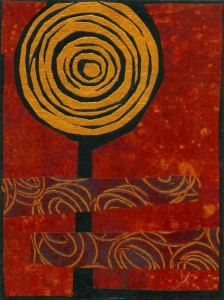

Epiphany 4: In the Realm of the Spirits

Also, I have a new blog endeavor at Devotion Café and would be delighted for you to stop by and visit; click Devotion Café.

And—I’ve recently added a feature that enables you to subscribe to The Painted Prayerbook. If you’d like to receive these blog posts via email, fill in the “Subscribe by email” box in the sidebar (near the top, a bit below my photo). After you submit your email address, you’ll automatically receive an email asking you to confirm your subscription. Once you’ve confirmed this, you’ll begin receiving these reflections.

Using Jan’s artwork
To use the image “Shimmers Within the Storm,” please visit this page at janrichardsonimages.com. Your use of janrichardsonimages.com helps make the ministry of The Painted Prayerbook possible. Thank you!

Using Jan’s words
For worship services and related settings, you are welcome to use Jan’s blessings or other words from this blog without requesting permission. All that’s needed is to acknowledge the source. If you’re using them in a worship bulletin, please include this info in a credit line:
© Jan Richardson. janrichardson.com.

The prose quotations from John O’Donohue are from his book To Bless the Space Between Us.
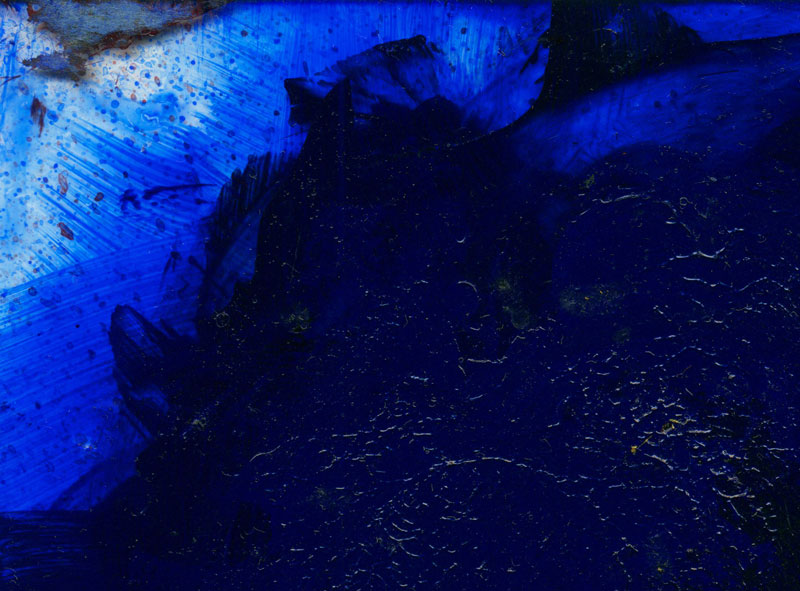
Epiphany 3: Blessing the Nets

January 19, 2012


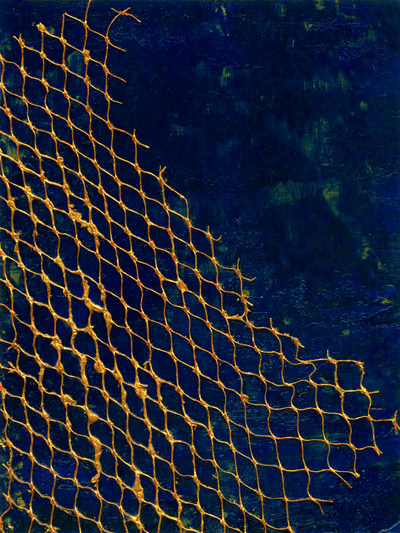
Casting © Jan L. Richardson

Readings for Epiphany 3: Jonah 3.1-5, 10; Psalm 62.5-12; 1 Corinthians 7.29-31; Mark 1.14-20

I marvel at how quickly they leave their nets, these fisherfolk who meet Jesus as they labor by the Sea of Galilee. What do Simon and Andrew hear in Jesus’ voice as he calls; what do James and John see as Christ beckons them to cast aside all they have known?

Perhaps, listening to Jesus, they remember the story of Jonah. Perhaps they think of the first time God called that reluctant prophet, and what happens when we run in the opposite direction of God’s call; how we are likely to wind up in a place that is dark and dank and lonely. A place that presses clarity upon us and inspires us to respond differently—as Jonah does—when the invitation comes again.

Get up, go
God says to Jonah.
So Jonah set out
and went.

Perhaps, encountering this man who immediately compels them, Simon and Andrew and James and John already know in their bones what Paul will later write about in his first letter to the Corinthians: how following Christ will mean letting go of what they have relied upon, will mean living without what they have become attached to.

And those who buy
as though they had no possessions,
Paul says to the church at Corinth;
and those who deal with the world
as though they had no dealings with it.

In the days, weeks, years to come, these four—and the eight soon to join them—will live into that initial burst of letting go. They will learn, and learn again, what it takes to follow Christ: how they will have to continually practice the art of leaving. And in their leaving, in their letting go, they will find their sustenance and their true home.

God alone is my rock and my salvation,
my fortress; I shall not be shaken
sings the psalmist to the Holy One.
On God rests my deliverance and my honor;
my mighty rock, my refuge is in God.

Follow me
Jesus says to Simon—
whom he will name Peter,
the Rock,
infused with God’s own being.

Follow me
he says to Andrew,
to James and to John.

Follow me
Jesus says to us.

What will we say in return?

Blessing the Nets

You could cast it
in your sleep,
its familiar arc
embedded in your
muscle memory
after months
years
a lifetime
of gathering in
what you thought
would sustain you
forever.

You would not
have imagined
it would be so easy
to cast aside,
would never have believed
the immediacy
with which your hands
could release their
familiar grip,
could let it go,
could let it simply continue
its arcing path
away from you.

But when the call came
you did not hesitate,
did not pause,
did not delay
to follow,

as if your body
had suddenly remembered
the final curve
of the arc,

as if the release
begun in your hands
now passed through you
entirely
and you let go
of everything

to cast yourself
with abandon
upon the waiting
world.

P.S. For a previous reflection on Mark 1.14-20, click the image or title below:

Epiphany 3: Hooked

For a reflection on Matthew’s account of this story, see:

Epiphany 3: Catch of the Day

[To use the “Casting” image, please visit this page at janrichardsonimages.com. Your use of janrichardsonimages.com helps make the ministry of The Painted Prayerbook possible. Thank you!]

Baptism of Jesus: A Return to the River

January 6, 2012


Born of Water, Born of Spirit © Jan L. Richardson

Reading from the Gospels, Epiphany 1/Baptism of Jesus: Mark 1.4-11

If you’re celebrating Epiphany this Sunday, scroll down or visit Epiphany: Blessing for Those Who Have Far to Travel.

I kept thinking I was going to be able to create a new reflection and image for Baptism of Jesus Sunday, but I was happily consumed with preparing the retreat for Women’s Christmas and finally had to let go of doing something entirely new for Sunday. If you haven’t visited my reflection on Women’s Christmas (which some folks celebrate on Epiphany) at the Sanctuary of Women blog, I’d love for you to stop by. The reflection includes the mini-retreat (which you can download as a PDF at no cost) that I designed as an opportunity to spend time in reflection on this day. If you can’t take time today, know that the retreat works anytime! Here’s where you can find it:

Celebrating Women’s Christmas

I do have a quartet of previous reflections on the Baptism of Jesus and invite you to visit these. Click on the images or titles below to find them. Do not miss Janet Wolf’s story about the baptism of Fayette in the post Epiphany 1: Baptized and Beloved. Her story continues to bless and haunt me as it challenges me to think about what the sacrament of baptism really means.

Baptism of Jesus: Following the Flow

Epiphany 1: Baptized and Beloved

Epiphany 1: Take Me to the River

Epiphany 1: Ceremony (with a Side of Cake)

I also have a charcoal of the Baptism of Jesus, which originally appeared in The Christian Century magazine. You can find it on my images website by clicking this thumbnail:

Whether you’re celebrating Baptism of Jesus or Epiphany this Sunday, I wish you many blessings!

[To use the “Born of Water, Born of Spirit” image, please visit this page at janrichardsonimages.com. Your use of janrichardsonimages.com helps make the ministry of The Painted Prayerbook possible. Thank you!]

Epiphany: Blessing for Those Who Have Far to Travel

December 31, 2011


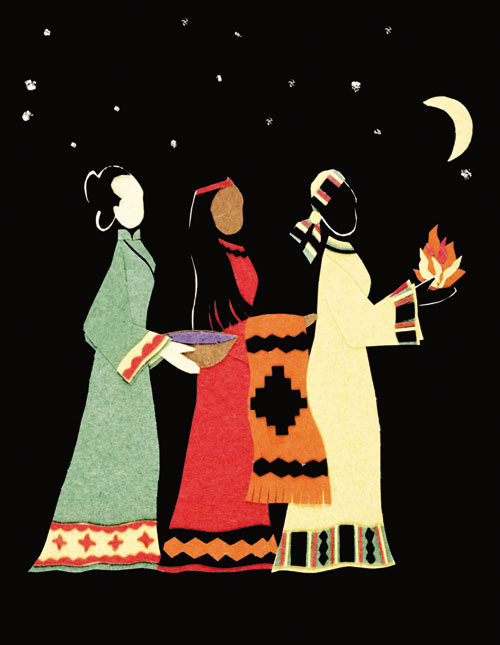
Epiphany © Jan L. Richardson

Reading from the Gospels, Epiphany, Years ABC: Matthew 2.1-12

Merry Christmas to you, still! Because Advent is always such a wonderfully intense time for me, with offering The Advent Door and being engaged in other holiday happenings, I usually arrive at Christmas Day quite spent and ready for a long winter’s nap. I am grateful that instead of being over on December 25, when I’m finally able to take a breath, Christmas is a season—a short one, to be sure, with only twelve days, but a season nonetheless, with its own rhythm and invitations.

This year, the days of Christmas have been for me a time of resting, connecting with family and friends, long walks in the beautiful Florida sunshine, and doing some dreaming about the year ahead. Though the coming months are sure to be marked by surprises, I want to enter the year with some sense of what I’d like for the path to look like, and where I’m feeling drawn to go.

The Christmas season ends with Epiphany, a feast day in which the early church celebrated Jesus’ brilliant manifestation (epiphaneia in Greek, also translated as “appearing”) not only to the Magi but also to the world through his birth, baptism, and first recorded miracle at the wedding at Cana. Eastern Christianity maintains this multifaceted celebration of Epiphany, while we in the West focus primarily on remembering and celebrating the arrival of the Magi, those mysterious and devoted Wise Men who traveled far to welcome the Christ and offer their gifts.

As we travel toward Epiphany and savor the final days of Christmas, this is a good time to ponder where we are in our journey. As we cross into the coming year, where do you find yourself on the path? Have you been traveling more by intention or by reacting to what’s come your way? What direction do you feel drawn to go in during the coming weeks and months? Is there anything you need to let go of—or to find—in order to take the next step? In the coming months, what gift do you most need to offer, that only you can give?

Blessings and traveling mercies to you as we approach Epiphany and the year to come. I look forward to walking with you.

For Those Who Have Far to Travel
An Epiphany Blessing

If you could see
the journey whole,
you might never
undertake it,
might never dare
the first step
that propels you
from the place
you have known
toward the place
you know not.

Call it
one of the mercies
of the road:
that we see it
only by stages
as it opens
before us,
as it comes into
our keeping,
step by
single step.

There is nothing
for it
but to go,
and by our going
take the vows
the pilgrim takes:

to be faithful to
the next step;
to rely on more
than the map;
to heed the signposts
of intuition and dream;
to follow the star
that only you
will recognize;

to keep an open eye
for the wonders that
attend the path;
to press on
beyond distractions,
beyond fatigue,
beyond what would
tempt you
from the way.

There are vows
that only you
will know:
the secret promises
for your particular path
and the new ones
you will need to make
when the road
is revealed
by turns
you could not
have foreseen.

Keep them, break them,
make them again;
each promise becomes
part of the path,
each choice creates
the road
that will take you
to the place
where at last
you will kneel

to offer the gift
most needed—
the gift that only you
can give—
before turning to go
home by
another way.

—Jan Richardson

2016 update: This blessing appears in my new book Circle of Grace: A Book of Blessings for the Seasons.

P.S. For previous reflections on Epiphany here at The Painted Prayerbook, click the images or titles below. Also, the special holiday discount on annual subscriptions to Jan Richardson Images (the website that makes my work available for use in worship and education) will be available through Epiphany Day (January 6). For info, visit Jan Richardson Images.

Epiphany: Where the Map Begins

Feast of the Epiphany: Blessing the House

Feast of the Epiphany: A Calendar of Kings

The Feast of the Epiphany: Magi and Mystery

[To use the “Epiphany” image, please visit this page at janrichardsonimages.com. Your use of janrichardsonimages.com helps make the ministry of The Painted Prayerbook possible. Thank you!]

You Who Bless

November 15, 2011


Christ Among the Scraps © Jan L. Richardson

Reading from the Gospels, Christ the King/Reign of Christ Sunday, Year A: Matthew 25.31-46

“Come, you who are blessed,” Jesus says; “for I was hungry and you gave me food, I was thirsty and you gave me something to drink, I was a stranger and you welcomed me, I was naked and you gave me clothing, I was sick and you took care of me, I was in prison and you visited me.”

You Who Bless

You
who are
yourselves
a blessing

who know
that to feed
the hungering
is to bless

and to give drink
to those who thirst
is to bless

who know
the blessing
in welcoming
the stranger

and giving clothes
to those
who have none

who know
to care
for the sick
is blessing

and blessing
to visit
the prisoner:

may the blessing
you have offered
now turn itself
toward you

to welcome
and to embrace you
at the feast
of the blessed.

P.S. For a previous reflection on this passage, visit Christ Among the Scraps. And Advent is just around the corner! I’m looking forward to spending the coming season at my blog The Advent Door and would love to have your company there.

I also want to let you know that my book Night Visions: Searching the Shadows of Advent and Christmas is back in print! Click the cover below to find out more.

[To use the “Christ Among the Scraps” image, please visit this page at janrichardsonimages.com. Your use of janrichardsonimages.com helps make the ministry of The Painted Prayerbook possible. Thank you!]

Blessing the Talents

November 7, 2011


Buried © Jan L. Richardson

Reading from the Gospels, Year A, Proper 28/Ordinary 33/Pentecost +22: Matthew 25.14-30

Again and again throughout the gospels we see it in Jesus: a persistent bent toward revelation, a hankering to bring into the open what we might be content to leave hidden. Seeing our brokenness and our sins, Jesus challenges us to offer these to the light of God, that they might not fester in the dark and twist toward evil. Seeing our giftedness and the graces that God plants in each of us, Jesus impels us to uncover these, that the power of God may show forth in the world.

“You are the light of the world,” he tells his hearers in Matthew. “A city on a hill cannot be hid. No one after lighting a lamp puts it under the bushel basket, but on the lampstand, and it gives light to all in the house. In the same way,” he urges them, “let your light shine before others” (Matt. 5.14-16). Later he tells them, “Have no fear of them [those who will persecute his followers]; for nothing is covered up that will not be uncovered, and nothing secret that will not become known. What I say to you in the dark, tell in the light; and what you hear whispered, proclaim from the housetops” (Matt. 10.26-27).

A lost coin, a lost sheep, a lost son; a bleeding woman seeking a surreptitious healing whom Jesus cannot allow to remain hidden; children whom the disciples seek to dismiss; gifts once enclosed in the earth that Jesus lifts up to point toward the kingdom of God: with constant persistence, Jesus—this incarnate God who took such visible and vulnerable flesh so that we might clearly see the love that God has for us—tugs at what has been hidden or missing or buried in order to show us how the presence of God shines through it.

And so we see this quality again in the gospel reading for this Sunday, in this parable told by the One who will not be content to let us hide what God has given to us, who urges us to uncover the treasure that God has placed within us, who calls us to show forth the presence of God in the way that only we can.

How do you do this in your own life? Is there anything you allow to hinder the gift of God in you? Is there some gift that you have been willing to let lie dormant because others do not value it, or it seems prideful to you to pursue it, or because you don’t know how to use it, or for lack of time or some other reason? How might you allow God to break through these obstacles for you, so that others can see the presence of God in you in the way that only you can reveal it?

Blessing the Talents

There are blessings
meant for you
to hold onto

clutched
like a lifeline

carried
like a candle
for a dark way

tucked into a pocket
like a smooth stone
reminding you
that you do not
go alone.

This blessing
is not those.

This blessing
will find its form
only as you
give it away

only as you
release it
into the keeping
of another

only as you
let it
leave you

bearing the shape
the imprint
the grace
it will take

only for having
passed through
your two
particular
hands.

– Jan Richardson

P.S. For a previous reflection on this text, in which I confess my fondness for the shovel-wielding servant, visit Parabolic Curves.

[To use the “Buried” image, please visit this page at janrichardsonimages.com. Your use of janrichardsonimages.com helps make the ministry of The Painted Prayerbook possible. Thank you!]

Heart of the Matter

October 16, 2011


The Two Commandments © Jan L. Richardson

Reading from the Gospels, Year A, Proper 25/Ordinary 30/Pentecost +19: Matthew 22.34-46

I came home from a recent trip to the library with an armload of books from the art department. From Arts & Crafts of Morocco to The Art of Japanese Calligraphy to Medieval and Renaissance Art and beyond, the books are providing savory fare for my hungry eyes in this season of needing some new sustenance in my practice as an artist. Today at teatime, my book of choice was Shaker Design, a catalog from an exhibit cosponsored by the Whitney Museum of American Art and the Corcoran Gallery of Art in the 1980s.

June Sprigg, the author of Shaker Design, writes,

The Shakers were not conscious of themselves as “designers” or “artists,” as those terms are understood in modern times. But they clearly worked to create a visible world in harmony with their inner life: simple, excellent, stripped of vanity and excess. Work and worship were not separate in the Shaker world. The line between heaven and earth flickered and danced. “A Man can Show his religion as much in measureing onions as he can in singing glory hal[le]lu[jah],” observed one Believer. Thomas Merton attributed the “peculiar grace” of a Shaker chair to the maker’s belief that “an angel might come and sit on it.”

I am fascinated by the elegant simplicity that the Shakers brought to the work of their hands. The lines of Shaker design seem to emerge directly from their sense of what is most essential; follow the simple curve of a bowl, the uncluttered planes of a cupboard or dresser or table, the weave of a basket, and you can see how it has been created by someone who managed to strip away all that wasn’t necessary, who found the heart of the piece.

As an artist whose work has become increasingly spare the past few years, I am drawn to and challenged by such designs, curious about how others—in a variety of media—have found their way to the lines of their handiwork. Looking at a Shaker chair, a Japanese tea bowl, an Amish quilt, I wonder, What did their makers have to pare away in order to discover what was essential? How did they find their way to the heart of the matter?

It’s these kinds of questions that we see Jesus engaging in this Sunday’s gospel lection. “Teacher,” a lawyer from the religious establishment asks him, “which commandment in the law is the greatest?” Designed to test him, the question nonetheless prompts Jesus to lay out the lines that lie at the core of his life and teaching: “‘You shall love the Lord your God with all your heart, and with all your soul, and with all your mind,'” Jesus says to the lawyer and to the others within earshot. ‘And a second is like it: ‘You shall love your neighbor as yourself.’ On these two commandments hang all the law and the prophets.”

Firmly rooted in his Jewish heritage, Jesus gathers up the wisdom of his forebears and distills it into these two commandments that stand at the center of his history and of our own. He has found the heart of the matter, bringing to light what is most important, what is most crucial and essential in our life together.

Jesus knows that arriving at and living into what is essential is rarely easy. With these two commandments, Jesus extends a call that is compelling in its utter directness and seeming simplicity, yet the work of love—loving God and one another and ourselves, with all the artfulness and creativity this asks of us—can be wildly complicated. Jesus’ words this week get at something I continually experience at the drafting table: arriving at something that appears simple and basic is one of the hardest things to do.

Maybe someday, in one of these reflections, I’ll include a picture of the box of scraps from my drafting table—all those pieces that I pared away, that I chose against, that I let go of in order to find the final design, the essential line, the heart of the matter. In the meantime, I am here to ask you: How do you do this in your own life? Where is Christ’s call to love—this call that draws us into the deepest places in our own hearts, the heart of the world, the heart of God—taking you? How do you sort through all that competes for your attention, so that you can find what is most crucial? What are the challenges along the way, and where do you find the presence of beauty and delight in the lines of your emerging life?

May the heart of God draw you in this week, and may you know the grace and power and beauty that come in discovering the design that God desires for you. Blessings!

P.S. For a previous reflection on this passage, see Crossing the Country, Thinking of Love.

[To use the “Two Commandments” image, please visit this page at janrichardsonimages.com. Your use of janrichardsonimages.com helps make the ministry of The Painted Prayerbook possible. Thank you!]

Taxing Questions, Take Two

October 14, 2011


Taxing Questions
© Jan L. Richardson

Reading from the Gospels, Year A, Proper 24/Ordinary 29/Pentecost +18: Matthew 22.15-22

I’m sorry to be posting so late in the week, but I wanted to bob up to the surface at least briefly to offer a link to an earlier reflection on this Sunday’s gospel lection. You can find it here: Taxing Questions.

Many blessings to you, and may the coming days bring good questions, given and received.