Archive for the ‘lectionary’ Category

Where God Grows

September 21, 2008


Where God Grows © Jan L. Richardson

Reading from the Gospels, Year A, Proper 21/Ordinary 26/Pentecost +15: Matthew 21.23-32

My sweetheart Gary and I spent much of this past week leading a retreat for a wondrous group of folks who were recently commissioned as ministers in the Florida Conference of the United Methodist Church. The retreat took place in Lake Wales at Bok Tower and Gardens, a piece of paradise about an hour and a half south of my home. I hadn’t been there since I was a young child. The first couple of days, I had a vague awareness that something seemed enchanting and familiar about the landscape in that part of the state. Then it struck me: it was the orange groves.

I grew up in north central Florida, in a small community that has preserved the landscape of “old Florida” in a fashion that has become rare. I’m a native Floridian several generations over; my great-grandfather was one of the settlers of the town I grew up in. With his sons he established a farm that remains in operation, and that has helped the town to preserve its rural landscape.

For decades, citrus was one of the mainstays of the farm, and it pervaded the culture of that region. Acres of groves stretched through my hometown and the surrounding area. Just to the south of us were groves whose owner had a citrus shop on the highway that looked out over Orange Lake. (A sign outside the shop proclaimed, “See the famous red bats!” Walking a little way into the grove by the shop, one would come to a small cage that contained…two red baseball bats.) At Silver Springs, a longtime attraction in nearby Ocala, the gift shop offered a plethora of citrus-related items, including pottery infused with the scent of orange blossoms.

Navel oranges were my favorite, and winter always found a bag or two of them stashed outside our back door, staying cool through the season. Fresh orange juice made frequent appearances at our breakfast table, and I loved it when Dad would take a sharp knife, peel an orange and slice it in half for me, and I would sink my teeth into its flesh.

Winter also brought the threat of freezing temperatures and the call that would come late at night, summoning all hands to fire the groves. Too young to join in, I envied my older sister and brother who got to participate in what I imagined to be the excitement of lighting the kerosene heaters that preserved the trees in those freezing nights. I assumed there would be a time when I would be old enough to go.

In the 1980s, a particularly bad freeze hit the groves. The heaters were not enough. We lost the trees, and the landscape of my hometown was forever altered. At the time, I had little awareness of what a loss it was. But these days I miss the presence of the flourishing groves. Even here in Orlando, located in “Orange” County a couple hours south of my hometown, citrus groves are hard to come by, many of them having given way to housing developments. Still, memories of the groves of my childhood linger in my imagination. Visiting Lake Wales this week stirred those memories, conjuring that landscape both real and mythic where the roots of my history remain.

My experience of those citrus groves helps me grasp the presence of the vineyard in next Sunday’s gospel lection. Matthew 21.23-32 is the second in a series of three lections containing parables about vineyards. The repetition got me intrigued and set me to pondering the place of the vineyard not only in this section of Matthew’s gospel but also in the whole of scripture. What is it that Jesus is calling upon here, in his repeated use of this image as a dramatic setting for his storytelling?

In Jesus’ time, the vineyard held a place in the culture that was not only real, being so prevalent in the landscape in that part of the world, but also mythic; it tapped into the people’s collective imagination with a constellation of meanings and associations. In the Bible, vines and vineyards stand for the people of Israel, as in Psalm 80, where the psalmist writes of how God brought a vine out of Egypt, and Isaiah 5, where, in a passage called “The Song of the Unfruitful Vineyard,” the prophet laments, “For the vineyard of the Lord of hosts is the house of Israel, and the people of Judah are his pleasant planting; he expected justice, but saw bloodshed; righteousness, but heard a cry!” Vineyards can be a place of danger; Judges 21 offers the chilling story of how men of the tribe of Benjamin hide themselves in the vineyards of Shiloh, emerging to capture the young women who have come out to dance, and carrying them off as wives. And vineyards are a place of delight, which is nowhere as evident as in the Song of Songs: “Come, my beloved,” the bride sings in chapter 7, “…let us go out early to the vineyards, and see whether the vines have budded….”

The vineyard offers elemental metaphors of fertility and fruitfulness. It is, at times, a profoundly feminine image, as in the Song of Songs, where it becomes identified with the bride’s own body. The vineyard is a place where both labor and love take place. Though it may be a place of harm, as we will see with particular clarity in next week’s gospel lection, it is a space where right relation becomes possible, as evidenced between the lovers in the Song, between God and the people of Israel, and, as we will see in John’s gospel, between Jesus and his followers (“I am the vine, you are the branches”).

For Jesus’ hearers, the vineyard grew not only in the landscape of their daily lives but also in a mythic landscape that stretched back for generations: the book of Genesis tells us that Noah was the first to plant a vineyard. Its tendrils also twined forward into a future where redemption would take place: “I will restore the fortunes of my people Israel,” God says in Amos 9.14; “…they shall plant vineyards and drink their wine….”

In setting this trio of parables in vineyards, Jesus subtly conjures all these associations. Though his hearers likely would not have consciously thought of each of these layers of meaning as he told these stories, the fact that the image of the vineyard was deeply embedded in their personal and collective memory would have shaped their reception of these parables.

All this has me wondering about how we hear the parables of Jesus in a context where so many of us live so distant from the settings that grounded his stories. I’ve spent little time in vineyards, save for the small bower of muscadine and scuppernong grapes that grew in my grandparents’ yard. Having grown up among the groves, however, I can appreciate how a landscape roots itself in one’s imagination, how it intertwines with personal and shared history, how it can be so easily evoked decades later, how it helps me enter into certain stories.

How do we hear these sacred stories that are rooted in an agrarian landscape that fewer and fewer of us inhabit? How do we receive the imagery of the Bible when we are cut off from so many of the sources that imbue those images with meaning? Think of them: not only vineyards, but also pastures, flocks, wellsprings, gardens, fields. And not only agrarian images, but other images as well that speak to what it means to be community together. What does the idea of church as a household mean, when home life for many folks is a fragmented experience? And what does the table of Communion conjure, when families eat in shifts as their schedules demand, or when we eat alone?

It would be easy, perhaps, to slide into a rant about how we’ve lost the sources that nourish our imagination, to lament how so much of our 21st century culture has divorced itself from the landscapes, both real and metaphorical, that cultivate a mythic memory. I’m not particularly interested in ranting here (though I’m not above tilting into a good one once in a while). I’m more interested in asking questions about how we in the church work to create spaces and rituals that cultivate the imagination, that nourish and call on our collective memory, that lay down the layers of sensory experience that help us connect with the sacred stories our tradition gives us.

I am alarmed by churches that, in an attempt to be welcoming to newcomers, strip their spaces of the symbols and rituals that link us to our shared story. I understand and affirm the desire to create a hospitable space for those who are unfamiliar with the terrain, but I don’t think we do this best by erasing the environment that helps evoke the stories.

We don’t tell the story well by trying to be overly efficient about it, either. I was talking recently with someone who lamented how her church rarely celebrates Communion, out of a belief that there’s “not enough time” to give to this central ritual that, when well done, engages every one of our senses, and thereby takes hold of us in a way that hearing alone, or seeing alone, cannot.

In a culture where so many of us are separated from the experiences and images that imbued Jesus’ hearers with understanding, our church communities can be places that provide other kinds of experiences that still link our senses, our memories, and our imaginations with our sacred texts. How do we draw one another into the mythic spaces that the scriptures offer? How do we ground one another’s hearing and reading of these scriptures in experiences that involve our seeing, hearing, touching, smelling, tasting? How do we cultivate a landscape that lingers in the memory like a vineyard, a grove, a space that, decades later, can still conjure a connection with the Divine who dwells both in the imagination and in daily life?

In telling this parable about the father who asks his sons to work in the vineyard, Jesus makes the poetic and prophetic point that the kingdom of God is open to all, including those whom many of Jesus’ hearers would have considered unworthy: prostitutes, tax collectors. He insists that even—and especially—those who have spent most of their lives pursuing other intentions belong in this space of redemption, relationship, fruitfulness, and delight. For all its seeming orderliness, the vineyard is a place of God’s wild grace. Perhaps only those who know the deep, unsated hunger that the world instills can ever, finally, understand and receive that.

In our 21st century world, how do we convey this kind of grace that God extends to all? How do we describe and evoke the ways that God calls us to give ourselves not only to the labor but also the delight that the image of the vineyard conjures? How does this parable resonate in your own memory and imagination? With what images, practices, and rituals do you invite others to connect with our sacred stories?

These aren’t rhetorical questions; I’d love to hear how you do this, or how you long to. It seems an especially fruitful time to ponder these questions in this month when, in the northern hemisphere, the harvesting of wine grapes is taking place, often accompanied with festivals. (The fact of which gave rise to September’s full moon being known as the “Wine Moon” in some quarters.) In this season, may the wild grace of God make itself known through all your senses. Blessings.

[To use the “Where God Grows” image, please visit this page at janrichardsonimages.com. Your use of janrichardsonimages.com helps make the ministry of The Painted Prayerbook possible. Thank you!]

A Vineyard of One’s Own

September 14, 2008


© Jan L. Richardson ◊The Painted Prayerbook◊

One of the cool things about going to The Grünewald Guild each summer is that it offers an opportunity to see what other artists are doing. One of the challenging things about going to the Guild each summer is that it offers an opportunity to see what other artists are doing. Coming into contact with creative folks is a two-edged sword: even as it supplies inspiration and camaraderie in a vocation that requires much solitude, it can also provide an opening for envy to seep in.

Take my friend Gilly. Gilly regularly comes over from England to teach at the Guild. As if having a fabulous accent weren’t enough, she’s also a fantastic artist. Much of Gilly’s work involves painting on fabric. Oftentimes, really big pieces of fabric. In churches, in her local theological school, and in other settings, Gilly creates large-scale pieces that both evoke and invoke a sense of the sacred.

Folks who teach at the Guild have an opportunity to give an evening presentation in which we share what we’ve been working on. This year, Gilly offered a PowerPoint presentation that contained images of her work, both in progress and completed. I was taken in particular by a series of large painted fabric pieces inspired by St. Patrick’s Breastplate, that remarkable prayer for protection attributed to the patron saint of Ireland. As Gilly described creating the pieces, and how she has used them with groups, I felt a stab of envy. For nearly a year the main artwork I’ve done has been the collages for this blog, which are 3 x 4 inches. I love working small right now. Particularly after completing a commission last year that was 4½ x 6½ feet, took nearly two years to do, and was a real trick to create in my 300 square foot studio apartment, the wee collages have been a wonderful way to explore some new directions and techniques in a more manageable and intimate fashion. But listening to Gilly, and seeing her images, it was hard not to compare. I envied her talent, her vision, her access to a church and a school where she could explore and offer her gifts. I envied her having a space that enabled her to create such large pieces.

I’ve been thinking about Gilly as I’ve pondered next Sunday’s gospel lection, Matthew 20.1-16. This passage is part of the conversation that Jesus has with the disciples following his encounter with the rich young man who asks him what good deed he must do in order to have eternal life. In talking with the disciples, Jesus tells a parable about a vineyard owner who hires laborers in the early morning, making an agreement to pay them the usual wage. He goes out to hire laborers again at 9:00, noon, 3:00, and 5:00, telling them he will pay them what is fair. When quitting time comes in the evening, the owner begins to pay them, starting with those he has most recently hired and working his way back to those he brought in first. Hearing that he paid the latecomers the full daily wage, the early birds are full of anticipation, then seething with resentment when he pays them the same wage. When they begin to grumble, he reminds one of the workers of their agreement. “Take what belongs to you,” the vineyard owner says, “and go; I choose to give to this last the same as I give to you. Am I not allowed to do what I choose with what belongs to me? Or are you envious because I am generous?” I like how the King James Version renders that last question: “Is thine eye evil, because I am good?”

In talking about this parable, we often use it as a way to describe not only the wideness of God’s mercy but also the wildness of it. We acknowledge how God’s sense of justice doesn’t always match our own, and how the grace of God is lavish and limitless, extending in an equally drenching measure to each person, irrespective of status. We admit that we don’t always understand the way that God’s love works, and that we are sometimes embarrassed by how much greater and deeper God’s generosity is than our own.

Even as I know and acknowledge these things, and am aware of how God tends to work with such incomprehensible mystery, I find myself lingering with the complaint of the first-come workers. The owner is right, of course; it’s his prerogative, he’s paid them the wage they agreed upon, they have no real cause for griping just because someone else got a sweeter deal. All the same, I resonate with their sense of indignation. I want to fix it for them. And not by negotiating with the owner for better wages. Rather, I find myself wanting to step into the story and say to the workers, “Oh, for Pete’s sake, get your own darned vineyard!”

I recognize the class issues that might have precluded day laborers’ purchasing a vineyard in that society. But for me, pondering this passage here in my 21st-century life, Jesus’ parable prompts me to ask, What does it look like to cultivate a vineyard of one’s own? How do we create a place in our lives where we aren’t beholden to others, subject to their whims? Where do we experience the freedom and the focus to tend a vision that God has given us, using all the gifts that God has provided us?

I’m not suggesting that cultivating one’s own vineyard means giving up the structures that provide income and some measure of security and stability. (I’m not suggesting it doesn’t, either.) As someone whose call led me to a nontraditional ministry that involves raising my entire income, I’m really clear about the kind of discernment that needs to go into making the big decisions about what work we will give our hands to, and how we will find support to do this, and what kind of structure we need. Yet whatever field God calls us to labor in, God also calls us to cultivate a space of freedom, a place where we have room to explore and discover and create what will bring sustenance and delight for ourselves and for the world—as vineyards are meant to do. I’ve found that creating such a place often involves piecing it together a scrap at a time. In forming connections, in cultivating relationships that sustain us, in moments of insight and inspiration, in making creative choices, in becoming clear about the work that’s uniquely ours to do, in doing whatever is necessary to do that work, in finding allies who can help us: in each action, we find another patch of the vineyard to which God beckons us.

Obsessing about what others are doing and constantly comparing our work to theirs distracts us from our own work of cultivation. Left unchecked, envy saps our energy, robs our creative focus, and eats us alive. I appreciate the way that Bonnie Friedman writes about this in her book Writing Past Dark: Envy, Fear, Distraction, and Other Dilemmas in the Writer’s Life. She asks,

What is this thing that can take the best from us and yet remain unsatisfied? When I think of envy, I think of Pharaoh’s lean cows [from Pharaoh’s dream in Genesis 41]. They eat up the healthy ones—cannibals, those cows!—yet they remain as skinny as ever, so that, the Bible tells us, ‘when they had eaten them up, it could not be known that they had eaten them; but they were still ill favored, as at the beginning.’ I’ve always felt sorry for those cows. We’re told they’re poor and lean-fleshed, emaciated and ugly. They feed, but cannot digest. They are unhealthy desire incarnate.

Friedman closes her chapter on envy by writing, “The antidote to envy is one’s own work. Always one’s own work. Not the thinking about it. Not the assessing of it. But the doing of it. The answers you want can come only from the work itself. It drives the spooks away.”

Maybe that’s what Jesus is trying to say, really, in telling this parable about the vineyard. He wants to remind his hearers that whatever circumstances we are in, we find a measure of power in staying focused on discerning and doing the work that is ours to do. Cultivating that quality and depth of attention is its own kind of vineyard.

The stab of envy can be painful, but its knife has a way of laying us bare and revealing to us what we need to work on. It’s a tool for cultivating the vineyard. When I acknowledge the presence of envy and let it do its piercing work for a limited time, it opens up room both to explore new directions that other artists inspire me toward, and also to renew my commitment to what I am uniquely called to do.

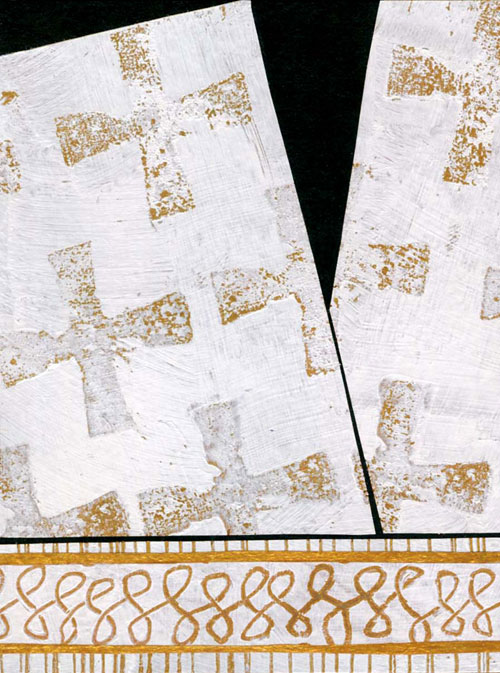
Who knows, maybe one day I’ll get desperate enough to knock out one of the walls of this cozy apartment, unroll a bolt of fabric over the side until it touches the driveway below, and start painting. Until then, I’m keeping my eye on these bits of painted paper, piecing them together inch by inch. There’s a vineyard in here somewhere.

How about you? Does envy surface in your own life? What triggers it? What message or invitation does it hold for you? What kind of vineyard are you cultivating, or longing to? Who can help? Whom can you help to do this?

Wishing you peace and sustenance and delight as you tend what is yours.

Seventy Times Seven and Nine-Eleven

September 7, 2008


Seventy Times Seven © Jan L. Richardson

Reading from the Gospels, Year A, Proper 19/Ordinary 24/Pentecost +13: Matthew 18.21-35

Well, now that I’m back from my long weekend with the Labor Day chicks, I have to face it: summer is over. Though it’s still hot as blazes here in Florida, returning from my time with the women means it’s time to shift into a new rhythm. There’s much to look forward to in the fall, but the transition is a bit bittersweet.

The calendar of the liturgical year, however, tells us that we’re still in the season of Ordinary Time. We have nearly three more months of it, in fact. Though we’ve been navigating this season for a good while, the gospel lections aren’t getting any easier. If anything, they’re growing more challenging. Ordinary Time takes us into the heart of Jesus’ teachings, where there is plenty to stretch and sometimes stump us. Next Sunday’s gospel lection provides an excellent case in point.

This passage follows on last week’s reading, which Jesus concluded by assuring us that wherever two or three are gathered in his name, he is in our midst. Peter, however, doesn’t allow us to linger in that moment. He knows that such concord and communion will not be a constant state among Christ’s followers. And so Peter asks Jesus, “Lord, if another member of the church sins against me, how often should I forgive? As many as seven times?” In the Bible, the number seven is often used to signify perfection, completeness, wholeness: seven days in the first story of creation, the seven pillars of Wisdom’s house, seven churches in the book of Revelation. Mark and Luke tell us that Jesus cast out seven demons—a perfect complement—from Mary Magdalene. (“A demon for every day of the week,” Kathleen Norris writes, “how practical; how womanly.”) Yet when it comes to forgiveness, seven is not complete enough for Jesus. “Not seven times,” he says to Peter, “but, I tell you, seventy-seven [or seventy times seven] times.”

We sometimes hear this passage as referring to a situation where a person is persisting in sin, causing harm again and again, compelling our forgiveness anew with each occurrence. I wonder, though, whether Jesus is instead acknowledging that in the life of the community, we will sometimes have to make multiple attempts to forgive a single act of harm. I suspect that Jesus well knew that forgiveness is an act—and an art—that we would have to work at. Again. And again. And again.

In this passage, Peter is asking specifically about forgiveness in the context of one’s intimate community. The word he uses here, adelphos, refers to a brother or fellow believer. He’s talking about sin that comes by the hand of one who is part of our circle, our kindred. We sometimes feel this brokenness all the more sharply because it comes from a source so close to us, where there are habits of familiarity and bonds of trust. This kind of sin tests the connections of a community to the limit.

The word forgive comes from aphiemi, a Greek word with a rich constellation of meanings that extend to financial, relational, and physiological matters. Aphiemi can mean to remit, to give up a debt, to keep no longer. We can translate it as leave behind, let go, forsake, divorce. In Matthew 27.50, it’s what Jesus does with his spirit; he gives it up, releases it. Aphiemi is a powerful word that speaks of loosing our hold on something or someone, to renounce our claim to it.

To forgive someone involves a releasing, a letting go, that is countercultural. This kind of act goes against the grain of a society where one of the primary ways we gain power is by accruing debts owed to us, obligations not just of money but also of time, favors, and other things that we think are owed us.

Forgiveness is such a radical and challenging practice that, as is his way, Jesus has to tell a story to try to explain it. He describes a servant who owes his king a staggering sum of money that he cannot pay. The king threatens to sell him, his family, and all his possessions. Pleading with the king, the servant receives extravagant mercy but fritters it away when he refuses to forgive a small debt that a fellow servant owes him. When the king hears of it, he hands him over to be tortured until he pays his debt in full.

Jesus caps the parable by telling his listeners, “So my heavenly Father will also do to every one of you, if you do not forgive your brother or sister from your heart.” It seems a harsh turn in the tale, with Jesus invoking an image of God as a torturer. Yet the truth is that it doesn’t take God to inflict pain on us for our refusal to forgive; suffering is a natural effect. The context of the parable makes sense, with its images of servitude, imprisonment, torture, and complex tiers of power. By what we refuse to forgive, we place ourselves in bondage.

Refusing to forgive someone who has harmed us often holds deep appeal because it is, in part, a path that seems to offer us a measure of control. This becomes particularly true in situations where the hurt has come from someone who has more overt power than we do. Our refusal to forgive may seem like the only way we can have any power. Yet as in the parable, our lack of forgiveness can eventually become a prison that not only holds the other person but our own selves.

Jesus never claims that forgiveness compels us to accept the behavior of one who has caused harm. He never tells us that forgiveness means saying that everything is okay or remaining with someone who persists in wounding us. In challenging us to forgive, he acknowledges that we may not be able to change the behavior of another, or to alter what they have done, but that we have power over how we will respond. To offer forgiveness means that we refuse to allow another’s sin to control us, to hold us, to bind us.

I’m intrigued that this parable should turn up in a week that holds the date of September 11. Amid the stark images and memories this anniversary stirs up, Jesus’ words remind me how important it is to persist in practicing the art of forgiveness, to work to keep my heart clear, to refuse to allow the destructiveness of another to colonize my soul. Forgiveness is an act that I can’t always conjure on my own. It instead requires a curious combination of work and grace. For my part, I have to cultivate an openness to the possibility. Sometimes it means asking to want to forgive, long before I actually do it, because I can’t always summon even the desire to forgive. But the forgiveness itself, that ability to release, to let go, to loose the bindings: that is purely the graceful work of God who does the same for me.

In this week of September 11, what might God be challenging you to loose your hold of? Is there pain, resentment, or anger occupying precious terrain in your heart? Is there any harm you are holding onto? Where is God in that for you? How might God be wanting to hold that for you, and to begin to release its hold on you?

In this and all weeks, blessings.

[To use the “Seventy Times Seven” image, please visit this page at janrichardsonimages.com. Your use of janrichardsonimages.com helps make the ministry of The Painted Prayerbook possible. Thank you!]

For What Binds Us

August 31, 2008


For What Binds Us © Jan L. Richardson

Reading from the Gospels, Year A, Proper 18/Ordinary 23/Pentecost +12: Matthew 18.15-20

If you have arrived here via The Text This Week, welcome! For my new reflection on this passage, please visit Where Two, Where Three.

Writing this, I’m sitting on the porch of a house on an island off Savannah, Georgia. Inside the house are the women with whom I spend each Labor Day weekend. From time to time I can hear their voices from where I sit; they are in the kitchen fixing dinner, or watching the game on TV, or talking at the table. These women are some of my closest friends from seminary. I have loved them nearly half my life. The seven of us are scattered across the Southeast: Florida, Georgia, Tennessee, North and South Carolina. We cross paths rarely during the rest of the year, but, in a tradition that began while we were still in school nearly two decades ago, we gather annually for several days of talking and eating and talking and eating and reading and napping and eating and did I mention talking?

Each of us is engaged in some kind of ministry. Most of us serve in settings beyond the local church, but all of us are connected with a congregation. And so, whenever we’re together, much of our talking has to do with church, and with all that comes from being part of a community still learning to be the body of Christ. Our stories reveal our awareness of the possibilities and painfulness that come with those relationships. We know how these communities can both call forth and stir up all that we are capable of as humans; we have seen the glory and the gore that come in attempting to be the church.

In our gospel lection for this Sunday, Jesus speaks to the challenge and the wonder of being in community. He recognizes that being his follower, being part of his body, will not relieve us of brokenness. Jesus is clear that being Christian doesn’t mean avoiding conflict, and that discord should not be allowed to fester and infect the entire body. He lays out a plan that requires his followers to engage a brother or sister who has done harm. His plan is one that seeks to preserve the dignity of the one perceived to have done wrong and to restore his or her relationship with the community.

Jesus’ blueprint for dealing with conflict is an ambitious one. It places a lot of trust in a church’s ability to discern what constitutes a sin and to deal with one another in ways that are both forthright and loving. I appreciate that he thought his followers could be this mature.

We Christians haven’t always been so good at this. In the presence of brokenness among the body, we have often either avoided making a direct response, or we have inflicted punishment that precludes ongoing relationship.

To engage one another in the way that Jesus describes in our gospel lection poses challenges on several fronts, not least of which is that we don’t always agree on what constitutes a sin. For another, we each have our own sins to reckon with, and times when we act out of our brokenness rather than our lovingness. It’s often so much easier to point toward what we see as sinful in another’s life than to deal with the ways that we ourselves bring harm to the body of Christ. Jesus knows this, too. It wasn’t so many chapters ago that he said, “Why do you see the speck in your neighbor’s eye, but do not notice the log in your own eye?” (Matthew 7.3)

Dealing with the sources of conflict in the church requires such profound humility on our part. We find this kind of humility in this story of Abba Moses, a desert father who spent much of his earlier life as a robber:

A brother at Scetis committed a fault. A council was called to which Abba Moses was invited, but he refused to go to it. Then the priest sent someone to say to him, ‘Come, for everyone is waiting for you.’ So he got up and went. He took a leaking jug, filled it with water and carried it with him. The others came out to meet him and said to him, ‘What is this, Father?’ The old man said to them, ‘My sins run out behind me, and I do not see them, and today I am coming to judge the errors of another.’ When they heard that they said no more to the brother but forgave him. (Benedicta Ward, The Sayings of the Desert Fathers.)

Being people of humility and forgiveness doesn’t mean doing away with discernment; after all, Abba Moses also cautioned, “Do not put confidence in him who does wrong to his neighbour, do not rejoice with him who injures his neighbour.” The health of the community requires us to be vigilant about rooting out the sources of harm. Yet Christ calls us to do so with a spirit that acknowledges our own brokenness and shortcomings and seeks to restore relationships wherever possible.

Engaging one another around the most difficult challenges of living together means that we have to know each other. It compels us to see one another with a clarity by which we not only recognize one another’s shortcomings but also know each other’s stories. This clarity grows elusive in a culture where face-to-face connections are becoming more difficult to form and maintain. It requires effort and intention to seek and sustain such seeing. My days with the women of this Labor Day group remind me how much the effort is worth. These women call me to remember what is possible among people who know one another this well, who know the questions to ask, who know how to challenge and sustain and accompany and love one another into being.

Jesus recognized the power of this kind of knowing. For all the challenges of conflict in a community, the power of concord is stronger. “Truly I tell you,” Jesus goes on to say in this passage, “if two of you agree on earth about anything you ask, it will be done for you by my Father in heaven. For where two or three are gathered in my name, I am there among them.” Where we find a place of connection amid conflict, where we gather in the name of the one who calls us to be his body, where we give ourselves to knowing one another: that is not only astounding, it is a miracle that moves heaven and earth.

Jesus underscores this by telling his followers what he has recently told Peter: that what they bind on earth will be bound in heaven, and what they loose on earth will be loosed in heaven. Jesus’ phrase about binding and loosing come from the rabbinic tradition, in which rabbis had the power to discern whether a questionable action would be permitted under the law. Yet in the context of this passage about our life together as followers of Christ, his words about binding and loosing prompt me to ponder what connects us, those threads that seem so strong and slack by turns. I think of Jane Hirshfield’s poem “For What Binds Us,” how she describes the scars that grow from our loving of one another, how those scars become cords that create “a single fabric that nothing can tear or mend.”

So, on this September day, what binds you? What holds you together with others? What do you fashion from the scars you carry? What do you long for in your relationships? What are you willing to do to find or create it? Who can help?

In your binding and loosing, in the conflict and concord that come in your loving: blessings.

[To use the “For What Binds Us” image, please visit this page at janrichardsonimages.com. Your use of janrichardsonimages.com helps make the ministry of The Painted Prayerbook possible. Thank you!]

To Have without Holding

August 26, 2008

Image: To Have without Holding © Jan Richardson

Reading from the Gospels, Year A, Proper 17/Ordinary 22/Pentecost +11: Matthew 16.21-28

One summer when I was preparing to become a minister, I spent the season doing a unit of Clinical Pastoral Education at a hospital in north Florida. CPE is something like an intensive internship in a setting that intertwines pastoral experience and regular reflection with a peer group and supervisor. During our orientation at the beginning of the summer, all the CPE interns toured the various units of the hospital. When we visited the Neonatal Intensive Care Unit, one of my colleagues asked, “How frequently do you have to deal with the death of an infant?” The nurse said, “Oh, we haven’t had a death in ages.”

I was assigned to the NICU for the summer. During my first three weeks, I received four calls for severely premature infants who had died.

In addition to the NICU, I also worked in Pediatric Surgery. Most of the patients had short stays, but I spent a fair bit of time with several who were there for longer visits. Midway through the summer, several of them were discharged on the same day. For most of them, leaving the hospital was great news; they were going home and settling back into a normal rhythm of life. One young boy, however, was not going home. An eight-year-old battling a tenacious spinal tumor, he was moving to a rehab center because he didn’t have a stable home to return to. The day I had met him, I knew he was going to be the one who broke my heart that summer. He was the last one I went to say good-bye to on that day of multiple leave-takings. Afterward, I went down to the river that runs by the hospital. We had sometimes gone there because he liked to watch the trains that passed nearby. I wept for all the good-byes the summer had held, not just within the hospital but beyond it as well.

I thought I had done a good job of collecting myself, but when I went back to the CPE office, the secretary took one look at me and said, “You know what you need to learn, Jan? Oh, what’s that word—detachment.” I bit back a sharp retort. Even at that early point in my pastoral formation, something in me knew that it wasn’t detachment I needed to learn, at least not in the way she was talking about. In that season of farewells, I was coming to see that my work lay in learning how to be fully present to people in whatever way was necessary, to let them draw near, and then, when it was time, to let them go with whatever grace I could muster.

The good-byes never get easy, of course, particularly when they seem premature. So I can really appreciate Peter’s predicament that we encounter in this week’s gospel lection, Matthew 16.21-28. Jesus has turned his face toward Jerusalem and, in so doing, he begins to tell the disciples what awaits him there. Peter cannot abide Jesus’ talk of his coming death. Taking Jesus aside, he remonstrates with him, saying, “God forbid it, Lord! This must never happen to you.” Jesus doesn’t bite back his response. He scolds Peter severely. “Get behind me, Satan! You are a stumbling block to me; for you are setting your mind not on divine things but on human things.”

With breathtaking speed, Peter has gone from being called a rock to a stumbling block. Jesus’ upbraiding of him seems harsh, yet the level of energy he puts into it reflects how important he considers it that Peter understand what he says. Peter, to whom he will give the power of binding and loosing, must learn to let Jesus go.

Jesus is concerned not only that Peter and his companions let him go but also that they learn to release their hold on their own selves. Turning toward the rest of the disciples, Jesus tells them, “If any want to become my followers, let them deny themselves and take up their cross and follow me. For those who want to save their life,” he says, “will lose it, and those who lose their life for my sake will find it.”

Self-denial is a tricky practice, and the Christian tradition hasn’t always done a good job of teaching it. It can be hard, after all, to wrap our brains around the idea that self-denial doesn’t mean giving up who we are at our core, the self that God created us to be. Rather, Jesus’ words here call us to recognize and release whatever hinders us from full relationship with God and one another. Self-denial challenges us to know the stumbling blocks within our own selves. It beckons us to open ourselves to the one who is the source and creator of our deepest self. And self-denial compels us to ask ourselves, “What are the actions, what is the way of being, that will leave the greatest amount of room for God’s love, grace, and compassion to move in and through me?”

The answer to that question won’t be the same for everyone, and that’s another thing that has made self-denial so tricky in the Christian tradition. A single form of self-denial won’t fit for all, and one of the greatest ways we can harm ourselves and others is to follow a path that’s not meant for us.

The desert fathers and mothers of the early church, who flung themselves into a physical and spiritual landscape designed to strip away all that separated them from God, had long practice in discerning the way of life that God intended for them to follow. In Benedicta Ward’s The Sayings of the Desert Fathers, Abba Macarius tells a story of meeting two monks, quite naked, who have spent forty years on a tiny island in a sheet of water where the animals of the desert come to drink. At first Macarius thinks the men are spirits, so strange is their presence there. Learning that they are monks of flesh and blood, he asks them, “When the winter comes are you not frozen? And when the heat comes do not your bodies burn?” They tell him, “It is God who has made this way of life for us. We do not freeze in winter, and the summer does us no harm.”

It is God who has made this way of life for us. They know that their way is not for all monks, just as Macarius’s way is not the path that God has made for them.

Jesus tells the disciples, “Let them deny themselves and take up their cross.” He doesn’t say that his followers should take up the cross that will be his own to bear, or that we should carry a cross that someone else has forced upon us. Rather, Jesus compels us to find the particular path that will enable us to do the work of giving up all that separates us from God, from one another, and from our deepest selves. As Peter learned, this includes releasing our desire to dictate the actions of others in ways we are not meant to do, and letting go of our attachment to outcomes that lie beyond our control. “To have without holding,” poet Marge Piercy puts it. In one of the great paradoxes of the spiritual path, it’s this kind of denial—this kind of detachment—that makes way for our deepest connections.

So what are you attached to just now? How do you know when a treasured expectation, desire, or relationship has become a stumbling block? Who or what helps you recognize these blocks? What might you build from them? Can you imagine what lies beyond them?

In your loving and letting go, may you find the way of life that God has made for you. Blessings.

[To use the image “To Have without Holding,” please visit this page at janrichardsonimages.com. Your use of janrichardsonimages.com helps make the ministry of The Painted Prayerbook possible. Thank you!]

The Thin Man

August 19, 2008


A Thin Place © Jan L. Richardson

Reading from the Gospels, Year A, Proper 16/Ordinary 21/Pentecost +10: Matthew 16.13-20

When I was in seminary, one of my professors threatened each year to give a Rock of Ages award to the student who made it through their theological education the least changed. We didn’t have such folks in abundance, but they were evident in each class: those who were present solely because their church or denomination required that they have a seminary degree. Sticking it out until they had that parchment in hand, these classmates went through the motions of education but remained impervious to the transformation that it offered.

Though Jesus refers to Peter as a rock in this week’s gospel lection, I suspect that Peter would have eluded such an award as my seminary professor threatened to give. Matthew tells us that Jesus and the disciples visit Caesarea Philippi, where Jesus, after asking his companions who others say that he is, then turns the question on them: “But who do you say I am?” Simon Peter, in a dazzling moment of clarity and insight, tells Jesus, “You are the Messiah, the son of the living God.”

Jesus is elated by Peter’s insight, and he begins to lay a blessing on him. He opens with calling him Simon, harking back to his follower’s former name. Jesus goes on to tell him, “You are Peter, and on this rock I will build my church, and the gates of Hades will not prevail against it.” Jesus’ naming of Peter plays on the Greek word for rock, petra; his name is sometimes translated as Cephas, from kepha, the Aramaic word for rock.

Peter, however, is a rock of a different sort. Unlike the folks who were candidates for my professor’s Rock of Ages award, Peter is not impervious to change. He exhibits his own points of resistance, to be sure, but he also harbors a fundamental openness to the transformation that Jesus offers. Jesus recognizes that Peter is still in formation. This disciple will yet do things that will provoke Jesus’ ire and disappointment. The human and earthy still run deep in Peter. Yet Jesus glimpses strength within him, and an openness that he knows will become a habitation for the holy.

Pondering this Petrine passage, I find myself thinking of Jacob in the wilderness. Genesis 28 describes how Jacob, having fled for his life, finds himself in a place between the home he has known and the life that is yet ahead of him. As darkness falls in that place, Jacob settles down to rest, laying his head upon a stone. During the night, he dreams of a ladder stretched between earth and heaven, with angels ascending and descending the ladder. He becomes aware of God standing beside him, offering words of promise and sustenance. Waking, Jacob cries, “Surely the Lord is in this place—and I did not know it!” He takes the stone he had used for a pillow, sets it up as a pillar, and pours oil on top of it. Jacob renames the place Bethel: House of God.

Jacob’s stone marks that spot as a thin place, to borrow a notion from Celtic traditions. Celtic folk have long held that in the physical landscape and in the turning of the year, there are places where the veil between worlds becomes thin. It’s not that God is somehow more present in those places, as if God could be more there than elsewhere; rather, something in those places and times invites us to be more present to the God who is always with us. We open, and we see.

Jesus names Peter the rock. In doing so, Jesus signifies that he both recognizes what is within Peter and is also calling forth what has yet to take form in him. In an action that echoes Jacob’s sacramental gesture, Jesus pours a blessing like oil upon Peter. After telling Peter that he will build his church—a house of God—upon him, Jesus goes on to say, “I will give you the keys of the kingdom of heaven, and whatever you bind on earth will be bound in heaven, and whatever you loose on earth will be loosed in heaven.” His words have the tone of incantation, of ceremony, of one who is initiating another into a sacred role. And, in fact, “binding and loosing” are words that come from the rabbinic tradition; they refer to what happens when a question arises about whether an action may be permitted. Steeped in the law, the rabbis had the power to determine which actions would be forbidden (bound) and which would be allowed (loosed). Jesus confers power upon Peter, an authority so profound that what Peter does will have import in both heaven and earth.

Like Jacob who recognized the presence of God in that in-between place, Peter knows Jesus in an instant of brilliant clarity. Where Jacob turned his stone into a sacrament and renamed that place the House of God, Jesus marks this moment by blessing his disciple and renaming him as a rock who will become a dwelling place for God. Peter himself becomes a thin place; within him meet the things of heaven and the things of earth. What Jacob knew, Jesus knew: this is a place upon which to build something holy.

And so I am asking myself this week, what is solid within me? What do I contain that would serve as the ground for a holy place, a sanctuary? How do I allow sacred ground to inhabit me even as I remain open to transformation, to change, to renovation and renewal? How does this happen for you? What thin place might God be seeking to create in the midst of your life and your own being? What might we need to let go of in order to make room for such a space?

May you recognize the holy in your midst this week, and be a place for it to dwell.

[To use the “A Thin Place” image, please visit this page at janrichardsonimages.com. Your use of janrichardsonimages.com helps make the ministry of The Painted Prayerbook possible. Thank you!]

The Feast Beneath

August 15, 2008


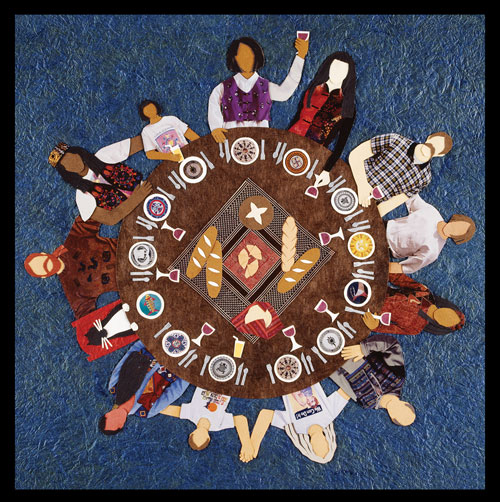
The Feast Beneath © Jan L. Richardson

It took a couple of days to get here, but I’ve made my way back from my sojourn at The Grünewald Guild. My travels home included hitching a ride from the Guild with a friend who lives near Seattle. En route we stopped by her sister’s home and had a mid-afternoon meal that involved homemade tortillas and salsa, courtesy of her in-laws who were visiting from Texas, yum. Midway through the meal we were joined by a gaggle of girls—my friend’s nieces and their cohorts. One of the girls was sporting a decorative Band-Aid, and another commented on how the Band-Aid had migrated from her lower arm to her upper arm. Another girl said the Band-aid was for an imaginary wound. The girl next to me, all of ten years old, dryly observed, “Yeah, those things hurt.”

I’m not sure when it happened, probably because it evolved so slowly, but somewhere in my adulthood I began to discern that motherhood was not part of my calling in life. When it comes to children, I’ve worked instead to cultivate being The Odd Aunt, and I am navigating the delights and challenges that come in sharing a life with a man who has a teenage son. Still, I get a twinge once in a while, like when I sat at that table of splendid girls on my way home from the Guild, and I wonder for a moment what the path of parenthood might have been like.

Had I become a mother, I hope I would have shared some of the qualities of the one we meet in this week’s gospel lection, Matthew 15.(10-20), 21-28. This Canaanite woman, whose name has gone unrecorded, offers an intriguing contrast to last week’s gospel reading. Where the storm-tossed disciples found it difficult to recognize and know Jesus, the Canaanite mother is replete with the gift of sight. Like so many women in the gospels, she recognizes Jesus, sees him, knows full well what he can do.

This Canaanite mother calls upon Jesus in his role as the Son of David to help her daughter, whom she says is tormented by a demon. For all her fervor, Jesus meets her shouting with silence. She has stirred up the disciples, however. As on previous occasions, they petition Jesus to send away someone who is making them uncomfortable. Yet unlike the instances involving children and hungry people, where Jesus stepped in to take action, he assumes here a stance of indifference. When Jesus finally speaks, it is to claim that he has been sent only to the lost sheep of the house of Israel.

It is not enough for this desperate mother. She kneels before him, saying simply, “Lord, help me.”

To the woman’s plea, Jesus responds, “It is not fair to take the children’s food and throw it to the dogs.” In the absence of hearing Jesus’ inflection and seeing his face, it’s difficult to discern how he intends these words. Is he weary by this point and short of temper? Is his human side feeling overwhelmed by the work that yet remains for him within the house of Israel, let alone the world beyond this house? Or does he know full well what this mother is made of, and chooses to use this as a teaching moment and an opportunity to match wits with a worthy opponent?

Whatever Jesus’ intent, it’s hard to avoid hearing the insult that lurks within his words. The woman, however, refuses to be dissuaded. Rather than hearing Jesus’ response as a barrier, she uses it as a doorway.

The woman is kneeling before Jesus, but she is not merely a supplicant. She is poised to wrestle a blessing from him. She is in a stance designed to disarm Jesus, to sweep him from his feet. She is in a posture from which she can look for crumbs and, from them, make a feast. She knows there’s one here somewhere for her and for her daughter.

She knows that Jesus knows this, too. She knows that Jesus carries abundance with him. It hasn’t been so long since he presided at the feeding of more than five thousand women, children, and men. She can smell the feast on him, the scent of the crumbs that cling to him.

“Yes, Lord,” the Canaanite woman responds to Jesus, “yet even the dogs eat the crumbs that fall from their masters’ table.”

This woman knows there is a whole other world beneath the table. She recognizes that beyond the tabletop of privilege, there is yet a place for her and the daughter whom she is desperate to save. Taking what lies beneath the table, the woman makes a feast. And in that place, the unnamed woman becomes a celebrant. She leaves with the blessing she has wrestled from Jesus; she leaves with a healing for her daughter.

Though I may not be a mother, the encounter between the Canaanite woman and Jesus challenges me to ponder what I’m feeling fierce about in my own life, and to what lengths I’m willing to go in order to save and preserve what lies within my care. How about you? What are you feeling fierce about in your own life? For what are you willing to cry out and challenge Jesus? Do you believe he can stretch himself to help you? What is the blessing that you need to wrestle from him?

Peace to you as you search for what will sustain you and all that is within your care.

[To use the “Feast Beneath” image, please visit this page at janrichardsonimages.com. Your use of janrichardsonimages.com helps make the ministry of The Painted Prayerbook possible. Thank you!]

Night Passage

August 5, 2008


Night Passage © Jan L. Richardson

Here at The Grünewald Guild, where I’ve finished a week of teaching and am beginning a week of writing, we gather for Matins at 8:30 AM. Matins invites us to a time of creative reflection and prayer before we head off to class or to whatever else will occupy our morning energies. Each Tuesday, which marks the first day of classes, Richard Caemmerer leads the service. Along with his wife Liz, Rich founded the Guild and directed it for twenty-five years until retiring a couple of years ago. Last week he began Matins by showing us a volume of the New Testament that his father-in-law had given him years ago. Printed in the early 1900s, and falling apart, this two-volume set was designed for those who are blind. Rather than using the system of patterned dots that Louis Braille devised, which took some time to gain widespread acceptance, the pages of this New Testament consist of raised letters that spell out each word of the scriptures.

Rich passed around a pile of the pages that have come loose from their binding. As I looked at the first page that came my way, and traced its letters with my fingers, I realized it was the gospel reading for this Sunday, Matthew 14.22-33. When Matins was over, I told Rich about the bit of synchronicity. “Well, then,” he told me, “you must have that page.”

And so I have the page here on my desk that overlooks the river that runs past the Guild. Tracing its letters once again, I’ve been thinking about seeing, and not seeing, and how difficult it sometimes is to learn to see, to recognize what’s before us.

The page with the raised letters describes how the disciples have spent the night on the waves, their boat tossed by the wind. When Jesus comes walking toward them on the water in the early, still-dark morning—“in the fourth watch of the night,” the King James Version more poetically puts it—they do not recognize him. Matthew tells us of the disciples’ terror, how they cry out in their fear, “It is a ghost!” Jesus calls words of assurance, yet they remain uncertain of what they see.

Peter decides to run something of a vision test here, calling out to the ghostly form that if he really is the Lord, “then command me to come to you on the water.” Jesus does. Peter hops out but then begins to falter on the waves. History has laid a great burden on Peter at this point in the story, and perhaps it is this that so weighs him down in the water, rather than the seeming failure of faith that many interpreters have attached to him. When Jesus catches Peter and pulls him into the boat, saying, “You of little faith, why did you doubt?” we have tended to hear these as words of rebuke. As a consequence, we sometimes carry around the cumbersome notion that if we just had enough faith, if we could, by force of will, generate a critical mass of it, a magical measure of it, we could fix whatever is wrong with us. That is a terrible load to carry by ourselves, and it’s not what Jesus intends.

I hear Jesus’ words to Peter as words of encouragement, not of harsh rebuke. His words are gentle and good-natured, acknowledging Peter’s gumption in stepping out of the boat. There is, however, a clear invitation and challenge that Jesus extends to his soggy friend. Jesus recognizes Peter. Every step of the way, on sea and on land, he sees him for who he is: impetuous, impulsive, devoted, good-hearted if not always clear-headed. Jesus wants Peter to be able to see him, to recognize both who he is and who he is calling Peter to become. Jesus knows that Peter’s sight is incomplete, that his vision will falter, that he is still learning to see. But he is learning.

In her book Pilgrim at Tinker Creek, Annie Dillard writes of reading Marius von Senden’s book Space and Sight. She conveys von Senden’s descriptions of what happened when eye surgeons began to perform the first successful operations to remove cataracts. For many of those who had been born with blindness, the experience was terrifying in the beginning. Their brains had never learned how to process and make sense of the images that now confronted their eyes. Shapes appeared flat, meaningless, fearsome. One young man, raised in what was then called an asylum for the blind, threatened to tear his eyes out. A newly sighted girl walked around for two weeks with her eyes closed.

Gradually, Dillard says, many of them passed through their fright and began to work with what their eyes were trying to tell them. She describes one man who, trying to develop his depth perception, would toss a shoe out in front of himself. He would estimate how far away the shoe was, walk toward it, pick it up, toss it again. Slowly, he began to see.

When Peter got out of the boat, it was his way of tossing a shoe, testing his depth perception there on the waters, feeling his way toward the one whom he was still learning to recognize and to know. Peter faltered but did not fail, and when he returns to the other disciples, he carries a new piece of vision with him. Matthew tells us that when Jesus and Peter get into the boat, the wind ceases, and those in the boat worship Jesus, saying, “Truly you are the Son of God.” For this moment, at least, in this space of calm on a once-contrary sea, they pass through the darkness, and they see.

Where do you recognize the presence of Christ in the midst of your days? How might God be challenging you to deepen your vision and stretch your sight? Is it more challenging for you to recognize the holy in places of chaos or of calm? What are you looking for, and looking at; are you turning your vision toward things that will help you see and know and respond with greater clarity?

By whatever ways it comes to us—by touch and sight and sound and all our senses—may we recognize the presence of the Christ who reaches out for us. Blessings.

[To use the “Night Passage” image, please visit this page at janrichardsonimages.com. Your use of janrichardsonimages.com helps make the ministry of The Painted Prayerbook possible. Thank you!]

A Gracious Plenty

July 30, 2008

Image: A Gracious Plenty © Jan Richardson

Reading from the Gospels, Year A, Proper 13/Ordinary 18/Pentecost +12: Matthew 14.13-21

Years ago, when I moved from a position as a pastor in a congregation into a creative ministry well off the beaten path, it stirred lots of questions. I was based at a retreat center outside Orlando, where I served as artist-in-residence. During my first few years there, many folks—most often my clergy colleagues—would ask me, “So are you still on that sabbatical?” Though my bishop had appointed me to this specialized ministry, in which I served full time, I realized that some folks thought I was taking a break from my vocation. The question occasionally grated, but I came to see that it contained opportunities to help stretch people’s ideas about where and how ministry takes place. I learned to love responding, “No, this is my real life!”

Eleven years since moving into the form of ministry to which I feel most called, I don’t get the sabbatical question these days, but I continue to be intimately acquainted with the ways that many folks perceive the arts and other creative work to be extraneous to who we are as the people of Christ. In some quarters, art is considered to be fluff, a luxury, a needless extravagance. Or art becomes a tepid, sanitized, watered-down endeavor that misses what an astounding thing it is that the first face we see of God in the scriptures—there, at the beginning of Genesis—is of God as creator, who labors with such artful passion, imbuing each creative gesture with a wild extravagance.

Because of lingering, centuries-old prejudices about art, I still find myself fielding questions about what it is that I do, and why I do it, and just how is it ministry, again? I’m glad to have those conversations. But especially with living in a place where the art-and-faith community is comparatively small (which describes any number of places, not just mine), I often feel like my call has led me into a pretty remote spot.

I’ve been paying attention to this sense of remoteness in pondering this Sunday’s gospel lection. Matthew offers his version of how Jesus, having just heard about the death of John the Baptist at a feast of a most gruesome sort, withdraws to a deserted place by himself. The crowds find him, however, and flock to him. He cures the sick among them. When the disciples remind Jesus that the hour is growing late, and that they are in a lonely, remote spot with no concession stands at hand, and that he needs to send the people into the villages to buy food, Jesus tells the disciples to feed the people themselves. By the time Jesus and the disciples leave this remote place, a miracle of feeding has occurred, with twelve baskets left over from what began as two fish and five loaves of bread.

Perhaps like most of us, I’m accustomed to often feeling like I’m in the position of the disciples, listening to Jesus tell me to do what I think I can’t do myself, in a place that seems more remote than I might like. Pondering the text this time around, I have found myself thinking, “Please, could I maybe, this time, think of myself as being among the crowds who were fed, and found nourishment in abundance, here in this isolated spot?”

I’m feeling that way because for the past few days, I’ve been in a remarkable place called The Grünewald Guild. Nestled among the Cascade Mountains in eastern Washington State, the Guild was founded more than twenty-five years ago as a retreat center devoted to exploring the connections between art and faith. For nine weeks each summer, as well as at other times of the year, the Guild offers classes in a variety of media. Most compelling for me is the way that our creative work takes place in a rhythm of community life, with morning and evening prayers, shared meals, presentations in the evening, and conversations in the in-between places. Those who come to the Guild may not necessarily identify themselves as artists in a vocational sense (or as Christians, either; it’s a community of hospitality to anyone who wants to come). But each person comes with some particular sense of the interplay between faith and art, along with the desire to explore that interplay in their own lives and in community. In the midst of a vocation that beckons me to do a lot of explaining, the Guild is a place where I am most in my element.

It is a miracle of feeding for body and soul.

Barely four days into my stay (I’m teaching this week and staying on next week to do some writing), I have received extraordinary gifts marked by synchronicity and grace. Friends who were here earlier in the summer left me a gift card for tea at the nearby hardware store/café. I enjoyed the tea yesterday in the company of a friend, who later sang to me several wondrous songs she had written here. Another friend gave me a folded paper structure that I can use as the basis for some of my work in the Soul of the Book class that I’m teaching. Some of the gifts, like this one, are very specific to this place, and it’s difficult to briefly describe them or the ways that they provide sustenance for someone whose vocation takes me to some pretty remote places in my inner terrain.

I don’t quite know how to take it all in, these gifts that appear like manna, like living bread. There is so much abundance. When I leave here in a dozen days, I am certain I will be trailing crumbs behind me. At least twelve baskets full. Sustenance enough for the path ahead.

What are you hungry for these days? How are you being fed? In the most deserted and remote places in your soul and in your community, how have you found, or long to find, sustenance?

May God meet your deepest hungers of body and soul with extravagance and grace. And may we know how to receive—and give—such feeding.

[To use the image “A Gracious Plenty,” please visit this page at janrichardsonimages.com. Your use of janrichardsonimages.com helps support the ministry of The Painted Prayerbook. Thank you!]

Something Old, Something New

July 23, 2008


Something Old, Something New © Jan L. Richardson

While I was at St. John’s University in Minnesota last week, I made a couple of visits to the Hill Museum and Manuscript Library (known in those parts as the HMML). The Benedictine monks of St. John’s founded the HMML to preserve the medieval manuscript heritage of Europe, Africa, and the Middle East, and it’s always a favorite destination for a girl with a blog called The Painted Prayerbook. This summer the HMML is home to a tasty exhibition of original folios from The Saint John’s Bible, the first Bible to be written and illustrated entirely by hand in more than five hundred years. Featuring the Wisdom Books section of The St. John’s Bible, the exhibition marks the completion of five of the planned seven volumes of this contemporary manuscript. By the time that Donald Jackson and his team of scribes and artists complete their lavish, monumental work, the Bible will have absorbed about ten years of their lives.

A group was touring the exhibition during one of my visits to the museum. As I took in the folios, with the gold dancing on their pages, I tuned an ear to the comments that the group’s HMML guide offered. After her presentation, she fielded a number of questions. “Why,” one person asked, “in this age of high-quality printing technology, would someone spend the time to create an entire Bible by hand?” As the guide responded, she spoke about the value of recovering ancient practices of bookmaking as a sacred art, and of the beauty that emerges in fashioning something by hand. She pointed out that contemporary technology has played a significant role in The Saint John’s Bible; a designer used a computer to plan the entire layout of the pages before the team began to lay the first strokes of ink, paint, and gold leaf on the vellum sheets.

It’s a treasure that draws from what is old and what is new.

We hear about such treasures in this week’s gospel lection, Matthew 13.31-33, 44-52. Jesus, who is in a parable-telling mood at this point in the gospel, offers a series of images that describe what the kingdom of heaven is like. He speaks of a mustard seed that grows into a tree, yeast that a woman mixes with flour, a man who discovers treasure hidden in a field, a merchant who finds a pearl of great value, and a net filled with fish. Jesus closes the litany of images by saying, “Therefore every scribe who has been trained for the kingdom of heaven is like the master of a household who brings out of his treasure what is new and what is old.”

The scribe about whom Jesus speaks is a rather different sort of scribe than those who have been laboring over The Saint John’s Bible. Jesus’ scribe is one versed in Mosaic Law, a person who knows and draws from the wealth of the law and also recognizes new treasure when it appears. Yet the scribes of The Saints John’s Bible, and the pages they have created, embody what Jesus’ kingdom-images evoke. Each reminds us of how the holy, which so often seems hidden, emerges when we stretch ourselves into searching for it, seeking it, laboring toward it. The bakerwoman kneading in her kitchen, the man who sells all that he has to buy the field, the merchant who gives up everything to purchase the pearl of great price, the scribe trained for the kingdom of heaven, the householder who brings forth treasure old and new: each of these has given themselves, devoted themselves, to a particular process by which treasure emerges. They know what skills it takes, what vision, what devotion. Each trained in their particular art, they possess in their bones the knowledge that tells them what ingredient to use, what tools old or new to employ, what treasure lies before them.

Offering these images, Jesus recognizes there are things that are worth a long devotion; there is treasure worth giving ourselves to for a decade, a lifetime. Such treasure might not have a usefulness that is obvious, or readily grasped. In a world where technological shortcuts abound (and are useful at times, to be sure)—bread machines, metal detectors, faux pearls, computer printers—something happens when we take the long way around, when we hunt for the holy that often loves to hide in work that takes time, takes the development of skill, takes commitment, takes the long view.

I think of when I was first learning calligraphy a few years ago. There was no getting around the need for practice. Over weeks and months, as I covered page after page with ink, shaky lines steadily grew more sure, and awkwardness began to give way to art.

This type of long laboring and searching reveals something about our own selves. Submitting ourselves to a process of practicing brings secret parts of ourselves to the surface; it draws us out and unhides us, and the holy that dwells within us. “The kingdom of God is among you,” Jesus says in Luke 17.21. Among us, and meant to be uncovered, to become visible, to offer sustenance and grace for the life of the world. Like bread. Trees. Pearls. Pages. Treasure born of what is old and what is new.

What treasure have you found, or long to find, in the hidden places of your life? What searching, what seeking might God be challenging you toward, to uncover what’s been buried? Is there anything in your life that invites you to encounter the holy in a process that takes time, practice, skill, devotion? What of yourself do you find in that, and what do you find of God?

May this week bring a hidden gift your way. Blessings.

[To use the “Something Old, Something New” image, please visit this page at janrichardsonimages.com. Your use of janrichardsonimages.com helps make the ministry of The Painted Prayerbook possible. Thank you!]