Archive for the ‘mystery’ Category

Trinity Sunday: A Spiral-Shaped God

May 12, 2008


A Spiral-Shaped God © Jan L. Richardson

Some years ago, at a retreat center in Ontario, I led a retreat in which we explored some of the riches that come to us from Celtic Christian traditions. When I saw that our meeting room had a smooth linoleum floor, an idea stirred. After tracking down several rolls of masking tape, I returned to the gathering space and got to work. When I finished a couple hours later, the center of our space held a circle with a triple spiral inside, large enough to use for walking prayer and meditation.

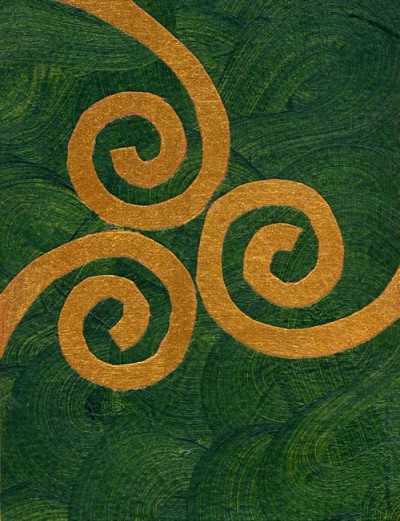
The symbol of the triple spiral is particularly prevalent in Celtic lands, where, in Christian times, it came to signify the Trinity. Evoking the energy, interconnection, and mystery of the triune God, the triple spiral graces such works as the remarkable insular Gospel books of the early medieval period, including the Book of Durrow and the Book of Kells.

On Trinity Sunday, we both celebrate God’s triune nature and also acknowledge the great mystery that it holds. Throughout the centuries, theologians have sought to define just how it is that God, Christ, and the Holy Spirit dwell together and with all of creation. Symbols of the Trinity abound, evidence of our desire to describe a being that comprises a community within itself. Attempts to convey the nature of the Trinity in images have occasionally produced some curious artwork, as in this image from a medieval Book of Hours that depicts three fellows sharing a single crown, and this image, added to a medieval English Psalter, that shows Abraham adoring a three-headed Trinity.

In their commentary on Trinity Sunday, the authors of Handbook of the Christian Year counsel us that rather than approaching this day with an emphasis on “the Trinity as an abstract concept, idea, or doctrine,” and seeking to explain or define it, it rather “seems more in keeping with the character of worship and of the Christian Year to treat Trinity Sunday as a day in which we praise and adore the infinitely complex and unfathomable mystery of God’s being to which we point when we speak of the Holy Trinity.” They go on to write,

Because our celebration of the Easter cycle is based upon the mighty acts of the triune God, and because we are entering upon the Sunday-to-Sunday half of the year when the emphasis is wholeheartedly upon each Sunday as the Lord’s Day, whose celebration is also based upon the mighty acts of the triune God, it is appropriate that we pause on this transitional Sunday to give ourselves over to the adoration and praise of the being—as distinct from the acts—of the triune God.

It is sometimes difficult, of course, to separate the doing of the Trinity from the being of the Trinity, for it is part of the nature of the Trinity to be in action, to work in relationship within itself and in cooperation with creation. This is one of the reasons that the Celtic symbol triple spiral speaks to my imagination: it evokes the God who both exists in a dynamic wholeness within itself yet also reaches out (or is it in?) to embrace us.

Historically, Celtic Christians offered no systematic theology by which they sought to define the nature and work of Trinity, but evidence of their experience of the triune God abounds. Beyond their artistic and symbolic depictions of the Trinity, they left a remarkable body of prayers and poetry that offer us an incarnate experience of the Trinity. In their poems and prayers, Celtic Christians moved from the abstract to the actual; for them, the triune deity was not a theological concept but rather was deeply embedded in daily life. In the Celtic imagination, God, Christ, and Spirit are intertwined with one another and with all of creation.

The Carmina Gadelica, a collection of prayers, poems, and blessings that Alexander Carmichael gathered in the Scottish islands and highlands in the 19th century, offers a feast of examples of this rich relationship with the Trinity, as in this prayer for the baptism of a child:

The little drop of the Father
On thy little forehead, beloved one.

The little drop of the Son
On thy little forehead, beloved one.

The little drop of the Spirit
On thy little forehead, beloved one.

To aid thee from the fays,
To guard thee from the host;

To aid thee from the gnome,
To shield thee from the spectre;

To keep thee for the Three,
To shield thee, to surround thee;

To save thee for the Three,
To fill thee with the graces;

The little drop of the Three
To lave thee with the graces.

With an intent both poetic and practical, this baptismal prayer serves as a graceful commentary on, and response to, the gospel reading for Trinity Sunday. In Matthew 28.16-20, we read the words that are, according to Matthew, Jesus’ final words to his disciples. In this passage that we often call the Great Commission, Jesus tells them to “Go therefore and make disciples of all nations, baptizing them in the name of the Father and of the Son and of the Holy Spirit, and teaching them to obey everything that I have commanded you.” Jesus’ words here are about the closest thing we have to an articulation of the Trinity in the scriptures. Jesus never uses the term “Trinity,” and he offers nothing like a doctrine of its nature. His words here, however, perhaps provide doctrine enough: he lets us know that Father, Son, and Holy Spirit exist in an inextricable relationship that propels us to be in relationship with the world, to live in service and to cultivate community. “And remember,” Jesus tells them at the last, “I am with you always, to the end of the age.” I am with you, he says: that being thing again, invariably bound together with the doing of the Trinity, an endless spiral of action and existence in which it dwells, and calls us to dwell as well.

In the Celtic triple spiral, there is a space where the three spirals connect. It is both a place of meeting and of sheer mystery. Its vast, vibrant emptiness reminds me that, in this life, we will never know all the names of God. Even as the Trinity evokes, it conceals. We will never exhaust the images we use to describe the One who holds us and sends us, who enfolds us and impels us in our eternal turning.

This week, as we travel toward Trinity Sunday, I’ll be holding that image of the triple spiral and the community in whose company I walked its path: inward, outward, journeying ever around the mystery at its center. Those walking companions remind me of how we are to be a living sign of the Trinity who dwells in eternal, intertwined relationship within itself and with all creation. As individuals and as communities, we are beckoned to times of spiraling inward, to attend to our own souls. We are propelled, in turn, into times of spiraling outward, to attend to the world beyond us. In all our turnings, the presence of God persists. With you always, Jesus said.

How do you experience the God who exists as a community and invites us to intertwined lives? How does this God become incarnate in the rhythm of your days?

Blessings on your spiral-shaped path.

[To use this image, please visit this page at janrichardsonimages.com. Your use of janrichardsonimages.com helps make the ministry of The Painted Prayerbook possible. Thank you!]
Easter 2: Into the Wound

March 29, 2008

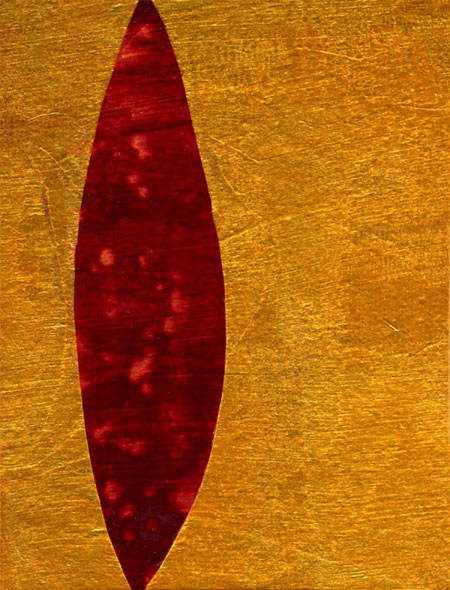
Image: Into the Wound © Jan Richardson

Reading from the Gospels, Easter 2: John 20.19-31

Tonight I pulled out a card, received from a friend years ago. On the front of the card is Caravaggio’s depiction of the scene that we find in this week’s lectionary reading. As Caravaggio sees it, Christ stands to the left, chest bared, drawing Thomas’s hand into his wound as two other disciples look on. It is an intimate scene: Christ bows his head over Thomas’s hand, gazing at Thomas as he pulls him toward his wound; Thomas leans in, brow furrowed, the other disciples standing so close behind him they threaten to topple him straight into Jesus. Yet Thomas seems about to tumble into the wound of his own accord. He is doing more than merely looking where Christ leads him; his whole being is absorbed in wonder. The first time I saw this image, I immediately had the sense that Thomas was thinking, There’s another world in there.

The title sometimes given this remarkable painting, and this remarkable man, is “Doubting Thomas,” which grates a bit. Three weeks ago, contemplating the gospel lection for Lent 5, I was reminded that in the story of the raising of Lazarus, Thomas is the one—the only one—who steps forward and expresses his willingness to die with Jesus. In this week’s reading, Thomas once again crosses into a place where others have not ventured: into the very flesh of the risen Christ.

Caravaggio’s painting illumines a point that the gospel writers are keen to make in the post-resurrection stories of Jesus. They want to make sure we know that the risen Christ was no ghost, no ethereal spirit. He was flesh and blood. He ate. He still, as Thomas discovered, wore the wounds of crucifixion. That Christ’s flesh remained broken, even in his resurrection, serves as a powerful reminder that his intimate familiarity and solidarity with our human condition did not end with his death. Perhaps that’s what strikes me so about Caravaggio’s painting: it stuns the viewer with the awareness of how deeply Christ was, and is, joined with us. The wounds of the risen Christ are not a prison; they are a passage. Thomas’s hand in Christ’s side is not some bizarre, morbid probe: it is a union, and a reminder that in taking flesh, Christ wed himself to us.

The presence of the Christ who joins himself to us, who is intimately acquainted not only with the delights that come in being human but also in the ways it breaks us open, comes as a particular solace this week. As I write this in the middle of the night, my sweetheart is keeping vigil by his mother’s hospital bed. She is dying. Just a month ago, we—Gary and his brothers and their families—threw a surprise party to celebrate Shirley’s 80th birthday. Shortly afterward, she was diagnosed with a recurrence of leukemia, and where we expected that another series of chemo would buy her some more time, complications set in with startling speed in the past week. Shirley remained alert until Gary and his three brothers arrived to be with her, and now she is letting go.

In a dozen hours I’ll fly to North Carolina, where Shirley’s extended family has begun to gather. I’ve been doing laundry today, working on taxes, paying bills, doing dishes, preparing for a retreat I’m scheduled to lead in Connecticut next weekend—all the mundane and sometimes marvelous details of life that persist even as another life is ending. As I pack, I’ll tuck in the card that my friend gave me all those years ago. And instead of Doubting Thomas, perhaps I’ll call him Believing Thomas. Thomas Who Asked for What He Needed. Thomas Who Crossed the Boundary.

Perhaps I’ll call him Thomas of the Passage, who reached out his hand and found what Shirley is finding in these passing hours:

There’s another world in there.

[To use the image “Into the Wound,” please visit this page at janrichardsonimages.com. Your use of janrichardsonimages.com helps make the ministry of The Advent Door possible. Thank you!]

The Painted Prayerbook

January 8, 2008

blog2008-01-08.jpg

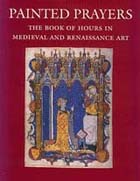
Some years ago, while browsing through the savory bookstore at the Washington National Cathedral, I happened upon Roger Wieck’s book Painted Prayers: The Book of Hours in Medieval and Renaissance Art. I was vaguely familiar with Books of Hours, mostly from seeing individual images that had been lifted from them for Christmas cards or book illustrations, but this was my first real introduction to this kind of book. Called the “medieval bestseller,” the Book of Hours was a popular prayerbook that enabled lay people to keep a similar rhythm of prayer as the monks, nuns, and priests who prayed the Liturgy of the Hours—the eight times of prayer that helped them remember the presence of God throughout the day and night.

In the days before the printing press, scribes and illuminators created these exquisite books by hand. They were often lavish creations that employed paints, inks, and dyes crafted from such materials as plants, flowers, and—yes—crushed bugs, as well as costly stones and minerals including lapis lazuli and gold. The contents of the Book of Hours varied. Virtually all of them contained a section of prayers called the Hours of the Virgin (with illuminations of the life of Mary, the mother of Jesus), the Hours of the Cross (with illuminations depicting the events around Jesus’ crucifixion), and the Hours of the Holy Spirit (with an illumination of the descent of the Holy Spirit at Pentecost).

As a writer and artist who creates books for reflection and prayer, I was enchanted by Wieck’s descriptions of these remarkable prayerbooks and by the wealth of color illustrations that he included. I began to cast about for more information on Books of Hours and, as I discovered the wondrous resources available, was soon thanking my lucky stars that I live in an age where color reproductions in print and on the web are so readily available.

One of the things that particularly struck me about these prayerbooks was how frequently the illuminated artwork (“illuminated” refers to the use of gold in an illustration) had an architectural context: in any given Book of Hours, most of the scenes are framed in a fashion that gives them the appearance of taking place in an arch, a doorway, a window. This kind of framing creates an entrance, a passageway that beckons the reader to cross into the scene being depicted. The passage, however, doesn’t go just one way: this kind of depiction also challenges readers to allow the characters to cross through the frame into their own world, and to ponder how the stories embedded in Books of Hours—stories of biblical characters and saints—might unfold in the reader’s own landscape.

This kind of artwork, with its two-way passage, underscores how the Book of Hours was a threshold book. Usually of a size that was small enough to carry in a pocket or purse, such a book’s owner could open it anywhere and, in that place, open themselves to the presence of God. The book offered a thin place, a sacred, illuminated space where heaven and earth met.

Fittingly, Wieck calls these books “portable cathedrals.”

My fascination with and research into Books of Hours eventually led me to other kinds of illuminated manuscripts that offer their own unique thresholds. Illuminated Psalters, Gospel books, Apocalypses, and other dazzling genres: they each have quickened my imagination and deepened my understanding of how a book can offer a threshold, a thin place, an invitation to go deeper into the mystery of God. For me, the bookly intertwining of words and images is particularly compelling and intriguing, both as a reader/viewer and as an artist/writer.

I share all this because this is the kind of stuff that’s been on my mind as I’ve been redesigning this blog in recent days. I’ve pretty much been lying low, blog-wise, the past couple of weeks, in the wake of the intensity of doing the daily writing and art-making for The Advent Door (I think I’ve nearly recovered!). Doing the Advent blog stirred some ideas and imaginings for what this blog could become.

I loved reflecting on the season’s lectionary readings in a way that intertwined image and words; I especially loved creating the abstract collages and seeing where they took me. One of the main things I envision doing with this newly redesigned/revamped/renamed blog is offering an artful reflection on a lectionary reading for each week, as I did during Advent. More broadly, this blog will be a place where I’ll contemplate the intersections of art and writing and faith, and a few other things besides.

A blog is different from a printed or handcrafted book, but it shares some common ground in the ways that it can invite us into a reflective, contemplative, sacred space. My hope is that, in the spirit of the medieval and Renaissance books that offered places of worship, respite, and challenge on the journey, the artful pages of this blog will invite you to notice some thin places along your own path.

With thankfulness for the generations of artists and scribes whose skills far exceed mine but whose books continue to inspire me and invite me into places of wonder and worship, it seems fitting to call this blog The Painted Prayerbook. Thank you for opening its pages. I look forward to sharing the journey with you.

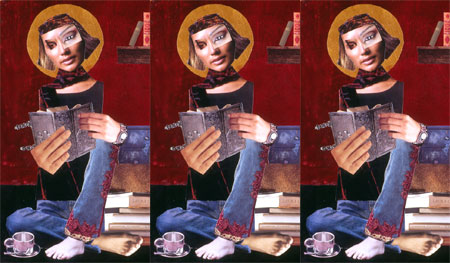
(Today’s artwork is a [triplicated] detail from an original mixed-media piece titled At Her Prayers: Mary Magdalene with a Book of Hours; it’s part of a series inspired by medieval Books of Hours. To see the series, visit The Hours of Mary Magdalene. For a related series, check out The Advent Hours.)

The Feast of the Epiphany: Magi and Mystery

January 6, 2008

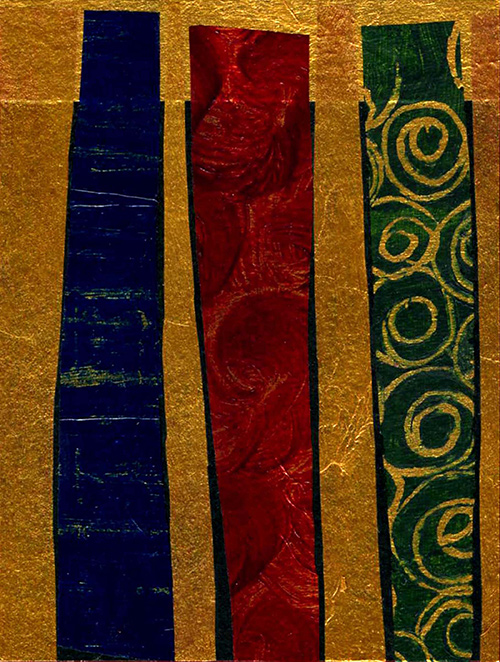
Image: Magi and Mystery © Jan Richardson

Merry Epiphany to you! I preached at First United Methodist Church of Winter Park this morning; here’s an approximation of what I shared.

Magi and Mystery
Matthew 2.1-12

We’ve seen them everywhere over the holidays: three regal men, sometimes depicted with camels, bearing gifts that they have traveled hundreds of miles to offer to Jesus. Although their story, which appears in the Gospel of Matthew, is distinct from the nativity story in Luke’s Gospel, and although it’s likely that they didn’t reach Mary, Joseph, and Jesus until Jesus was a couple of years old, these wise travelers are almost always depicted along with the shepherds and others who inhabit the story of the birth of Christ. Christmas cards and nativity sets vividly bring together the stories that Matthew and Luke offer. In the manger scene in my parents’ home, the wise men join not only the shepherds and the traditional cow and donkey who welcome Christ into the world; owing to my mom’s great sense of whimsy, they stand also alongside such creatures as a dinosaur, a moose, and a giraffe. Kind of a “Noah’s Ark meets the Nativity” sort of thing.

We have these really familiar images of these wise men who come to welcome the Christ and lavish him with gifts, but the truth is that Matthew’s Gospel tells us very little about them. Matthew refers to them as “magi,” a word that means wise men or astrologers. We’re not certain where they came from; possibly Persia, about a thousand miles away, where there was a class of priestly folk who were referred to as magi. We’re not sure how many of them there were. Because they offered three gifts, tradition has often assumed there were three wise men (one gift per wise man, please!), but estimates across the centuries have ranged from two to twelve. We don’t even know their names, though legend has called them Gaspar, Melchior, and Balthasar.

The wise men are sometimes referred to as the three kings, a designation that comes not from Matthew’s Gospel but from passages in the Hebrew scriptures that refer to kings who come bearing gifts for a great new ruler.

All this is to say that the magi are shrouded in mystery. In the midst of Matthew’s relative lack of information, we do know these things: they possessed the ability to read the heavens, they felt compelled to follow a star, they traveled a vast distance to welcome and pay homage to Jesus, and they brought him amazing presents.

I’m intrigued by the fact that Matthew, who is so fuzzy on certain details regarding the magi, is very specific about the gifts they brought. This suggests that the gifts are part of Matthew’s whole point in telling the tale of Jesus’ birth. The first hearers and readers of Matthew’s story would have understood the significance of the wise men’s offerings, but, as we ponder the story two millennia later, it’s good to remind ourselves of what these gifts would have meant.

In Jesus’ day, the first gift, gold, had lots of the same connotations that it does for us. It’s precious. It’s lavish. It’s a gift fit for a king. In the Bible, gold is sometimes mentioned in the same breath as royalty. Isaiah and the Psalms refer to kings who bring gold to honor a great ruler. For the wise men, the gift of gold was a way of acknowledging Jesus as a king.

It is, perhaps, a little harder for us to grasp the value of frankincense and myrrh. Both frankincense and myrrh come from the aromatic resin of trees. More bluntly put, they are dried tree sap. What a gift for a child! But in Jesus’ time, they were costly, myrrh especially so. Frankincense was typically used in religious rituals. In Exodus 30, God tells Moses to make an incense that includes frankincense, for use in the tent of meeting, where God meets with the priests; God tells Moses, “It shall be for you most holy.” The wise men’s gift of frankincense symbolizes that God has come in the person of Christ, that Christ himself has become the place of meeting between divinity and humanity.

Myrrh seems like perhaps the strangest gift of all. In Jesus’ time, it was especially associated with funerals and was used in the process of preparing a body for burial. In the New Testament, the only mentions of myrrh, besides today’s reading, are in the gospels of Mark and John, in connection with Jesus’ crucifixion and death. This seems a curious gift for a young child, and I have to wonder if this gift haunted Jesus a bit. Though it carries some foreshadowing of what will happen to Jesus, I think the magi intended it not as a morbid gift but rather as a reminder to Jesus that, even for him, earthly life is brief, and we are called to use it well.

On this day of Epiphany, as we set off into the new year, I want to invite us to think of the wise men’s gifts to Jesus as gifts for us as well. These gifts, rich with symbolism, have invitations for us who seek to follow Christ, who are the body of Christ. I want to suggest that within these gifts, so rich with significance and symbolism, are questions that can accompany us into this new year.

The gift of gold, the gift that recognized Jesus was as a king, invites us to consider the question: Who were you born to be? This is perhaps the most crucial and most complicated question of our lives. Some of the most interesting people I know are those who, well along in their journey, are actively discerning who God has called them to be. When I was in seminary, half of my classmates were what we call “second career students,” folks who had been doing some other work in the world before discerning a call that involved theological training. I entered seminary straight out of college, very wet behind the ears, and it was a wonderfully rich experience to be in classes with folks in their 40s, 50s, and 60s. They were a great reminder that this process of becoming who we were born to be is a lifelong adventure. That’s true even for those of us who carry a strong sense of what we’re called to do. I tend to be really focused—I sometimes think of it as Attention Surplus Disorder—and have always had some sense of what I’ve wanted to do. What I wanted to do went through some changes before I discerned a call to ordained ministry, but I can see the common thread linking those vocations I was interested in. Even now, in a vocation that has taken me deeply into who I believe I was born to be, I’m still growing into my understanding of that call.

The gift of frankincense, the gift that recognized Jesus as the one who is a meeting place of humanity and divinity, invites us to ponder the question: How do you want to encounter God? This kind of question is at the core of the Connect theme that we’re living with at First Church. As we set out into this new year, how might you seek to stay connected with God, within and beyond this congregation?

The gift of myrrh, the gift that recognized that even for Jesus, earthly life is brief, a twinkling of an eye, invites us to reflect on the question, What is your relationship with time? How do you enter into your days in a way that helps you discern who you are and helps you seek God? Annie Dillard writes that “how we spend our days is, after all, how we spend our lives.” She also writes, “Live every day as if it were your last and then someday you’ll be right.”

So, a trinity of questions for this new year:

Who were you born to be?

How do you want to encounter God?

What is your relationship with time?

Carrying the crucial questions can be uncomfortable. It’s not always easy to live with mystery, but I’ve found that a good question can carry me a long way. It invites me to rely on God to show me the path, rather than thinking I should always rely on myself to know everything and do everything.

The magi didn’t show up with maps; they brought gifts that helped Jesus know who he was. Like the wise men, who had to travel by another road when they left Jesus, we may find ourselves on some strange and unfamiliar and mapless paths when we seek to follow Christ. But in his company, we will, like those wise travelers, find our way home.

[To use the image “Magi and Mystery,” please visit this page at janrichardsonimages.com. Your use of janrichardsonimages.com helps make the ministry of The Painted Prayerbook possible. Thank you!]