Archive for the ‘Ordinary Time’ Category

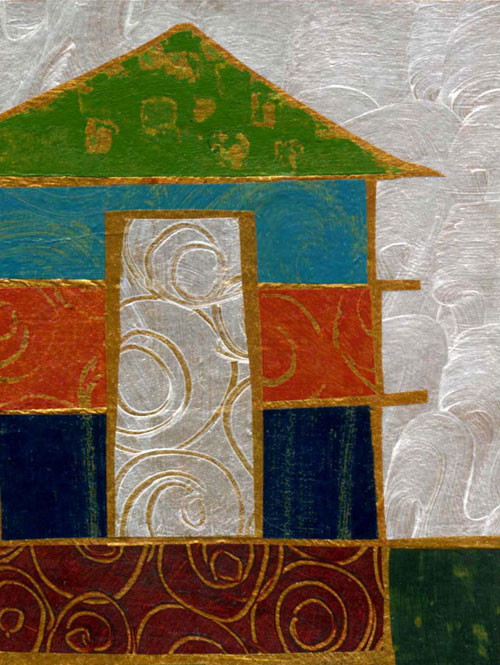
House Dreaming

May 28, 2008


© Jan L. Richardson ◊The Painted Prayerbook◊

When a friend of mine was ready to build a house on the land he had purchased in eastern Kentucky, he sent out a request to some friends. Scott invited us to offer an object, a tangible blessing that he would bury in the ground upon which he would build the house. He recalls that “Folks were amazingly thoughtful—some of the items included tea, Legos and puzzle pieces from my childhood sent by my mother, guitar strings, a bit of climbing rope, a bit of granite from my home town (Lithonia meaning roughly ‘rock place’), a wine chalice from my potter friends, shells from our childhood vacation spot, herbs, bits of plants and dirt from various parts of the country, and chocolate.” After all the gifts arrived, Scott gathered with some friends for a ceremony on his property. Placing the gifts in the ground, they offered a blessing for what would take root in that place. Married now and with young children, Scott and his family flourish in the house built atop the buried blessings.

It was just a few weeks ago, on Easter 5, that we did some reflecting on houses. Pondering Jesus’ words in John 14, where he speaks of the dwelling place he is preparing, we noted how houses are places not only of personal but also collective memory and imagination. Jesus’ words in that passage, as well as in this week’s Gospel lection, underscore the fact that throughout the scriptures, a house is rarely just a physical building. Rather, it evokes a constellation of meanings: a house may refer to a place of worship, the people of Israel, the members of a particular ancestral lineage (as in the house of Jacob), or a group of people who dwell together (a household). Jesus sometimes uses houses to describe the kingdom of God, as in the parable of the woman who sweeps her entire house, looking for her lost coin. Houses also contain a deeply individual meaning, as in this week’s gospel lection, Matthew 7.21-29. Here the image of the house is thoroughly personal, in that it refers to the house that we build with our own particular life, yet it resonates with nearly all the other meanings that house holds. The house that we construct with our life, the house that is our life, is intimately involved with the entire household of God.

In this parable about the wise man who built his house on rock and the foolish man who built his house on sand, Jesus urges us to dig deeper, as it were, into this homely imagery. He challenges us to recognize how the health of a house (and its inhabitants) depends on what we build it upon. The wholeness of the house, he tells us, rests on its foundation. And for Jesus, our tangible response to him forms the foundation of our dwelling with him. Our practices, our searching, our work to live out his call: these acts are blessings that sustain the structure and help its inhabitants flourish.

Jesus makes clear that we can’t cut corners in this kind of house building. There is no shortcut to the kingdom, no substitute for doing the work that’s involved. We are saved by grace alone, but we are called to respond to that grace, to give flesh to our understanding that hospitality is not something we only receive in Christ but that we offer as well. Many of the gospel lections that we’ll journey with during Ordinary Time will speak specifically, and sometimes uncomfortably, to the kind of work that Christ beckons us to do. He emphasizes that it’s not work just for the sake of work (and it’s not constant work, either; rest is one of the ways that we respond to Christ). Rather, our response is for the purpose of relationship. As Jesus highlights in the opening verses of this passage, it’s possible to do really impressive work, work that seems holy on the surface, but is empty because it’s focused on results—on a show of power—rather than on relationship with the one who is the source of true power. “I never knew you” is the lament that Jesus, in Matthew 7.23, predicts he will utter to those who hear but do not respond.

The solidly built house in Jesus’ parable has, like the kingdom of God, a now-and-not-yet quality. The house that he describes is something of a mystical house that stands complete and inhabited, yet which we are also in the process of building. Living together in a house that we are still working on sometimes seems daunting. We can get to feeling like Sisyphus in our perpetual practicing, particularly in those times when we start focusing more on the practices themselves and less on the relationship the practices are designed to cultivate. Too, we don’t always know precisely how the structure will take shape and what it will look like. Our call, however, isn’t always to finish the house but rather to be faithful in laying the groundwork, to discerning and doing the work that’s in front of us, the work that is ours to do.

And here’s a cool thing: don’t gotta do it alone. Aren’t meant, in fact, to do it alone. I think again of my house building friend, how he asked for help and invited others to share in blessing and building the foundation.

What are you building your life on? What are the practices that give wholeness to the house of your life? Are there any places in the foundation that feel shaky? Is there someone you could ask for help as you build? What’s the dream house of your soul look like?

A blessing upon your building.

Happy Ordinary Time!

May 24, 2008


© Jan L. Richardson ◊The Painted Prayerbook◊

So, did you sense the shift when we moved into the new season? Did you hit the after-Pentecost sales and send out your “Merry Ordinary Time” cards? No? It tends to sneak up on us, doesn’t it, this new and subtle season of the Christian year. We have spent the past six months swimming in the Big Stories that Advent, Christmas, Epiphany, Lent, Easter, and Pentecost provided for us. These holy days and seasons have offered something approaching an embarrassment of riches with the themes they have brought us: birth, incarnation, the wilderness, suffering, death, resurrection, the life of the community, and the work of the Holy Spirit. It’s been a good and grounding groove.

And now for something completely different.

Ordinary Time officially began with the ending of Pentecost, and with Trinity Sunday now behind us, the new season is upon us in earnest. Stretching out for the next six months, Ordinary Time invites and challenges us to move into a mode that is shaped by something other than the “high seasons” that the past half-year has offered us. I sometimes find this new rhythm a little disorienting at first. Living in Florida, where the natural seasons are present (really, we do have them) but subtle, I rely on the liturgical year to help me tell time. Without the big markers I’ve been living with for the past six months, the days and weeks sometimes seem like they’ve lost their cohesion, that they’re oozing out into a nearly interminable horizon that holds few occasions for liturgical celebration. Plus, it’s a really long stretch of looking at green paraments every Sunday.

This season, however, beckons us to find the sacred in its subtlety. In the introduction to her book The Time Between: Cycles and Rhythms in Ordinary Time, Wendy M. Wright reminds us that the “ordinary” in “Ordinary Time” does not mean “boring, uneventful, undistinguished, everyday.” Rather, it “comes from the word ordinal, to count.” With its being a seemingly in-between time, however, Wright observes that this season holds us in a different way than do the seasons “when the beauty of the faith is etched in high relief.” She writes,

I like to think of the entire spectrum of the liturgical cycle of Ordinary Time with all its varied rhythms—of Sunday observance, daily prayer, the sanctoral cycle, the tapestry of stories that dramatize the call and response of Jesus and the first disciples, the seasons of our own discipleship throughout the life cycle, the ritual practice of the great Christian rites, the dynamics of our inner faith lives—as one greater movement of desire to be face-to-face, heart-to-heart with God. The deep grammar of the church year’s Ordinary Time is perhaps uttered most keenly in our ceaseless longing. By it we are propelled into the future. We pine for it as past. We trace the surface of the present with anxious fingertips. Call our desire awareness, mindfulness, mysticism, aesthetic sensitivity, faithfulness, or whatever. It is the fundamental movement of the Christian life.

Given the intensity of the stories that have accompanied us during the months between Advent and Pentecost, one might be tempted to think that Ordinary Time gives us something of a rest. It offers us a different rhythm, to be certain, but as we move into this season, the lectionary doesn’t let us off the hook. The Gospel lection for this Sunday, Matthew 6.24-34, challenges us with questions that lie at the heart of Christian life: Whom will we serve? Where will we place our trust and our energy?

To pose these questions, Jesus turns, in his typical incarnational way, to a couple of earthy examples at hand: the birds of the air and the lilies of the field. Urging his disciples not to devote themselves to worry and anxiety, he borrows the well-fed birds and well-clad lilies as signs of how God cares for God’s creatures.

I have to say that living without worry seems pretty easy to do if you’re a creature who can get by on worms and water. For the rest of us, giving up anxiety often seems more of a challenge. I’ve been pondering this Gospel passage in the midst of hearing news of the mounting death count from the earthquake in China and the cyclone in Myanmar. And I’ve been contemplating Jesus’ words with an awareness, too, of the daily terrors and suffering that shape the lives of so many on this planet. How is it, I wonder, that God has provided, is providing, will provide for their needs? What do Jesus’ images of birds and lilies look like in places that seem devoid of beauty and care?

I was reflecting on this with a couple of friends at lunch today. We each know how little we have in the way of answers to these kinds of questions, other than a sense that somehow God is present in the rubble, literal or otherwise, that disasters leave behind. One of my friends, a Benedictine, reminded us of St. Benedict’s words in chapter 4 of his Rule. After he has provided his monks with a lengthy list of what he calls “The Tools for Good Works,” Benedict wraps up this chapter by writing, “And finally, never lose hope in God’s mercy” (Rule of Benedict 4.74).

Wrestling with this week’s lection, I find myself wondering not so much how to keep myself from worrying but wondering instead how I might be called to relieve someone else’s worry, to be part of the way that God provides clothing and shelter and solace for someone. How do I live as someone who not only hopes for God’s mercy, for myself and others, but participates in that hope by becoming a sign and a vessel of God’s mercy in this world? As someone whose ministry involves raising my entire income, and who lives with the ordinary causes of worry that so many of us deal with, I’m not unacquainted with anxiety. At the same time, I’m aware of how the presence of persistent worry and anxiety may be a sign that I’ve become too absorbed by my own concerns, too consumed with my own needs, and that I need to allow God to draw my attention beyond myself to attend to those who need something that I can offer. It’s a way of trying to do what Jesus, at the beginning and ending of this Gospel lection, challenges us to do: to choose whom we will serve, and to focus first on the kingdom of God, that all other things in our lives may fall into their rightful places.

As we set out into this season of Ordinary Time, where is your energy going? What—and whom—are you serving? What worries, anxieties, needs, and desires are shaping your days? How might you invite God to transform your anxiety into acts of hope, mercy, and love in this world?

Deep blessings to you in these ordinary days.