Feast of Saint Clare

August 11, 2008


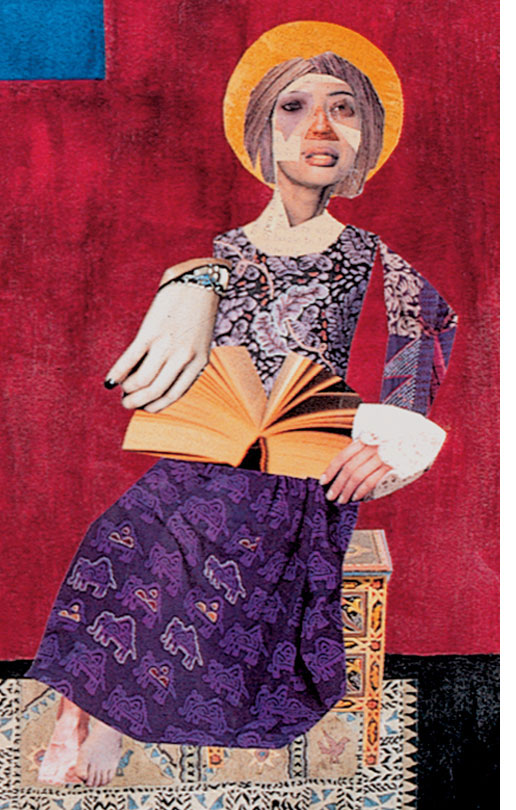
Saint Clare © Jan L. Richardson

When I became the Artist in Residence at a Catholic retreat center more than a decade ago, it was due in large measure to the hospitality of the Franciscan community that administered the center. I harbor a deep fondness for Franciscans as a result, and so today is a particular day of celebration. It’s the Feast of Saint Clare, the friend and colleague of Saint Francis who became a remarkable leader in her own right.

Born in Assisi, Italy, around 1194, Clare was the third of five children born to the well-to-do Favorone family. The story is told that as Clare’s mother Ortulana anxiously prayed for her child’s safe birth, a voice called to her, “O lady, do not be afraid, for you will joyfully bring forth a clear light that will illumine the world.” When she gave birth to a healthy daughter, Ortulana and her husband named her Chiara or Clare: the clear one, the bright one.

In his book Clare of Assisi: Early Documents, Regis Armstrong relates a story about Clare that took place on Palm Sunday in 1212. He writes that “when all the young ladies of the town customarily dressed in their finest and proudly processed to the Bishop for a palm branch…Clare remained in her place, prompting him to come to her.” Although some ascribed her reticence to shyness, Armstrong suggests that this was “a symbolic gesture suggesting her renunciation of the social conventions of the time with all the vanity and appeal to wealth with which they were imbued and the Bishop’s awareness and reverence of the movement of God within her.” That same Sunday, Clare, who had befriended a radical young preacher named Francis, secretly went to Our Lady of Angels, the Portiuncula, where she made a commitment to Francis and his spiritual brothers to embrace their life of devotion and poverty.

Clare lived in several monasteries, moving more than once to avoid pressure from her family, who had sought to arrange a marriage for her. Other women later joined her, including her mother, and Clare became the leader of the Poor Ladies of San Damiano, later to be known as the Poor Clares. Clare and her sisters shared Francis’s passion for poverty, humility, and charity to all, particularly those on the margins of the affluent society in which Clare and Francis had grown up.

In a time when women’s monastic communities received various forms of protection from the church, including financial support, Clare insisted that her community have the right to poverty, trusting that the goodwill of others would provide for their needs. The church authorities resisted Clare on this point, but she refused to relent. Finally, on August 10, 1253, Clare received an approved copy of the Rule she had written for her community. Bearing the seal of Pope Innocent IV, the document ensured that the charism of poverty would remain the privilege of the community that Clare had founded. Clare died the next day.

Although tradition attached to Clare the identity of la pianticella (the little plant) of St. Francis, she embodied her own distinct vision, one that continued to shape Franciscan life after Francis’s death. Clare’s few surviving writings reveal a deep commitment to a God-centered life, a life in which she sought to give up all that would hinder intimacy with God.

In Clare’s “Second Letter to Blessed Agnes of Prague,” she offers this blessing:

What you hold, may you [always] hold.
What you do, may you [always] do and never abandon.
But with swift pace, light step,
unswerving feet,
so that even your steps stir up no dust,
may you go forward
securely, joyfully, and swiftly,
on the path of prudent happiness,
not believing anything,
not agreeing with anything
that would dissuade you from this resolution
or that would place a stumbling block for you on the way,
so that you may offer your vows to the Most High
in the pursuit of that perfection
to which the Spirit of the Lord has called you.

And so may this be our blessing for this day. Happy Feast of Saint Clare!

Artwork: detail from “Saint Clare” © Jan L. Richardson. To use this image, please visit this page at janrichardsonimages.com. Thank you!

Clare’s blessing is taken from Regis Armstrong’s book Clare of Assisi: Early Documents.

Night Passage

August 5, 2008


Night Passage © Jan L. Richardson

Here at The Grünewald Guild, where I’ve finished a week of teaching and am beginning a week of writing, we gather for Matins at 8:30 AM. Matins invites us to a time of creative reflection and prayer before we head off to class or to whatever else will occupy our morning energies. Each Tuesday, which marks the first day of classes, Richard Caemmerer leads the service. Along with his wife Liz, Rich founded the Guild and directed it for twenty-five years until retiring a couple of years ago. Last week he began Matins by showing us a volume of the New Testament that his father-in-law had given him years ago. Printed in the early 1900s, and falling apart, this two-volume set was designed for those who are blind. Rather than using the system of patterned dots that Louis Braille devised, which took some time to gain widespread acceptance, the pages of this New Testament consist of raised letters that spell out each word of the scriptures.

Rich passed around a pile of the pages that have come loose from their binding. As I looked at the first page that came my way, and traced its letters with my fingers, I realized it was the gospel reading for this Sunday, Matthew 14.22-33. When Matins was over, I told Rich about the bit of synchronicity. “Well, then,” he told me, “you must have that page.”

And so I have the page here on my desk that overlooks the river that runs past the Guild. Tracing its letters once again, I’ve been thinking about seeing, and not seeing, and how difficult it sometimes is to learn to see, to recognize what’s before us.

The page with the raised letters describes how the disciples have spent the night on the waves, their boat tossed by the wind. When Jesus comes walking toward them on the water in the early, still-dark morning—“in the fourth watch of the night,” the King James Version more poetically puts it—they do not recognize him. Matthew tells us of the disciples’ terror, how they cry out in their fear, “It is a ghost!” Jesus calls words of assurance, yet they remain uncertain of what they see.

Peter decides to run something of a vision test here, calling out to the ghostly form that if he really is the Lord, “then command me to come to you on the water.” Jesus does. Peter hops out but then begins to falter on the waves. History has laid a great burden on Peter at this point in the story, and perhaps it is this that so weighs him down in the water, rather than the seeming failure of faith that many interpreters have attached to him. When Jesus catches Peter and pulls him into the boat, saying, “You of little faith, why did you doubt?” we have tended to hear these as words of rebuke. As a consequence, we sometimes carry around the cumbersome notion that if we just had enough faith, if we could, by force of will, generate a critical mass of it, a magical measure of it, we could fix whatever is wrong with us. That is a terrible load to carry by ourselves, and it’s not what Jesus intends.

I hear Jesus’ words to Peter as words of encouragement, not of harsh rebuke. His words are gentle and good-natured, acknowledging Peter’s gumption in stepping out of the boat. There is, however, a clear invitation and challenge that Jesus extends to his soggy friend. Jesus recognizes Peter. Every step of the way, on sea and on land, he sees him for who he is: impetuous, impulsive, devoted, good-hearted if not always clear-headed. Jesus wants Peter to be able to see him, to recognize both who he is and who he is calling Peter to become. Jesus knows that Peter’s sight is incomplete, that his vision will falter, that he is still learning to see. But he is learning.

In her book Pilgrim at Tinker Creek, Annie Dillard writes of reading Marius von Senden’s book Space and Sight. She conveys von Senden’s descriptions of what happened when eye surgeons began to perform the first successful operations to remove cataracts. For many of those who had been born with blindness, the experience was terrifying in the beginning. Their brains had never learned how to process and make sense of the images that now confronted their eyes. Shapes appeared flat, meaningless, fearsome. One young man, raised in what was then called an asylum for the blind, threatened to tear his eyes out. A newly sighted girl walked around for two weeks with her eyes closed.

Gradually, Dillard says, many of them passed through their fright and began to work with what their eyes were trying to tell them. She describes one man who, trying to develop his depth perception, would toss a shoe out in front of himself. He would estimate how far away the shoe was, walk toward it, pick it up, toss it again. Slowly, he began to see.

When Peter got out of the boat, it was his way of tossing a shoe, testing his depth perception there on the waters, feeling his way toward the one whom he was still learning to recognize and to know. Peter faltered but did not fail, and when he returns to the other disciples, he carries a new piece of vision with him. Matthew tells us that when Jesus and Peter get into the boat, the wind ceases, and those in the boat worship Jesus, saying, “Truly you are the Son of God.” For this moment, at least, in this space of calm on a once-contrary sea, they pass through the darkness, and they see.

Where do you recognize the presence of Christ in the midst of your days? How might God be challenging you to deepen your vision and stretch your sight? Is it more challenging for you to recognize the holy in places of chaos or of calm? What are you looking for, and looking at; are you turning your vision toward things that will help you see and know and respond with greater clarity?

By whatever ways it comes to us—by touch and sight and sound and all our senses—may we recognize the presence of the Christ who reaches out for us. Blessings.

[To use the “Night Passage” image, please visit this page at janrichardsonimages.com. Your use of janrichardsonimages.com helps make the ministry of The Painted Prayerbook possible. Thank you!]
A Gracious Plenty

July 30, 2008

Image: A Gracious Plenty © Jan Richardson

Reading from the Gospels, Year A, Proper 13/Ordinary 18/Pentecost +12: Matthew 14.13-21

Years ago, when I moved from a position as a pastor in a congregation into a creative ministry well off the beaten path, it stirred lots of questions. I was based at a retreat center outside Orlando, where I served as artist-in-residence. During my first few years there, many folks—most often my clergy colleagues—would ask me, “So are you still on that sabbatical?” Though my bishop had appointed me to this specialized ministry, in which I served full time, I realized that some folks thought I was taking a break from my vocation. The question occasionally grated, but I came to see that it contained opportunities to help stretch people’s ideas about where and how ministry takes place. I learned to love responding, “No, this is my real life!”

Eleven years since moving into the form of ministry to which I feel most called, I don’t get the sabbatical question these days, but I continue to be intimately acquainted with the ways that many folks perceive the arts and other creative work to be extraneous to who we are as the people of Christ. In some quarters, art is considered to be fluff, a luxury, a needless extravagance. Or art becomes a tepid, sanitized, watered-down endeavor that misses what an astounding thing it is that the first face we see of God in the scriptures—there, at the beginning of Genesis—is of God as creator, who labors with such artful passion, imbuing each creative gesture with a wild extravagance.

Because of lingering, centuries-old prejudices about art, I still find myself fielding questions about what it is that I do, and why I do it, and just how is it ministry, again? I’m glad to have those conversations. But especially with living in a place where the art-and-faith community is comparatively small (which describes any number of places, not just mine), I often feel like my call has led me into a pretty remote spot.

I’ve been paying attention to this sense of remoteness in pondering this Sunday’s gospel lection. Matthew offers his version of how Jesus, having just heard about the death of John the Baptist at a feast of a most gruesome sort, withdraws to a deserted place by himself. The crowds find him, however, and flock to him. He cures the sick among them. When the disciples remind Jesus that the hour is growing late, and that they are in a lonely, remote spot with no concession stands at hand, and that he needs to send the people into the villages to buy food, Jesus tells the disciples to feed the people themselves. By the time Jesus and the disciples leave this remote place, a miracle of feeding has occurred, with twelve baskets left over from what began as two fish and five loaves of bread.

Perhaps like most of us, I’m accustomed to often feeling like I’m in the position of the disciples, listening to Jesus tell me to do what I think I can’t do myself, in a place that seems more remote than I might like. Pondering the text this time around, I have found myself thinking, “Please, could I maybe, this time, think of myself as being among the crowds who were fed, and found nourishment in abundance, here in this isolated spot?”

I’m feeling that way because for the past few days, I’ve been in a remarkable place called The Grünewald Guild. Nestled among the Cascade Mountains in eastern Washington State, the Guild was founded more than twenty-five years ago as a retreat center devoted to exploring the connections between art and faith. For nine weeks each summer, as well as at other times of the year, the Guild offers classes in a variety of media. Most compelling for me is the way that our creative work takes place in a rhythm of community life, with morning and evening prayers, shared meals, presentations in the evening, and conversations in the in-between places. Those who come to the Guild may not necessarily identify themselves as artists in a vocational sense (or as Christians, either; it’s a community of hospitality to anyone who wants to come). But each person comes with some particular sense of the interplay between faith and art, along with the desire to explore that interplay in their own lives and in community. In the midst of a vocation that beckons me to do a lot of explaining, the Guild is a place where I am most in my element.

It is a miracle of feeding for body and soul.

Barely four days into my stay (I’m teaching this week and staying on next week to do some writing), I have received extraordinary gifts marked by synchronicity and grace. Friends who were here earlier in the summer left me a gift card for tea at the nearby hardware store/café. I enjoyed the tea yesterday in the company of a friend, who later sang to me several wondrous songs she had written here. Another friend gave me a folded paper structure that I can use as the basis for some of my work in the Soul of the Book class that I’m teaching. Some of the gifts, like this one, are very specific to this place, and it’s difficult to briefly describe them or the ways that they provide sustenance for someone whose vocation takes me to some pretty remote places in my inner terrain.

I don’t quite know how to take it all in, these gifts that appear like manna, like living bread. There is so much abundance. When I leave here in a dozen days, I am certain I will be trailing crumbs behind me. At least twelve baskets full. Sustenance enough for the path ahead.

What are you hungry for these days? How are you being fed? In the most deserted and remote places in your soul and in your community, how have you found, or long to find, sustenance?

May God meet your deepest hungers of body and soul with extravagance and grace. And may we know how to receive—and give—such feeding.

[To use the image “A Gracious Plenty,” please visit this page at janrichardsonimages.com. Your use of janrichardsonimages.com helps support the ministry of The Painted Prayerbook. Thank you!]

Something Old, Something New

July 23, 2008


Something Old, Something New © Jan L. Richardson

While I was at St. John’s University in Minnesota last week, I made a couple of visits to the Hill Museum and Manuscript Library (known in those parts as the HMML). The Benedictine monks of St. John’s founded the HMML to preserve the medieval manuscript heritage of Europe, Africa, and the Middle East, and it’s always a favorite destination for a girl with a blog called The Painted Prayerbook. This summer the HMML is home to a tasty exhibition of original folios from The Saint John’s Bible, the first Bible to be written and illustrated entirely by hand in more than five hundred years. Featuring the Wisdom Books section of The St. John’s Bible, the exhibition marks the completion of five of the planned seven volumes of this contemporary manuscript. By the time that Donald Jackson and his team of scribes and artists complete their lavish, monumental work, the Bible will have absorbed about ten years of their lives.

A group was touring the exhibition during one of my visits to the museum. As I took in the folios, with the gold dancing on their pages, I tuned an ear to the comments that the group’s HMML guide offered. After her presentation, she fielded a number of questions. “Why,” one person asked, “in this age of high-quality printing technology, would someone spend the time to create an entire Bible by hand?” As the guide responded, she spoke about the value of recovering ancient practices of bookmaking as a sacred art, and of the beauty that emerges in fashioning something by hand. She pointed out that contemporary technology has played a significant role in The Saint John’s Bible; a designer used a computer to plan the entire layout of the pages before the team began to lay the first strokes of ink, paint, and gold leaf on the vellum sheets.

It’s a treasure that draws from what is old and what is new.

We hear about such treasures in this week’s gospel lection, Matthew 13.31-33, 44-52. Jesus, who is in a parable-telling mood at this point in the gospel, offers a series of images that describe what the kingdom of heaven is like. He speaks of a mustard seed that grows into a tree, yeast that a woman mixes with flour, a man who discovers treasure hidden in a field, a merchant who finds a pearl of great value, and a net filled with fish. Jesus closes the litany of images by saying, “Therefore every scribe who has been trained for the kingdom of heaven is like the master of a household who brings out of his treasure what is new and what is old.”

The scribe about whom Jesus speaks is a rather different sort of scribe than those who have been laboring over The Saint John’s Bible. Jesus’ scribe is one versed in Mosaic Law, a person who knows and draws from the wealth of the law and also recognizes new treasure when it appears. Yet the scribes of The Saints John’s Bible, and the pages they have created, embody what Jesus’ kingdom-images evoke. Each reminds us of how the holy, which so often seems hidden, emerges when we stretch ourselves into searching for it, seeking it, laboring toward it. The bakerwoman kneading in her kitchen, the man who sells all that he has to buy the field, the merchant who gives up everything to purchase the pearl of great price, the scribe trained for the kingdom of heaven, the householder who brings forth treasure old and new: each of these has given themselves, devoted themselves, to a particular process by which treasure emerges. They know what skills it takes, what vision, what devotion. Each trained in their particular art, they possess in their bones the knowledge that tells them what ingredient to use, what tools old or new to employ, what treasure lies before them.

Offering these images, Jesus recognizes there are things that are worth a long devotion; there is treasure worth giving ourselves to for a decade, a lifetime. Such treasure might not have a usefulness that is obvious, or readily grasped. In a world where technological shortcuts abound (and are useful at times, to be sure)—bread machines, metal detectors, faux pearls, computer printers—something happens when we take the long way around, when we hunt for the holy that often loves to hide in work that takes time, takes the development of skill, takes commitment, takes the long view.

I think of when I was first learning calligraphy a few years ago. There was no getting around the need for practice. Over weeks and months, as I covered page after page with ink, shaky lines steadily grew more sure, and awkwardness began to give way to art.

This type of long laboring and searching reveals something about our own selves. Submitting ourselves to a process of practicing brings secret parts of ourselves to the surface; it draws us out and unhides us, and the holy that dwells within us. “The kingdom of God is among you,” Jesus says in Luke 17.21. Among us, and meant to be uncovered, to become visible, to offer sustenance and grace for the life of the world. Like bread. Trees. Pearls. Pages. Treasure born of what is old and what is new.

What treasure have you found, or long to find, in the hidden places of your life? What searching, what seeking might God be challenging you toward, to uncover what’s been buried? Is there anything in your life that invites you to encounter the holy in a process that takes time, practice, skill, devotion? What of yourself do you find in that, and what do you find of God?

May this week bring a hidden gift your way. Blessings.

[To use the “Something Old, Something New” image, please visit this page at janrichardsonimages.com. Your use of janrichardsonimages.com helps make the ministry of The Painted Prayerbook possible. Thank you!]
Feast of Mary Magdalene

July 22, 2008


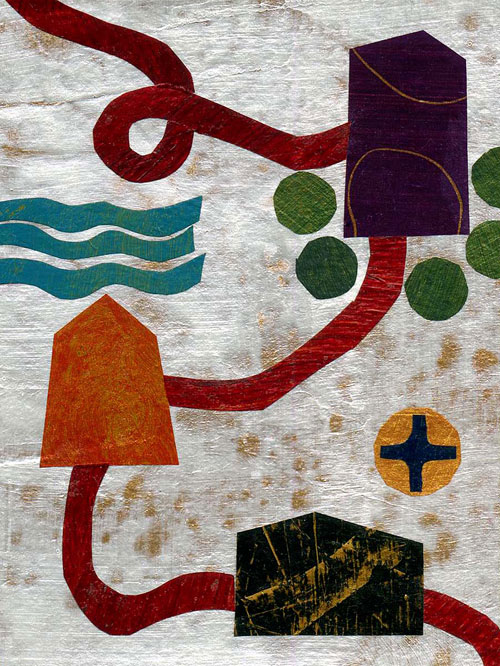
Magdalene Ascending: The Divine Hours
© Jan L. Richardson

Happy Feast of Mary Magdalene! In the rhythm of the Christian year, this is the day when we especially remember and celebrate the friend and disciple of Jesus who, along with other women, provided support for his ministry. For proclaiming the news of Christ’s resurrection, the Magdalene became known as the “Apostle to the Apostles.”

The Bible offers few details about her life—only Luke mentions her prior to her crucial role at Jesus’ death and resurrection. But having sparse information about her life leaves lots of room to spin some great stories. In the Middle Ages, a cycle of legends emerged that elaborated upon the Magdalene’s leadership in the early Christian movement. As a preacher chick, I’m particularly fond of the legend that involves Mary Magdalene moving to France and becoming a famous preacher; she is also said to have released prisoners from a French jail.

The legends tell, too, that Mary Magdalene spent the final years of her life as a hermit in the wilderness, clad only in her long hair. At the canonical hours, angels would come and swoop her up to heaven to share in the liturgy, then return her to the wilderness until they came to swoop her up again. The above image depicts that legend; titled Magdalene Ascending: The Divine Hours, it comes from the series The Hours of Mary Magdalene, which you can visit here (click on the images for enlarged views). Inspired by depictions of Mary Magdalene in medieval Books of Hours and in other artwork from the Middle Ages, the series draws from the legends of the Magdalene as well as biblical accounts that offer intriguing hints about her life.

Think of the images as greeting cards from me to you on this day. A blessed feast to you!

In the Weeds

July 15, 2008


In the Weeds © Jan L. Richardson

Reading from the Gospels, Proper 11/Ordinary 16/Pentecost +5: Matthew 13.24-30, 36-43

I’m lingering in Minnesota for a few days in the wake of a great retreat with the Saint Brigid’s community. As I was running some errands yesterday with my friend Mary, the founder of Saint Brigid’s, we passed some wheat fields—not a typical sight in my usual landscape. It was an interesting bit of convergence, given our gospel lection for the week. Matthew offers us a tale of wheat and weeds, with Jesus weaving these agrarian images into a parable about the kingdom of God.

Matthew lets us in on Jesus’ explanation of this parable, and it seems pretty straightforward at the surface. Jesus offers an interpretive equation in which, not surprisingly, wheat=good and weeds=bad. I’m curious, however, about how Jesus has the householder respond to the laborer who asks him whether they should gather the weeds. The householder tells him to allow the weeds and the wheat to grow together until harvest time, at which point the laborers will gather the weeds and burn them. Removing the weeds too soon would cause harm to the growing wheat.

Jesus’ parable has set me to pondering how weeds and wheat grow together in my own life. I have found myself thinking about my creative process, in particular the challenges that I experience as an artist and a writer. I’ve long been aware that part of my ongoing work is to cultivate practices that support the work. There is part of me that needs a measured rhythm of life—like orderly rows of wheat, say. Yet that orderly part of me regularly grapples with the part that needs a strand of something that’s a bit wilder, something less domesticated.

Something weedy.

I sometimes grow dismayed by what I allow to creep into my creative life: commitments that distract me, weariness, or plain old resistance to the process. Though being an artist and writer lies at the heart of who I am, I sometimes wrestle with how the work brings my inner self to the surface, confronting me with the raw, unformed stuff I carry around inside me. Some days it’s easier to let the weeds grow, as if they could provide a bit of wild shelter from the work of cultivating my interior crop.

My spiritual director has challenged me to think about the ways I see those times of distraction and discouragement, those occasions when I skirt the demands of the drafting table or the blank page in favor of something else. Where I have tended to view those times as wasteful, extraneous to what I’m supposed to be about in this world, she invites me to see them as part of the process, integral to the creative crop. There’s something about spending time among the weeds that serves to clarify my vision and sharpen my desire. Weeds don’t make for a steady diet, and eventually I get hungry for what will sustain and satisfy, and will do whatever is necessary to find my way to that sustenance. In the fullness of time, an interior apocalypse comes around: the weeds fall away, and burn in the fire that comes in times of focused creating. The longed-for crop flourishes, and feeds.

What’s growing in the landscape of your life? How do you discern the difference between the weeds and the wheat? What do you do with the weeds? How might they be part of the work of cultivating your landscape?

Blessings to you in the wild and weedy places.

[To use the “In the Weeds” image, please visit this page at janrichardsonimages.com. Your use of janrichardsonimages.com helps make the ministry of The Painted Prayerbook possible. Thank you!]

Getting Grounded

July 8, 2008


Getting Grounded © Jan L. Richardson

This week finds me packing my bags, getting ready to head to Minnesota for my always-anticipated annual retreat with fellow oblates of St. Brigid of Kildare Monastery. As usual, we’re having our gathering at a wonderful retreat house on the grounds of St. John’s Abbey, a Benedictine men’s community. Also as usual, our retreat falls over the Feast of St. Benedict (July 11), which always makes for a festive time to be hanging out with Benedictine folk. The retreat offers a near-embarrassment of Benedictine riches, in fact. In addition to having occasion to celebrate and pray with the monks and others connected with St. John’s, we’ll visit the sisters at St. Benedict’s Monastery just down the road, joining them for Vespers on the Eve of the Feast.

Throughout our retreat, we’ll also have our own rhythm of community prayer. Stepping together into the ancient rhythm of the Liturgy of the Hours, my fellow retreatants and I will keep a schedule that will include morning, noon, and evening prayer as well as compline, the nighttime prayer. Getting up for 7 AM morning prayer is a real stretch for this night owl. But entering that rhythm of prayer together for a few days, when we are otherwise a dispersed community praying in relative (if spiritually connected) solitude, is a cool thing.

Though we keep to a liturgy schedule that sets aside appointed times for prayer, the Liturgy of the Hours beckons us to a pace that is anything but task-oriented. It invites us to slow down and savor what the liturgy offers us: the Word that reveals itself in the scriptures, in the prayers, and in the silence. In her book The Cloister Walk (which she wrote during a stay at St. John’s), Kathleen Norris observes that liturgical time “is essentially poetic time, oriented toward process rather than productivity, willing to wait attentively in stillness rather than always pushing to ‘get the job done.'”

When not praying the Liturgy of the Hours, we’ll spend some of our retreat in sessions exploring this year’s theme, “Simplicity in the Monastic Tradition.” I’m delighted that one of the folks presenting a session this year will be Fr. Luke Dysinger, OSB. For years I’ve been passing around Fr. Luke’s online introduction to lectio divina, Accepting the Embrace of God: The Ancient Art of Lectio Divina, providing it as a resource on retreats and elsewhere. I particularly appreciate Fr. Luke’s discussion of what he calls lectio on life, which first got me thinking about our own lives as sacred texts—an idea that shapes much of my work these days.

With all this to look forward to, I’m intrigued that the lectionary offers us Matthew 13.1-9, 18-23 for this Sunday. The Parable of the Sower is all about the work to which both the Liturgy of the Hours and lectio divina invite us. These ancient practices each beckon us to be loiterers in the neighborhood of the Word, to hang out and dawdle with it, rather than moving through it with a briskness that assumes we know what it has to say. The liturgy and lectio both invite us to consider how we’re allowing God to cultivate us, how we are tending our interior earth as a place where the Word can take root and grow—not just for ourselves but for the life of the world.

As I head out tomorrow, I’ll be carrying those images that Jesus offers in this week’s gospel lection. I’m curious to see what earth might get moved in my soul in the coming days, what new ground God might challenge me to give. How about you? What sort of cultivation is going on in your soul these days? Is there any earth that God might be inviting you to offer? What practices are you keeping—or needing—that help you do this kind of sacred groundwork?

Me, I’m off to finish packing. Blessings to you in all your journeying.

[To use the “Getting Grounded” image, please visit this page at janrichardsonimages.com. Your use of janrichardsonimages.com helps make the ministry of The Painted Prayerbook possible. Thank you!]
If the Yoke Fits…

July 2, 2008


If the Yoke Fits © Jan L. Richardson

Reading from the Gospels, Year A, Proper 9/Ordinary 14/Pentecost +3: Matthew 11.16-19, 25-30

In the church that my sweetheart Gary attends, there is a young man who has a syndrome that affects his cognitive abilities. Among the challenges this poses, both for him and those around him, is that he doesn’t always make good choices for himself, and this has sometimes made his road pretty rough. At a recent worship service, in which we celebrated the ordination of one of the church’s pastors, this young man was among those who spoke. It’s sometimes difficult to follow the thread of what he’s saying, but I found myself struck when he said that the newly ordained pastor had helped him understand how God wants us to make things easier for ourselves, not harder. I commented on it to Gary afterward, how those particular words had constellated like a divine message amid his somewhat disjointed words. “Yeah,” Gary said, “I’ve learned it’s good to pay attention when he talks. That kind of stuff happens a lot with him.”

Make things easier, not harder. The words have been haunting me for weeks now. I am a creature drawn to complication. Given the choice between making the way easy and making the way difficult, I sometimes tilt toward difficulty. I’ve learned my soul often needs to have something to push against, something to forge and form it. I feel kind of like Jacob sometimes; occasionally I need a heated wrestling match with the divine, a struggle that will help me find a new name.

There’s a difference, though, between the complications and complexities that forge the soul and those that drain it. I can wax poetic about the holy disruptions that have deepened me, but I recognize, too, my capacity for choosing complications that stem from some other, less sacred impulse. There are times when I make the way difficult for myself because I’ve taken on too much, or because I’m avoiding something that needs attention, or because I’m giving too much energy to something that I don’t need to be giving that energy to. I recognize that I’m capable of manufacturing my own complications rather than waiting for the ones that come around naturally in traveling with Christ.

So this week’s Gospel lection has given me pause for thought. I’ve found myself particularly chewing on the part where Jesus urges his followers, “Come to me, all you that are weary and are carrying heavy burdens, and I will give you rest. Take my yoke upon you,” he continues, “and learn from me; for I am gentle and humble in heart, and you will find rest for your souls. For my yoke is easy, and my burden light.”

I have to say that it’s long been a challenge for me to buy the notion that Jesus’ yoke is easy and his burden light. I’ve seen a lot of evidence that suggests the contrary. But I wonder if much of the difficulty, heaviness, and exhaustion that we experience in ourselves and that we witness in others comes because we are making our own darn way—and making it difficult—rather than tending our connection with the one who wants to make the way for us and to work alongside us. I wonder if perhaps what Christ meant is not that walking with him is uncomplicated but rather that when we focus on our relationship with him, the road opens before us with less resistance and less striving on our part.

I have to say, too, that I’ve struggled with Jesus’ use of the image of a yoke. On the surface, a yoke connotes bondage, servitude, and the diminishing of freedom and choice. In scanning the Web for images of yokes, however, I realized that I was imagining a single-user yoke, one that someone who has power over us places upon us, something that we have to pull alone. What I found more often on the Web were images of double yokes, designed for working animals to pull in tandem. How might it be to imagine this as the kind of yoke that Jesus was talking about, a yoke that we don’t have to pull alone, a yoke that he wears with us? A yoke not for servitude, not for bondage, but a tool of connection, a way of being in relationship with Christ that makes our work easier, not more difficult.

It’s this kind of relationship, this connection with the Christ who labors alongside us, that makes it possible to go into the complicated realms that our souls sometimes need. This relationship helps us choose between complexity that deepens us and complexity that deadens us. So closely connected with Christ, it becomes more possible to discern how to move in directions that will provide energy and wisdom.

Jesus’ yokeish words find an intriguing resonance in the apocryphal Book of Sirach, also known as Ecclesiasticus. As he describes the Wisdom of God, whom he depicts as a woman, the author of the Book of Sirach writes,

Come to her with all your soul,
and keep her ways with all your might.
Search out and seek, and she will
become known to you;
and when you get hold of her,
do not let her go.
For at last you will find the rest she gives,
and she will be changed into joy for you.
Then her fetters will become for you a strong defense,
and her collar a glorious robe.
Her yoke is a golden ornament,
and her bonds a purple cord.
You will wear her like a glorious robe,
and put her on like a splendid crown. (Sirach 6.26-31)

I don’t know that the yoke imagery will ever sit comfortably with me, but it challenges me to ponder what I’m attaching myself to these days. Truth is, we always bind ourselves, however subtly, to something: people, places, habits, possessions, beliefs, ways of being in the world. What or whom are you yoked to right now? Have you sought these connections, or have you allowed them to be placed upon you by others? Do these connections deepen you or deaden you? Do they draw you closer to Christ or farther away from him? Do they connect you with the power, freedom, and choice that God gives you, or do they diminish your power, freedom, and choice? How might Christ be inviting you to live and work in closer relationship with him?

In your living and your laboring, may you find deep relationship and rest. And a few holy complications.

[To use the “If the Yoke Fits” image, please visit this page at janrichardsonimages.com. Your use of janrichardsonimages.com helps make the ministry of The Painted Prayerbook possible. Thank you!]

A Place for the Prophet

June 23, 2008


A Place for the Prophet © Jan L. Richardson

Reading from the Gospels, Year A, Proper 8/Ordinary 13/Pentecost +2: Matthew 10.40-42

In her book Dakota: A Spiritual Geography, Kathleen Norris tells a story that’s said to come from a Russian Orthodox monastery. A seasoned monk, long accustomed to welcoming all guests as Christ, says to a young monk, “I have finally learned to accept people as they are. Whatever they are in the world, a prostitute, a prime minister, it is all the same to me. But sometimes,” the monk continues, “I see a stranger coming up the road and I say, “Oh, Jesus Christ, is it you again?”

Hospitality is on Jesus Christ’s mind in this week’s Gospel lection, Matthew 10.40-42. In this passage we find Jesus continuing his instructions to the disciples as he prepares to send them into the towns to “heal the sick, raise the dead, cleanse lepers, and cast out demons” (Matthew 10.8). He tells them, “Whoever welcomes you welcomes me, and whoever welcomes me welcomes the one who sent me. Whoever welcomes a prophet in the name of a prophet will receive a prophet’s reward….”

I find myself thinking that it’s one thing to welcome a prostitute or a prime minister, as the longtime monk had learned to do. But a prophet?

As guests go, prophets are not the easiest folks to have around. In their role as the mouthpiece of God, they tend to come out with things that can make a host uncomfortable. The Hebrew prophets, after all, weren’t so much foretellers as forth-tellers: they perceived the present injustice among their people with uncommon clarity, and they addressed it with uncommon candor. “Thou art the man,” Nathan says to David (2 Samuel 12.7). “The dogs shall eat Jezebel within the bounds of Jezreel,” Elijah says of Ahab’s wife (1 Kings 21.23). “Do not pray for the welfare of this people,” God says to Jeremiah. “Although they fast, I do not hear their cry, and although they offer burnt-offering and grain-offering, I do not accept them; but by the sword, by famine, and by pestilence I consume them” (Jeremiah 14.11, 12). Famine and destruction, devastation and woe: the prophets were pretty intense fellows. Even in their hopeful moments, which produced some of the most amazing and sustaining poetry of the Bible, they still confront their hearers with words that make it hard to relax around them.

It’s not always easy to welcome those who remind us what it is we’re supposed to be in this world, who call us to live as the people God created us to be, who ask so much of us. It can sometimes be a tiresome, “Jesus Christ, is it you again?” kind of prospect.

But I think of a woman who extended this kind of hospitality to a traveling prophet. Her name, like that of so many women, went unrecorded; history recalls her simply as the Shunammite woman. Having befriended the prophet Elisha and recognizing him as a holy man, she convinces her husband that they should provide a space for him. I love the homely, hospitable details that the story in 2 Kings 4.8-37 provides. “Let us make a small roof chamber with walls,” says the woman of Shunem, “and put there for him a bed, a table, a chair, and a lamp, so that whenever he comes to us, he can go in there” (2 Kings 4.10).

Elisha recognizes the gift, and after a time, he wants to know how he can repay the woman for her hospitality. “What is to be done for you?” the prophet asks. And thus begins a tale of birth, and death, and the raising of the dead, a story that echoes in Jesus’ sending of the disciples to do the same kind of work.

I think of the Shunammite woman as I ponder Jesus’ words about how those who welcome a prophet in the name of a prophet will receive a prophet’s reward. Which at first doesn’t hold a lot of appeal, given the usual “rewards” bestowed upon prophets. For their efforts, they are dangerously prone to imprisonment. Beheading. Crucifixion. Slaughter by various methods. But in the land of Shunem, a woman welcomed a prophet with a room, a bed, a table, a chair, a lamp. Looking for no reward, the woman provided a sacred space for a holy man. And within the space of her own self, an unexpected child began to grow.

It’s a strange economy, this kind of hospitality. We can’t know what we will set in motion when we offer some space to the ones whom Jesus tells us to welcome. We offer a cup of cold water, or a place to rest, or an extra room, or a corner of our heart; we cede some precious territory to one who comes with a word from God; we open ourselves to remembering who it is God put us here to be, and all of a sudden, we’re carrying something we never expected to carry. Maybe it’s not a literal child, as it was for the Shunammite woman. But this kind of hospitality always makes room for new life to take root in us and to come through us in ways that we can’t predict. That’s part of the strange economy, the curious ecosystem of hospitality: open a space to the holy stranger, and God creates a sacred space within our own selves. An extra room in our own souls. A place for God to grow.

What’s hospitality like for you these days? How do you make room for those who challenge you to remember who God created you to be? What kind of holy space might God be wanting to create in your life? In you?

Blessings to you as you discern where to extend a welcome, and where to receive one.

[To use the “A Place for the Prophet” image, please visit this page at janrichardsonimages.com. Your use of janrichardsonimages.com helps make the ministry of The Painted Prayerbook possible. Thank you!]
Out of the Dark

June 17, 2008


© Jan L. Richardson ◊The Painted Prayerbook◊

In 1941, a young Jewish woman named Etty Hillesum began to keep a journal. Hitler’s armies had invaded her homeland of The Netherlands nine months before she took up her pen. As the Nazi forces wielded increasing control over nearly every aspect of her life and the life of her community, Etty continued to write, filling a series of eight exercise books over the next nineteen months. “If I have one duty in these times,” she observed, “it is to bear witness.”

Etty bore witness not only to what was happening in the world around her but also in the world within her—the one place the Nazis could not invade. Amid the mounting terrors that the Nazis were inflicting, Etty documented and reflected on the dailiness of her life. She wrote of the complexities of her relationships with family and friends, her work as a Russian tutor, her passionate appetite for reading (among her favorites were the works of the poet Rilke as well as the Gospels). She wrote of her hungers, her longings, her prayers. Her diaries weren’t a form of escapism; rather, they convey her conviction that the exterior and interior worlds are not separate from one another. Etty believed that doing one’s inner work is crucial to the thriving of a society. She wrote that if we refuse to look into our own shadows, if we resist going into the dark places within ourselves and our world, our shadows eventually spill out in hatred and violence—as her own homeland was experiencing.

Etty recognized both her capacity for hatred and the need to let it go. On a February day, she notes the martyrdom of a young man; she comments on how he had played the mandolin, and had a wife and child. She runs into a friend and talks with him about the martyred man. Her friend asks, “What is it in human beings that makes them want to destroy others?” Etty’s response reminds him that they, too—the two of them—are among the human beings of whom he speaks. “I see no other solution,” she tells him, “I really see no other solution than to turn inwards and to root out all the rottenness there.”

Etty wrote with a sense of her own frailty—she describes occasions of anxiety, illness, and depression—as well as a keen understanding of the brokenness around her. In the midst of this, Etty evinces a stubborn willingness to enter the darkness and its mysteries. There she finds the presence of God and the riches of her own soul.

One spring morning she wrote,

I went to bed early last night and from my bed I stared out through the large open window. And it was once more as if life with all its mysteries was close to me, as if I could touch it. I had the feeling that I was resting against the naked breast of life, and could feel her gentle and regular heartbeat. I felt safe and protected. And I thought: how strange. It is wartime. There are concentration camps. I can say of so many of the houses I pass: here the son has been thrown into prison, there the father has been taken hostage, and an 18-year-old boy in that house over there has been sentenced to death. And these streets and houses are all so close to my own. I know how very nervous people are, I know about the mounting human suffering. I know the persecution and oppression and despotism and the impotent fury and the terrible sadism. I know it all.

And yet—at unguarded moments, when left to myself, I suddenly lie against the naked breast of life and her arms round me are so gentle and so protective and my own heartbeat is difficult to describe: so slow and so regular and so soft, almost muffled, but so constant as if it would never stop.

That is also my attitude to life and I believe that neither war nor any other senseless human atrocity will ever be able to change it.

In 1942, Etty Hillesum was sent to the labor camp at Westerbork, where she held a position that enabled her to travel back and forth to Amsterdam. Her position offered the possibility of escape, and on one occasion, friends tried to kidnap her to prevent her return to Westerbork. Etty resisted, believing she was called to remain with those who were suffering. At Westerbork she continued to tend her inner terrain, acknowledging both the beauty and the struggle that she found. In one of her letters from the camp, she wrote,

When I think of the faces of that squad of armed, green-uniformed guards—my God, those faces! I looked at them, each in turn, from behind the safety of a window, and I have never been so frightened of anything in my life as I was of those faces. I sank to my knees with the words that preside over human life: And God made man after his likeness [Genesis 1.27]. That passage spent a difficult morning with me.

On September 7, 1943, Etty was put on a train to Auschwitz, along with her mother, father, and one of her brothers. None of them returned.

Etty flung a postcard from the train as they left Westerbork; a farmer found it and put it in the mail. On the postcard Etty had written, “We left the camp singing.”

Etty has been constant with me as I’ve pondered this week’s gospel lection, Matthew 10.24-39. Her words and her life have provided both commentary and challenge as I’ve prayed with Jesus’ words about shadows and darkness. With her own life she continues to teach me about how everything that is hidden eventually becomes revealed, about how we are called to proclaim in light what God tells us in the darkness. She persists in telling me what it means not to fear those who can kill the body but not the soul, and how we find our lives by losing them.

With her eloquent, raw, searing, haunting words, Etty reminds us that the shadows may hold fear and terror, but beneath that, deeper than that, more enduring than that, they contain the presence of God, who dwells in darkness as well as in light. She bears witness to the God who is shrouded in mystery yet longs to be known by us and to know us in all our brokenness and our beauty.

So how do we sort through what lies in the shadows of our own souls, our society, our world? How do we listen for the voice of God in the darkness and receive the revelations that Christ has for us there? How do we bring to light what we find in the shadows? Who or what helps us navigate the connections between the inner and outer realms? How does God call us to bear witness to, to “tell in the light,” what we find there?

Blessings to you in darkness and in daylight.

[Quotations from Etty: The Letters and Diaries of Etty HIllesum, 1941-43. Edited by Klaas A. D. Smelik, 2002.]