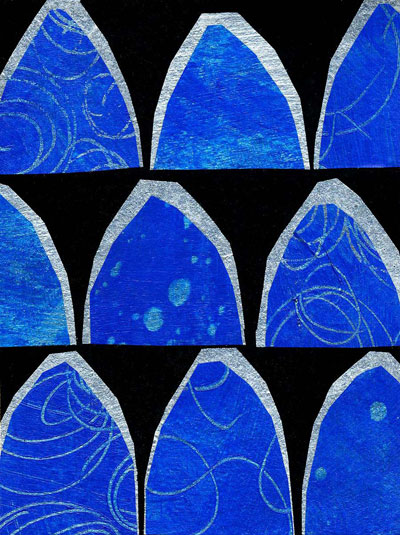
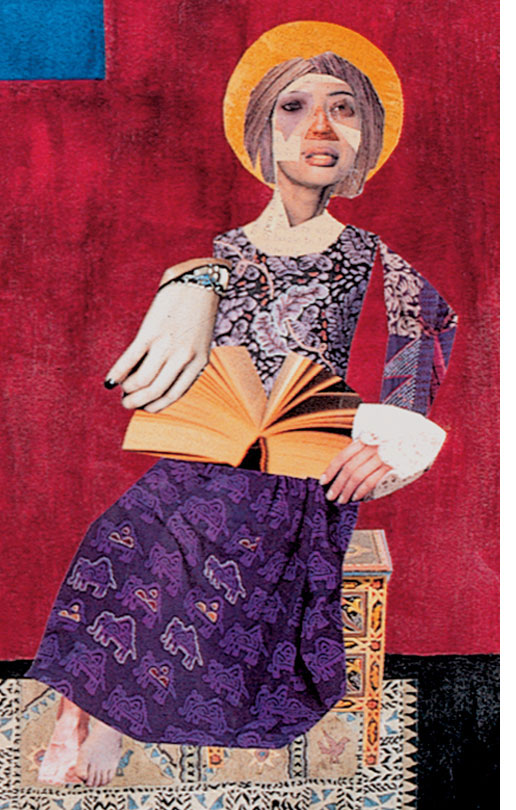
 Image: A Place to Dwell
© Jan Richardson
As I’ve shared in a couple recent posts, I’ve been doing some traveling, most recently to Connecticut, where I led a retreat for a wondrous group of women. I left for Wisdom House just twelve hours after arriving home from the funeral for my sweetheart’s mom in South Carolina, so I wasn’t exactly in the most rested state when I arrived in Connecticut. Fortunately, the retreat didn’t start until the following day, and it was a great gift to have some time to rest, settle in, and absorb the hospitality of the staff and the space at Wisdom House. So much of the space that weekend invited me to be aware of the holy: the art gallery, the chapel, the soulful space created by the women who gathered.
Sister Jo-Ann, my wonderful host at Wisdom House, took me on a tour of the Farm House that’s on the property of the retreat center. Built in the 1700s and used for smaller retreats, the Farm House enchants. With seemingly endless rooms, including tiny bedrooms that remind me of monks’ cells, and lots of inviting nooks and crannies, it’s the kind of space I could happily spend a few weeks in. Though nobody resides there full-time these days, the Farm House possesses a sense of habitation and warmth. There’s a plaque by the front door that lists the names of those who have lived there, from generation to generation. It invites those who cross the threshold, whether for a few hours or a few days, to enter it as a dwelling place, a habitation for the holy.
Nourished by the hospitality I received at Wisdom House, I’ve returned home to my sweet little studio apartment. I’ve lived here for nearly a decade, and the ongoing process of learning how to inhabit this 300 square foot space, and how to work in it as an artist and writer, is one of the most creative things I’ve ever done. Every few months or so I move a few things around in order to squeeze out a few more square inches. My latest accomplishment has involved creating a writing nook. Desperate for a space that I can devote solely to writing (an activity from which I am easily distracted), I recently looked at the landing at the top of my stairs and realized that, especially with its window that overlooks the back yard, it would make a great space to write. It doesn’t make the writing any easier (I didn’t expect it to), but it does offer greater focus, which comes as a needed gift.
I’m intrigued by spaces and by how our experience of architecture shapes our perception of it. Our sense of a physical place goes beyond the interplay of form and function; particularly as we experience a space over time, the outward, physical space can become intertwined with the interior space of our psyches and souls. The places we inhabit or regularly visit imprint themselves on our memory and imagination, coloring how we perceive and engage those spaces. Gaston Bachelard, in his famed book The Poetics of Space, observes that “A house that has been experienced in not an inert box.”
With spaces on my mind, I’ve particularly appreciated the chance to ponder this week’s Gospel lection, John 14.1-14. Sharing a table (an evocative space in itself) with his disciples shortly before his death, Jesus tells them—among many other things—that “In my Father’s house there are many dwelling places.” He uses an architectural image to help them begin to understand the kind of place that he is preparing for them, yet Jesus himself, recognizing the layers of meaning that a house can evoke, is talking about far more than architecture here. The word that Jesus uses for “house” is the Greek word oikia (related to oikos), which refers not only to the physical structure of a house but also to the family that dwells there: the household. D. Moody Smith, in his commentary on John’s Gospel, notes the relationship between the word for “dwelling places,” monai, and the verb meno, which means to remain, abide, dwell, endure.
John likes this word. We visited meno on Epiphany 2, reflecting on the story in the first chapter of John’s Gospel, in which two of John the Baptist’s disciples ask Jesus where he is staying—where he is meno-ing—and he tells them, “Come and see.” He knows they are asking more than where his physical dwelling is.
Here, at the other end of Jesus’ ministry, we find this word again. The disciples did indeed come and see—boy, howdy, what they saw—yet Jesus is still beckoning them to go deeper in the ways that they will abide with him, both now and in the future.
Jesus tells his companions about these dwelling places in order to encourage them and stir their hope. At the same time, he desires to be clear with the disciples that dwelling with him is not a far-off proposition; rather, he is calling them to live with him now and throughout their earthly lives. In John 15, which we don’t visit in the Revised Common Lectionary this year, Jesus goes on to offer the image of the vine and branches as a vivid metaphor for how he desires the disciples to abide with him and he with them. Variations of meno appear many times in John 15; Jesus really wants them to get this whole abiding thing before he goes.
In addition to the images that Jesus offers with oikia and monai, he tells the disciples (in response to Thomas’ question about how to get to these dwelling places) that he himself is the way—the hodos in Greek, which can mean a physical road or journey as well as a way of life. Jesus’ description of himself as the way has a deep resonance with other images that we have visited in the weeks of Lent and Easter. His invitation to the Baptist’s disciples to come and see, the wellspring of living water that he offers a thirsty woman, breaking bread at Emmaus, the piercing of his body in the crucifixion, his invitation to Thomas to place his hand in his very flesh: these are among the stunning images that describe how Jesus opens his very self—body and soul—to us. In reflecting on this, D. Moody Smith draws our attention to Hebrews 10.20, in which the author writes of how we can enter the sanctuary—that holy space—“by the new and living way that he opened for us through the curtain (that is, through his flesh).”
I wrote last week of Christ as the radically hospitable shepherd who not only guards the flock but lays himself down to become the gate for them. This week’s metaphor of Christ as the way further develops this image. Here at the Last Supper, Jesus speaks not only of future concerns but also of present ones, and he means for his friends to understand that the way, the journey, is itself a dwelling place. Jesus is not simply telling them about the destination he intends for them; he is calling them to make their dwelling in him now; he is urging them to make the way, and Christ’s very self, their home.
Where are you living these days? Where are you making your home? How do you make your journey, your path in life, a dwelling place?
Blessings to you in these resurrection days.
[To use the image A Place to Dwell, please visit this page at janrichardsonimages.com. Your use of janrichardsonimages.com helps make the ministry of The Painted Prayerbook possible. Thank you!]
 Happy Pentecost to you! On this occasion of Pentecost’s unusual confluence with Mother’s Day, I’ve found myself thinking about the frequency with which Mary, the mother of Jesus, appears front and center in artful depictions of Pentecost. In the first chapter of Acts, the author makes a point of noting that “certain women, including Mary the mother of Jesus,” were among those who gathered in the upper room, devoting themselves to prayer. The text implies her prayerful presence at Pentecost, and artists across the centuries highlighted her among the gathered assembly. Because of her presence and leadership among the disciples, along with her role as the mother of Christ, Mary became known as Queen of the Apostles as well as Mother of the Church.