Archive for the ‘art’ Category

Christ Among the Scraps

November 19, 2008


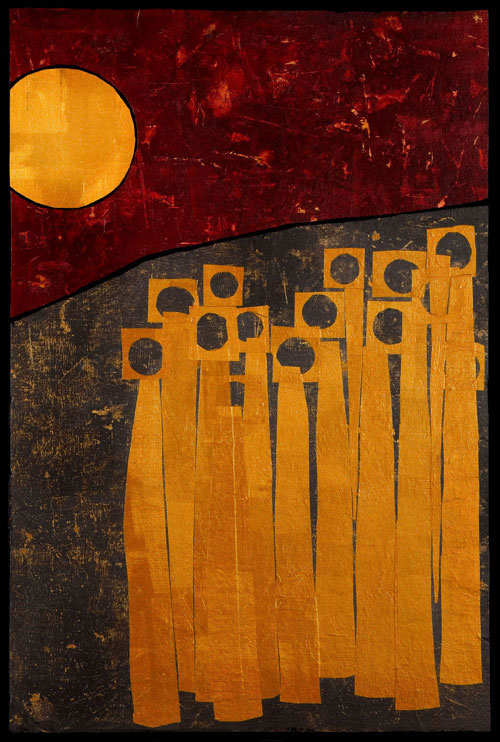
Christ Among the Scraps © Jan L. Richardson

Reading from the Gospels, Christ the King/Reign of Christ Sunday, Year A: Matthew 25.31-46

So I spent last night at the drafting table, pushing pieces of painted papers around. I had made a few sketches as I reflected on this week’s gospel lection. I sat down at the drafting table with those sketches in hand. But then a scrap caught my eye, and another scrap, and another. Owing to an intense travel schedule and natural tendencies, I probably have not cleared off my drafting table since before Ordinary Time began about six months ago. So each week, with every collage, scraps have lingered, gathering and multiplying in a brilliance of colors.

The sketches now abandoned, I played with the painted pieces, picking up, setting aside. I chose scraps that I had tried to use in earlier collages. I chose pieces from which I had previously cut shapes. I chose papers that I’d experimented with as I tried different colors or marking techniques. I chose from the leavings, the left behind. I dug my hands deep into the pile, hitting the bottom of the stack, turning over layers that hadn’t seen the light of day in months. Sorting. Sifting. Choosing.

I thought about this passage in which Jesus speaks of sorting and of sifting, how he describes a day when he will confront us with the choosing we have done: what we embraced, what we rejected. What we failed even to notice. He speaks of those who recognize him and minister to him, and those who don’t. This text from Matthew lies at the deepest core of our call as followers of Christ. And it is, perhaps, the one that most fiercely challenges us, that stretches us the farthest.

When was it that we saw you?

I turn the scraps over in my hands. Sorting, choosing. Finding the pattern. I think of how my deepest regrets—what few I allow myself—are most often attached to occasions when I didn’t see. Didn’t know how to see, didn’t yet have the eyes for seeing. The realization of it—the dawning knowledge of where my vision was lacking—is itself a kind of punishment. But an invitation, too. To learn to look more closely. To take in what I have rushed past.

When was it that we saw you?

A face begins to take shape from the scraps. My initial sketches had to do with doors, entryways—places of hospitality and welcome. But I look into these eyes and wonder what passage they offer. One eye, the crimson, was left over from the collage that I did for my reflection on John 9.1-41 during Lent. Jesus spat on the ground, John tells us, and made mud, and placed it on a man’s unseeing eyes. He told the man to go wash in the pool of Siloam, whose name means Sent. The sent man saw. And he recognized the one who sent him. Jesus tells him that he has come so that those who do not see may see.

When was it that we saw you?

I begin to glue the pieces that I have chosen from the scraps. I find myself thinking of a talk I recently heard in which the speaker seemed to think that evangelism is something that involves our taking Jesus to places he hasn’t already been. And I pray for eyes to see the ways that Christ already inhabits every place. How there is no place it hasn’t already occurred to him to visit, no space in which he isn’t already working to make a home, no person through whom he might not startle me with the blazing of his presence.

When was it that we saw you?

By his words in Matthew 25, Jesus assures us that our greatest sin lies not in having the wrong theology or refusing to believe as others would have us believe or failing to take him to a place he has never gone. Our sin lies in neglecting to recognize and respond to him where he already is.

Jesus gets awfully specific in telling us where we can find him. Each of the habitations he lists here is marked by lack: lack of food, lack of water, lack of hospitality, lack of clothing, lack of health, lack of freedom. Christ chooses these places, inhabits these spaces, waits for us to show up. Waits, too, for us to recognize those places in ourselves. He knows that if we haven’t recognized the poverty within our own souls, and how he dwells there, it’s hard to see him and serve him in others without being patronizing.

When was it that we saw you?

This Sunday is the last in Ordinary Time. Christ the King Sunday, the liturgical calendar tells us. As we prepare to cross the threshold into Advent, I wonder what Christ, this sovereign who came in such a ragged, radical guise, has in store for the season to come. How he’ll show up. Where he’ll invite me to see him.

I rinse my gluey brushes, clean off my palette, call it a night. I gaze at this unexpected face that gazes back at me. Christ among the Scraps, I’ll call it. Making his home.

When was it that we saw you?

That’s question enough for this week. Blessings.

[To use the “Christ Among the Scraps” image, please visit this page at janrichardsonimages.com. Your use of janrichardsonimages.com helps make the ministry of The Painted Prayerbook possible. Thank you!]

Parabolic Curves

November 11, 2008


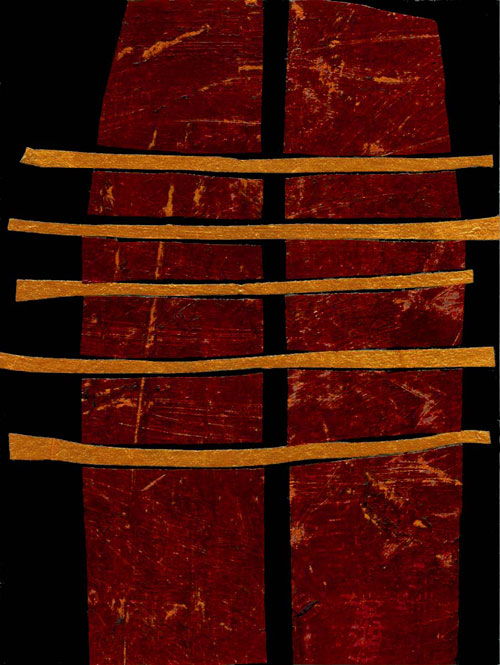
Buried © Jan L. Richardson

Reading from the Gospels, Year A, Proper 28/Ordinary 33/Pentecost +22: Matthew 25.14-30

So I’ve flown to Toronto, celebrated my sister’s wedding, enjoyed some quality family time (and some crisp Canadian weather), and am winging my way back home as I write. And still those bridesmaids are traveling with me, the ones from last Sunday’s gospel lection. Maybe it has something to do with the synchronicity of their story popping up in the lectionary during the week of my sister’s wedding, but I suspect the persistence of the bridesmaids’ presence simply means they’re not finished with me yet.

It’s the so-called foolish bridesmaids in particular who have lingered with me, the ones who found themselves lacking the oil reserves that would have granted them admittance to the wedding festivities. They’ve been haunting my imagination as curious twins of the wise, well-provisioned bridesmaids. Embodying that which we are urged to reject, the foolish bridesmaids are the wise bridesmaids’ shadow sisters. They challenge us to ponder the part of ourselves that can’t get it together, that is content to live with lack, that is caught in cycles of procrastination and passivity. Their presence calls us to reckon with our resistance toward looking beyond the obvious options.

The foolish bridesmaids appear willing to accept the groom’s verdict, his denial of entry, without question. Perhaps they have forgotten that God performs miracles with oil, as in the story of the hungry widow of Zarephath, who, in her lack, gave hospitality to Elijah, and whose jar of oil was perpetually replenished (1 Kings 17.8-16). The women of Jesus’ parable seem not to know the occasions when God provided water in the wilderness, or the times when Jesus turned a couple of fish and a few loaves of bread into a feast that fed thousands who neglected to pack a lunch, or the story of the woman who told Jesus that even the dogs ate the crumbs from beneath the master’s table, and who thereby won a healing for her daughter. The foolish bridesmaids haven’t heard the story of the widow who hounded the judge until he gave her justice. They haven’t encountered Jesus’ counsel in Luke 11, where, in teaching about persistence in prayer, Jesus invites his listeners to imagine going to the house of a friend at midnight and asking for three loaves of bread for a guest who has arrived. “I tell you,” Jesus says, “even though he will not get up and give him anything because he is his friend, at least because of his persistence he will get up and give him whatever he needs.” Jesus goes on to say, “Ask, and it will be given you; search, and you will find; knock, and the door will be opened for you” (Luke 11.5-13).

Denied entry, these oil-poor bridesmaids don’t know—or don’t care—that they can knock harder on the door that bars them from the wedding feast, and that God has a fondness for those who, faced with two choices, search for Option C.

The Parable of the Bridesmaids is not merely a prelude to the parable of this week’s gospel lection but a parallel to it; in a sense, Matthew 25.14-30 is a retelling of the bridesmaids’ tale. Jesus emphasizes these parables’ parallel nature in the simile with which he starts his story: “For it is as if,” he says, and launches into his narrative of the man who, “going on a journey, summoned his slaves and entrusted his property to them; to one he gave five talents, to another two, to another one, to each according to his ability.” And thus begins one of Jesus’ most familiar parables.

We likely know the rest of this story, how one slave turns his five talents into ten, how the next turns his two talents into four, and how the third slave buries his single talent in the ground. On the day of reckoning, the two slaves proffer their profits and receive the expected praise, while the third offers this account: “Master, I knew that you were a harsh man, reaping where you did not sow, and gathering where you did not scatter seed; so I was afraid, and I went and hid your talent in the ground. Here you have what is yours.” He receives a thorough castigation for being wicked and lazy. His one talent is given to the man who now has ten, with the master offering this rationale: “For to all those who have, more will be given, and they will have an abundance; but from those who have nothing, even what they have will be taken away.” The parable ends with the master’s command to throw this “worthless slave…into the outer darkness, where there will be weeping and gnashing of teeth.”

Okay, may I just say it? I find myself liking the third servant more than the first two. The entrepreneurial servants of the parable do precisely as expected: they enlarge the master’s fortune in his absence, they follow his plan without question, they perform as he has compelled them to do. The third fellow, however, calls things as he sees them. He knows his master is corrupt, and, with a curious mix of courage and fear, he says so to his face. And thereby reaps the master’s wrath.

So I find myself wondering, why is it that we most often read this passage as a judgment against the third servant and not against the man who has perpetuated an unjust system? Do we really think that the harsh and reportedly corrupt master of this parable represents God, who, after a period of absence, comes back prepared to throw out those who have not performed as expected? Do I really want to be like the first two servants, willing to participate in and perpetuate injustice?

Much like the wise bridesmaids, the two multi-talented men serve as the foil for the one who proves inept and unprepared. One could say they are the suck-ups who provide a contrast to the screwup. We might wonder at a parable that presents a narrative ecosystem in which the only available choices seem to lie either in perpetuating the master’s corrupt business plan or hiding his loot in the ground.

But we might wonder, too, at the servant who perceives these as the only options. He is savvy enough to recognize the system that surrounds him, and, presumably, he has participated in it up to this point. He finally demonstrates a measure of bravery that enables him to, as the phrase goes, speak truth to power. But like the foolish bridesmaids, he possesses a streak of passivity that, within the landscape of the parable, proves his undoing. Perhaps this is what makes each of them—the hapless bridesmaids, the single-talent servant—foolish: ultimately, they prove unwilling to take responsibility for pushing toward another option, looking for another choice. They have forgotten the God who startles with stunning abundance in the midst of the starkest lack.

The servant who buried his sole talent reminds me that when we cannot imagine other possibilities, we tend to hoard what we have, clinging to what is comfortable or at least familiar. And not only to hoard, but to hide. In the absence of eyes to see the wealth that God reveals in the wilderness, we secret away what small measure we have, thinking it will be enough to sustain us, and hoping it will protect us. It’s difficult, however, to draw sustenance from secrets, and it’s hard even for God to bless and multiply that which remains hidden. Darkness has its uses, and its gifts: growth requires gestation, a season of deep shadow, the absence of light for a length of time. But what we leave underground too long grows distorted and becomes decayed. As the third servant discovered, what we hide—our habits, our beliefs, our own selves—has a way of unburying itself.

I take this parable seriously as a profound call to unhide ourselves, to resist accepting the obvious options, to stretch ourselves toward the fullness for which God created us. I recognize how this story, along with the parable of the bridesmaids, warns of the pain that comes from our passivity. Yet I also read this parable in the light of the stories of the God who does miracles with what is most basic and elemental: oil, water, wine, bread, our very selves. This is the stuff in and through which God brings transformation, and the means by which God sustains the world.

This week I find myself wondering, what do I hide, and why? What parts of my created self have I sent underground? Is there anything I’ve left too long in the dark? Do I harbor any passivity that I need to invite God to turn into persistence? As the season of Advent approaches, with its rich play of light and dark, what might God desire to reveal and to transform in my own life?

In these lingering days of Ordinary Time, may God stir our imagination, sharpen our vision, and give us courage to unhide what God desires us to offer. Blessings.

[To use the “Buried” image, please visit this page at janrichardsonimages.com. Your use of janrichardsonimages.com helps make the ministry of The Painted Prayerbook possible. Thank you!]

Midnight Oil

November 4, 2008


Midnight Oil © Jan L. Richardson

Well, my suitcase has just barely finished cooling off from my recent trip to Seattle, and already I’m packing again. This week I’m heading to Toronto, with joyous cause: my sister is getting married. I have received official approval from the Canadian government to perform the wedding, learning along the way that the wheels of bureaucracy turn at about the same speed across international borders. I am grateful to the folks who provided support and endorsement in the process, including a couple of officials in The United Church of Canada, the denomination that served as the “governing authority” that, per Canadian requirements, sponsored my application. The wedding will be small and sweet. I’m working to resist the urge to ask my Canadian-transplant sister, when it comes time in the ceremony, “So, you take this man, eh?”

So I have matrimony on my mind, which coincides well with this week’s gospel lection. Matthew 25.1-13 offers the Parable of the Ten Bridesmaids, which has sometimes been referred to as the Parable of the Wise and Foolish Virgins, owing to the pronounced distinction that the parable makes between the two groups. As was the case with the Parable of the Wedding Banquet that we visited just a few weeks ago, this lection offers a setting that calls to mind my wedding anxiety dreams, which generally fixate on some aspect of not being ready for the big event. With its emphasis on being prepared, our story at hand does little, on the surface, to alleviate my lurking anxieties.

This is a tale to leave procrastinators quaking. Jesus’ story provides little solace for those of us who struggle with being prepared and timely. There seems to be no help here for the five bridesmaids who lack the oil necessary to trim their lamps. The five wise bridesmaids certainly don’t offer any aid. These bridesmaids may be well stocked with oil for their lamps but they seem dramatically lacking in grace toward those who find themselves oil-poor.

Fortunately, Jesus has plenty to say elsewhere about grace, and I don’t think that’s the primary issue he’s trying to tackle in this parable, though grace does surface in a roundabout manner. With this story of the bridesmaids, Jesus beckons his hearers to give thought to their own role in their relationship with the divine. He lifts up the necessity of taking personal responsibility, a quality not always embraced these days. The good news in this parable, and in the Christian faith, is that we do not have to look to someone else to mediate our relationship with Jesus, nor does our inclusion in the body depend on access to special secrets. This parable implies that wisdom comes not in having hidden knowledge; even the wise bridesmaids didn’t know what time the bridegroom would show up. Rather, wisdom lies in discerning and cultivating what is ours to offer. The wise bridesmaids may seem graceless, but providing for everybody isn’t the bridesmaids’ job here. It’s one occasion where taking care of everyone else isn’t a woman’s responsibility. The wise women of this story instead call us to attend to that which will deepen our relationship with God and hone our ability to receive God’s ever-present grace.

The wise bridesmaids do what is necessary to provide light. In the context of the teaching that Jesus is doing here about the kingdom of heaven and the end of days, it’s good to remember that, at its Greek root, the word apocalypse means to reveal, to uncover, to unhide. The bridegroom is meant to be seen when he finally arrives (as is the bride, who, though some of the most ancient manuscripts of Matthew include a reference to her, for the most part is curiously absent from this story). The bridesmaids, these women, are the ones who provide the light by which the celebrants may see the groom.

Later in this chapter Jesus will become quite specific about the sorts of actions that provide light for the world—the radical stuff of feeding the hungry, clothing the naked, visiting prisoners. Jesus means for these light-bearing bridesmaids to inspire and model for us what it means to perceive the presence of Christ among us and to minister to him in the infinite and surprising variety of forms that he takes. This parable, in fact, offers a powerful resonance with the gospel stories of the women who, seeing Jesus and recognizing who he is, anoint him with oil in a lavish fashion.

We have to be cautious with this text, however, lest it tempt us to think Jesus’ point is all about work—that our invitation to the party depends on what we do. All ten bridesmaids, after all, were invited to join in the celebration. And all ten fell asleep, so, though Jesus admonishes his hearers to stay awake, it wasn’t solely for somnolence that the unwise bridesmaids were denied entrance. Evidently what makes the wise bridesmaids wise is that they know what it takes to make a party. We need light, that we may see one another and know one another. We need light so that we may recognize the one who beckons us to join in the feast, not because he wants only to put us to work but also because of the sheer fact that he desires our company and delights in our presence.

When I was in seminary, I heard Jim Wallis, one of the founders of the Sojourners community, tell a story about a colleague living in a village in Central America. She worked in a community that was marginalized in all kinds of ways. She poured herself into her work for social justice, laboring with great might to bring change to this village. One day, some of the people of the village came to her, asking her why she worked so hard, why she didn’t join them in their fiestas or sit with them in their porches in the evening.

“There’s too much work to do!” the laboring woman replied. “I don’t have enough time.”

“Oh,” the people of the village said. “You’re one of those.”

“One of who?” the woman asked.

“You are one of those,” they responded, “who come to us and work and work and work. Soon you will grow tired, and you will leave. The ones who stay,” they said, “are the ones who sit with us on our porches in the evening and who come to our fiestas.”

Jim Wallis said that his colleague took the story to heart, that she became a party animal, and that she was still there.

There is work to do: flasks to be filled, lamps to be lighted, long nights ahead that call for labor and readiness instead of rest. Especially with Advent approaching, it’s a good time to ask ourselves what it is we’re getting ready for, and how, and why. It’s a good time, too, to ponder how, and whether, we are seeking sustenance for our own selves. We cannot find or fashion light merely by our own efforts; it comes not solely with labor but by opening ourselves to the light of Christ that we find as we linger with one another.

This is the place where I would normally ask what practices help you cultivate your openness to the God who calls us to the celebration—what are you doing to keep your oil flask full? But I find myself thinking of the fabled story from the desert fathers, the one where Abba Lot goes to Abba Joseph and recites the list of practices by which he’s seeking the presence of God: praying, meditating, fasting, etc. “What else can I do?” he asks. Old Abba Joseph stands up and stretches his hands toward heaven. His fingers, the story says, become like ten lamps of fire. “If you will,” Abba Joseph says to Abba Lot, “you can become all flame.”

And so I want to ask, not just how are we keeping our oil flasks full, not just how we’re taking care of our lamps, but how might we ourselves become all flame? What are we burning for? How do we become people who do not merely carry well-provisioned lamps but who are vessels of living light, illuminated by the one who called himself the Light of the World?

On this dark November night, this prayer: For one another, with one another, may we blaze.

Blessings.

[To use the “Midnight Oil” image, please visit this page at janrichardsonimages.com. Your use of janrichardsonimages.com helps make The Painted Prayerbook possible. Thank you!]

[Abba Joseph story from The Sayings of the Desert Fathers, translated by Benedicta Ward, SLG.]

Feast of All Saints: A Gathering of Spirits

October 26, 2008


A Gathering of Spirits © Jan L. Richardson

Ahhhh…it’s the Feast of All Saints, almost. I love this time of year. Here in central Florida we’re just beginning to touch the fringe of Autumn’s cloak. There’s something stirring, a shift in the works, and it doesn’t have to do solely with the weather.

I’m not sure quite when it started, but for many years, the trinity of days from October 31 to November 2, encompassing Halloween, All Saints’ Day, and All Souls’ Day, has been a thin place in the landscape of my year. The ancient Celts, who celebrated the major festival of Samhain around November 1, believed that the veil between worlds became especially permeable at this time. In something of that spirit, I find that these days offer an invitation to ponder the past. Not with a desire to return to it, or to second-guess it, but with a mindfulness of what has gone before, and perhaps to have a brief visit from the ghosts of What Might Have Been.

It’s this kind of impulse that gave rise to the feasts of All Saints and All Souls. Recognizing the ancient habit of looking to the past at this time of year, the church created new ways to remember the dead with practices in which we can still hear the echoes of the ancient celebrations. Each culture that observes these feast days continues to add their own layers of meaning and mystery, as with the Día de los Muertos (Day of the Dead) celebrations that originated in Mexico (and which, of course, rest on pre-Christian festivities). My own observance of these days usually includes setting aside some time for quiet, for remembering, for prayer, for doing some writing that’s just for me. And good food, of course. And lighting a few flames.

I had a taste of the Feast of All Saints a bit early this year. The theme for the Grünewald Guild’s gala dinner and auction that Gary and I helped with in Washington last weekend was A Gathering of Spirits. The title came from Carrie Newcomer’s song of the same name, which she wrote out of her experiences of teaching at the Guild. I created a piece of artwork for the auction and the cover of the evening’s program—it’s the image you see above—and designed it with the theme, and Carrie’s song, in mind. It shares the same title.

The folks who contributed artwork to the auction each had to write an artist’s statement to accompany our piece. Here’s how mine went:

Before the paint, before the color-drenched layers, it began with a prayer. Penciled words across the white paper: a litany of blessing, a liturgy of thanksgiving for a holy place in the Plain Valley where the worlds of art and faith intertwine. Then the painting, then the cutting, then the layering of papers atop the penciled prayer. With every piece, another prayer; with every layer, another memory of those who have passed through the thin, thin place that is the Guild. Remembering how their presence lingers. A communion of saints, say, to sustain us when the way grows daunting. Or call it this: a gathering of spirits.

What stirs your memories in this season? Who are the folks, living or dead, who linger close in these days? Whom do you gather with? Who or what haunts you? How do your memories help inspire your path ahead?

May this week offer you a thin place and a gathering of good spirits. Blessings.

(To use this image, please visit this page at janrichardsonimages.com. Your use of janrichardsonimages.com helps make the ministry of The Painted Prayerbook possible. Thank you!)

Crossing the Country, Thinking of Love

October 24, 2008


The Two Commandments © Jan L. Richardson

Reading from the Gospels, Year A, Proper 25/Ordinary 30/Pentecost +19: Matthew 22.34-46

Last week. Thursday. Gary and I are somewhere over the continent, making an arc toward Seattle. We are flying across the country to help with an event for the Grünewald Guild; Gary to perform, me to serve as emcee for the gala dinner and auction that will help raise funds to sustain this remarkable retreat center. This is a bonus trip, an out-of-season treat; I’ve never been to Washington State except in the summer, when I go to teach at the Guild, nor have I seen most of these folks anywhere but on the Guild’s property.

I’ve finished the collage for this post and am ambitious to think that I can write the accompanying reflection en route to Seattle. With my tray table serving as a makeshift desk, I turn to Sunday’s lection once again. Matthew gives us another encounter between Jesus and the Pharisees, with this one containing their question, “Teacher, which commandment in the law is the greatest?” Quoting from the Hebrew scriptures, Jesus tells them, “‘You shall love the Lord your God with all your heart, and with all your soul, and with all your mind.’ This is the greatest and first commandment. And a second is like it: ‘You shall love your neighbor as yourself.’ On these two commandments,” Jesus says, “hang all the law and the prophets.”

I pull out some notes that I had jotted down as I prepared for this trip. They are filled with impressions, questions, points of connection between the text of the scripture and the text of my life. There are scripture verses I’ve scribbled down. This passage not only drew from earlier sources but also inspired later scripture writers, so there is a web of texts that link to this one. I’ve written down Deuteronomy 6.5, from which Jesus quotes in responding to the Pharisees. It’s part of the Shema, the prayer that lies at the heart of Jewish life: “Hear, O Israel: The Lord is our God, the Lord alone,” the ancient prayer begins. And Leviticus 19.18: “You shall not take vengeance or bear a grudge against any of your people,” God compels Moses to tell the people of Israel, “but you shall love your neighbor as yourself: I am the Lord.” There is Mark 12.28-34, a parallel to Matthew’s version, which places Jesus’ questioner in a rather different light. And Luke 10.25-37, where, alone among the synoptic gospels, Jesus uses the question as an occasion to tell the Parable of the Good Samaritan.

Romans 13.8-9 appears among my notes. “Owe no one anything,” Paul urges the church in Rome, “except to love one another; for the one who loves another has fulfilled the law.” Galatians 5.14, in which he writes, “For the whole law is summed up in a single commandment, ‘You shall love your neighbor as yourself.'” And James 2.8, where the writer refers to love of one’s neighbor as the “royal law.”

Psalm 110.1 made its way into my notes. It’s the piece of poetry that Jesus quotes in the second portion of this week’s lection, where he poses his listeners a question about how David can call the Messiah “Lord,” if the Lord is his son. It seems a bit of an odd turn, a particularly circuitous question that Jesus has devised to stump his listeners. (It works, evidently. “No one was able to give him an answer,” Matthew says in concluding the passage; “nor from that day did anyone dare to ask him any more questions.”)

Looking up from my notes, I hand the gospel passage to Gary, ask him what he thinks. Does this second part of the reading offer a connection with Jesus’ words about love, or is it a distinct passage that happens to be in the same lection but requires a separate treatment? Gary ponders the passage for a bit, then suggests that each portion offers a commentary on the relationship between humans and God. The first part seems straightforward, if sometimes gut-wrenchingly difficult. In the second part, there is a deft subtlety in Jesus’ confounding question. In challenging his hearers to ponder how the Messiah can be both David’s ancestor and heir, Jesus underscores the manner in which he stands both within time and beyond it. He is Love embodied, entering into the fullness of what it means to wear flesh in this world. Yet he reminds us that Love is not bound by time, is not confined to chronology, can take us in seeming circles as we enter deeper and deeper into its mysteries.

I ponder these things, then finally I put my notes away, and my Bible, and my laptop. I am tired in body and in brain. There is time yet to try to work all the scattered notes and questions and thoughts into some sort of coherence. For now, I sit back, speeding over the darkened, unseen landscape below. Jesus’ words persist like a refrain, like a heartbeat, a steady pulse as we pass through another time zone, and another. Arcing across the country, I am traveling with someone I love, traveling toward people I love, all of whom continue to teach me about the mysteries of the simple yet achingly intricate commandment of love, this ancient law that draws us so far beyond ourselves and yet circles us deeply back within.

I close my eyes, resting before the arrival. Waiting. For now, it is enough.

How about you? What challenges and what gifts do you find in Jesus’ words in this passage? Where has love led you? Toward what—or whom—do you feel it drawing you? What sustains you along its path?

Blessings.

[To use the “Two Commandments” image, please visit this page at janrichardsonimages.com. Your use of janrichardsonimages.com helps make the ministry of The Painted Prayerbook possible. Thank you!]

Taxing Questions

October 14, 2008


Taxing Questions © Jan L. Richardson

Reading from the Gospels, Year A, Proper 24/Ordinary 29/Pentecost +18: Matthew 22.15-22

I’ll not make too much of the fact that this week’s gospel lection, Matthew’s famous “render unto Caesar” passage, falls during a week that has also included doing the paperwork for my quarterly sales tax payment. The timing is a mild coincidence that could tempt me to rant a bit about how I’d be happier to render unto Caesar if he didn’t it make it so *!@?!# difficult, and didn’t provide so many convoluted disincentives to those who work to be conscientious about our rendering. But, like I said, I’m not gonna rant.

The point of this passage, which also appears in Mark and Luke’s gospels, isn’t really about paying taxes, anyway. Each of these three evangelists makes a point of stating that Jesus’ questioners are seeking to entrap him with their queries. Luke adds a couple of details in his version, noting that the religious leaders sought to “trap him by what he said, so as to hand him over to the jurisdiction and authority of the governor.” Luke goes on to say that Jesus “perceived their craftiness” as they asked him, “Is it lawful to pay taxes to the emperor, or not?”

I know these questioners. I’ve met them, these folks who have learned the knack of asking questions that aren’t really questions but rather are a litmus test. I think of the friend years ago who, upon learning of my call to ordained ministry, began to barrage me with a series of questions organized around other topics that I (a woman pursuing ordination) must be equally wrong about: What did I think about homosexuality? Fornication? The inerrancy of scripture? Or the member of a church I once served, who walked into my office one morning with bagels and tea; his hospitality proved short lived, as he then set upon me with what amounted to arguments with question marks tacked onto the end.

There’s a kind of violence to this form of encounter in which someone, whether through intention or through an unconscious ingrained pattern, approaches us with an inquisitiveness that harbors a weapon. In these hands, questions transmogrify into snares, cudgels, tools for distancing and defining and diminishing. Thinking they already know the answer, such questioners aren’t really interested in engagement but in finding confirmation of their assumptions and fodder for their prejudices.

With his craftiness detector on, Jesus recognizes a loaded question when he hears it. And he doesn’t exactly choose to turn the other cheek here. He, too, possesses a certain level of cunning; he responds to the question, but he cuts through their assumptions about how he will answer it. Given choices of A or B, Jesus will always come up with an inventive C.

I’m intrigued by his ability to do this—by his capacity to receive every question that every person poses to him, by his ability to recognize when he’s being baited, by his ingenuity in coming up with an unexpected response. Most of all I’m intrigued by the remarkable grounding that helps him to achieve this. This takes an intense clarity, a deep sense of who one is and what one is called to do. Faced with those who approach us with assumptions and ulterior motives, having this kind of clarity and grounding offers some hope of responding as Jesus did. It takes, too, cultivating an imagination that sees beyond limited and limiting choices and the assumptions that underlie them.

Where do we get this kind of grounding, clarity, and imagination? I found myself thinking of one example during a phone conversation last night with the St. Brigid’s community. We were reflecting on the practice of praying the Psalms, using as our starting place Kathleen Norris’s splendid essay on “The Paradox of the Psalms” in her book The Cloister Walk. As we talked about the gifts and challenges of praying the Psalms, I remembered a story that Robert Benson relates at the opening of his book Between the Dreaming and the Coming True. He tells of being in a class with “a man with his well-worn, heavily marked Bible open before him, playing a game of ‘trap the teacher.’ He should have known better,” Benson observes, “than to try to trap this particular teacher. Those who pray the Psalms by heart do not rattle very easily.” Benson continues,

The teacher was finishing up a series of talks on praying the Psalms that she had been giving to a community of about sixty of us. I do not now remember the man’s question. I remember only that it had a ‘Well, that is all very well and good, but the God of Abraham [and, therefore, of judgment and vengeance, one got the feeling] is going to make sure that the good guys get into heaven and the bad guys don’t, no matter what’ edge to it. It was asked in a spirit that was not exactly in keeping with the spirit of our prayer community, which was to be together for two years.

Hazelyn McComas looked at him for a minute and then said softly, and with fire in her eyes, ‘I cannot answer that. But I can say this: We Christians are awfully hard on each other and on ourselves, too. And we seem to be especially that way about things that may not really matter.’

In recounting the rest of McComas’s response, Benson solidifies his depiction of her as a woman who was able to respond in much the same way that Jesus did when posed with a taxing question. Recognizing its intent, she neither dismisses it nor gives in to the assumptions that framed it. She finds another way, a true response that rises from the depths of who she is.

Benson recognizes the life of prayer that provides the deep well from which McComas responds to her questioner. She has, he says, “spent a life seeking for glimpses of and listening for whispers of God within the ancient prayers of the Chosen People.” I love his observation that “Those who pray the Psalms do not rattle very easily.”

It’s one thing to know the surface of the scriptures, and another thing entirely to enter the Bible as a place where God meets God’s people—an approach that runs through Hazelyn McComas’s teaching. Entering the biblical text with the desire to meet God enables us to frame our questions, and to respond to the questions of others, in a dramatically different way. When we travel the scriptural landscape as a pilgrim open to the presence of God in every place, rather than as a tourist who thinks we know everything about a place because we’ve visited it a few times, we cultivate a humility that fosters the kind of clarity and imagination that fueled Jesus’ response to his interrogators.

Jesus, of course, prayed the psalms.

I’m not wanting to turn this into a reflection specifically about praying the psalms, but Matthew’s text got me thinking about Robert Benson’s story, and Hazelyn McComas’s, and about my own story of attraction and resistance toward the psalms, those ancient prayers that have sustained the people of God for millennia and that lie at the heart of the monastic tradition to which I feel so drawn. And all these stories are part of the larger story of my own searching and hungering to meet God in the scriptures and elsewhere, and to sink my roots deep into a landscape that helps me grow into someone who can recognize and ask the questions that matter, and resist the ones that don’t.

So what kinds of questions are you receiving these days, and how do you respond? What questions are you asking, and where are they coming from? Are there ways that you try to box Jesus in, thinking you know how he’s going to act in your life? Are there ways that you allow yourself to be boxed in by others or by your own self? What practices help you meet God, in our sacred texts and elsewhere? How do you cultivate an openness to the surprising, imaginative, unexpected ways that God might be wanting to act in your life? What’s option C?

What are you rendering to God?

In these days, may we be people of remarkable imagination. Blessings.

[To use the “Taxing Questions” image, please visit this page at janrichardsonimages.com. Your use of janrichardsonimages.com helps make the ministry of The Painted Prayerbook possible. Thank you!]

News from the Studio

October 13, 2008

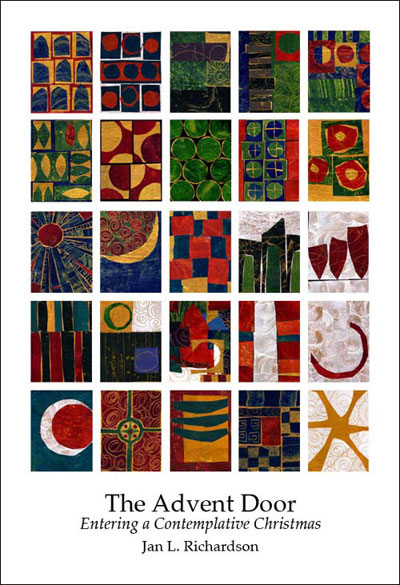
With Advent just around the corner (this year it begins on November 30), the coming season is on my mind. I am all for not rushing into the next season before this one is done (though Ordinary Time does go on for such a long stretch and I’m about ready for a shift), but I did treat myself to one Christmas CD this weekend (the wondrous La Bela Naissença: Christmas Carols from Provence) to inspire me as I worked on a new print. The print features the twenty-five collages that I created last year for my other blog, The Advent Door. Inspired by the tradition of the Advent calendar, which offers a treat for each day between December 1 and 25, I created a collage and reflection for each of those days.

The new print is available on my web site, either by visiting the main page at janrichardson.com or by going straight to the Color Prints page. With its invitation to cross the thresholds of Advent with a mindfulness that sometimes eludes us in the weeks leading to Christmas, it makes a nifty gift for yourself and others. I’d be delighted for you to stop by and check it out, and also to pay a visit to The Advent Door, where I’ll be painting some new doors as the next season gets rolling.

Until then, may the presence of God linger close to you in these ordinary days.

Getting Garbed

October 10, 2008


Getting Garbed © Jan L. Richardson

Reading from the Gospels, Year A, Proper 23/Ordinary 28/Pentecost +17: Matthew 22.1-14

I have anxiety dreams. Not frequently, mind, but they do pop up once in a while. And for the past couple of years it’s been the case that when the anxieties floating around my subconscious emerge in a dreamscape, they tend to attach themselves to one activity in particular:

Weddings.

I have anxiety dreams about other people’s weddings. I’m performing the ceremony, and I’m running late. Or I’m in the church, but I can’t get to the sanctuary. Or the ceremony is about to happen, and I realize we haven’t actually planned it. Or I don’t have my robe.

I have anxiety dreams about my own wedding, which, God willing, will take place about this time next year. (Note to those who know us: this does not constitute an announcement! It’s not official; we haven’t set the actual date!) It’s the day of the wedding, and I haven’t sent out the invitations. Or we’ve taken care of every detail except for actually planning the service. Or the wedding starts in five minutes and I haven’t dressed. Or I don’t have a wedding gown.

The anxious landscape of those wedding dreams feels to me a lot like the setting of this Sunday’s gospel lection. In Matthew 22.1-14, we find a wedding banquet that is, by turns, wondrous and terrible. It reminds me, in fact, of the old “That’s good! That’s bad!” shtick. In this case, it would go something like this:

A wedding banquet! That’s good!
No, that’s bad; the invited guests didn’t come!
But the king sent people to look for them! That’s good!
No, that’s bad; they killed them and burned their city!
But then they went into the streets and invited everyone they found! That’s good!
But then the king saw a guy who wasn’t wearing a wedding robe, and he had his attendants throw him into the outer darkness, where there will be weeping and gnashing of teeth!

Oh, that’s bad. Definitely very bad.

It’s a wondrous text. In its high points, it shares similarities with Luke 14.15-24; both passages contain parables of a great wedding banquet to which the invited guests find reasons not to go, and so a wild and wondrous array of last-minute B-list folks wind up enjoying a splendid feast. It’s one of my favorite depictions of the kingdom of God.

It’s a terrible text. In his version of the wedding banquet, Matthew sets the stakes considerably and painfully higher than does Luke. Those who refuse to come suffer violent repercussions. Matthew’s inclusion—and punishment—of the hapless, robeless fellow strikes a particularly curious note that feels like a scene out of one of my wedding anxiety dreams.

The fellow comes to the banquet, after all, but somehow, whether by intention or inadvertence—the text isn’t clear—he misses the line where they were handing out wedding robes. The severe punishment inflicted upon him got me wondering about the significance of the missing wedding garment, and, beyond that, about the symbolism of clothing in scripture, and how it bears on this story.

Given that the Bible doesn’t always provide a wealth of descriptive details, I was surprised and then fascinated as I considered the scriptures with garments in mind. Significant mention is made of clothing from almost the very beginning. When God exiles Adam and Eve from Eden, God does not leave them to their fig leaves; in a charmingly domestic gesture, God “made garments of skins for the man and for his wife, and clothed them” (Gen. 3.21). Exodus tells of the lavish vestments fashioned for Aaron and his sons, clothing that was intertwined with their ordination and service as priests of God. When Ruth, a stranger from another land, seeks security in her new home, she goes by night to her kinsman Boaz, asking of him, “Spread your cloak over your servant” (Ruth 3.9). In Matthew’s gospel, the hem of Jesus’ robe becomes a conduit of healing for a woman who has bled for years (Mt. 9). The father of the prodigal son cries out for his returning child to be garbed in the best robe (Luke 15.22). In John’s version of the crucifixion, the soldiers’ division of Jesus’ clothing and their casting of lots for his tunic is seen as a fulfillment of Psalm 22: “They divided my clothes among themselves, and for my clothing they cast lots” (John 19.24).

The book of Revelation surpasses all others in taking particular note of what people are wearing; their garb is laden with symbolic import, with white robes achieving particular prominence. The visionary John draws our attention to “one like the Son of Man” who is clothed with a long robe and a golden sash (Rev. 1), white robes that will be given to members of the church in Sardis “if you conquer” (Rev. 3), the twenty-four elders surrounding the throne who wear white robes and golden crowns (Rev. 4), martyrs who receive a white robe (Rev. 6), a multitude clad in robes that have been made white by washing them in the blood of the Lamb (Rev. 7), an angel garbed with a cloud (Rev. 10), witnesses who prophesy wearing sackcloth (Rev. 11), a woman clothed with the sun (Rev. 12), seven angels robed in pure, bright linen and golden sashes (Rev. 15), a bride clothed with fine linen that is the righteous deeds of the saints (Rev. 19), and a rider wearing a robe dipped in blood who is followed by armies clad in fine white linen (Rev. 19).

Clothing carries such symbolic weight that, in the scriptures, simply being in relationship with God and doing what God would have us do is spoken of in the vocabulary of textiles. “I put on righteousness,” Job claims in one of his discourses, “and it clothed me; my justice was like a robe and a turban” (Job 29). “I will greatly rejoice in the Lord,” Isaiah exults, “…for he has clothed me with the garments of salvation, he has covered me with the robe of righteousness, as a bridegroom decks himself with a garland, and as a bride adorns herself with her jewels” (Isaiah 61).

From Genesis to Revelation, clothing takes on significance in virtually every case as a sign of God’s providence. Time and again, God cares for God’s people by providing clothing for them. It is a tactile, tangible, textured sign of God’s mercy, care, and love. Perhaps to help make up for giving us such vulnerable skin, God works to ensure that we have something to wear. So important is this that God compels us to participate with God in providing clothing for one another. Covering the naked with a garment is among the list of actions in Ezekiel 18 that make a person righteous. Jesus picks up this theme with particular directness in Matthew 25: “Then the king will say to those at his right hand, ‘Come, you that are blessed by my Father, inherit the kingdom prepared for you from the foundation of the world…I was naked and you gave me clothing….” And if anyone takes our coat, Jesus tells us, “do not withhold even your shirt” (Luke 6).

So providential is God on this point that Jesus specifically instructs us not to sweat the clothing issue. “And why do you worry about clothing?” he asks. “Consider the lilies of the field, how they grow; they neither toil nor spin, yet I tell you, even Solomon in all his glory was not clothed like one of these. But if God so clothes the grass of the field,” Jesus continues, “which is alive today and tomorrow is thrown into the oven, will he not much more clothe you—you of little faith? Therefore do not worry, saying, ‘What will we eat?’ or ‘What will we drink?’ or ‘What will we wear?’” (Matthew 6.28-31).

So, given how hospitable God is when it comes to garbing us, what’s the deal with the garmentless guy getting booted out into the teeth-gnashing darkness? Where is the good news in this parable?

I’m intrigued by the suggestion, posed by a couple of folks I’ve come across, that we rethink our tendency to assume that the king of this parable is God, who comes off looking supremely grumpy and vindictive in this tale. These exegetes suggest that the king instead symbolizes earthly authorities, and the robeless man thrown into the darkness in fact refers to Jesus. They draw our attention in particular to Isaiah 52.13-53.12, where the prophet describes the suffering servant. In his silence and in his afflictions, the servant indeed bears a resemblance to the wedding guest whom the king commands his attendants to bind and throw into the darkness.

Particularly bearing in mind that Jesus grounded his teachings in the Hebrew Scriptures, it’s an enticing suggestion to ponder. I’m not clear, however, that it explains everything. Jesus is telling the parable to describe the kingdom of heaven, and it seems hard to get around the implication that the king in this kingdom is, well, God.

The text doesn’t provide enough clues for us to be certain whether the wedding guest was missing a robe by intention or by accident. Jesus seems to imply that the guest failed to properly receive the sacred hospitality extended to him, or to receive it fully enough—he deigned to come to the feast, but not to wear the correct attire—and therefore was punished in such a fashion that one wonders if perhaps it would have been best for him not to have come at all.

Given the scriptural witness to God’s bias in favor of garbing the garmentless, it seems fair to interrogate the text and its traditional interpretation. At the very least, we need to read Jesus’ parable in light of the scriptures’ well-established depiction of God as one whose propensity for clothing us extends even to the prodigal.

For my part, in pondering this passage in the realm of lectio divina, all my wonderings have come down to this:

What am I clothing myself in? Or, perhaps more precisely, how am I allowing God to garb me these days?

Am I feeling good because I’ve accepted God’s invitation to show up at the feast, but in truth have neglected to open my arms fully to the wonders before me? Am I harboring some sense of rebelliousness—I’ll come in for the party, but you can’t make me dress right? Given that I think a measure of well-placed rebellion is okay, how do I work to ensure that I’m not directing my rebelliousness toward God and God’s hospitable intentions toward me? And on those occasions when I’m wrestling with God, or needing things to be less intense in my relationship with God, or when I simply need to temporarily set aside a metaphorical holy cloak that’s grown too weighty or wearisome, can I trust that God won’t bind me and send me into the darkness to gnash my teeth? If, in my waking life, I’ve wandered into a landscape that feels like those wedding anxiety dreams—I’m not in the right place, I can’t get there, I’m not ready, I don’t have the right thing to wear—can I rest in the God who gives party clothes to the prodigal and spreads a cloak over the stranger and, in baptism, clothes us with Christ’s own self (Galatians 3)? Can I trust that this same God will provide what I need and will let me linger at the feast?

I think I can do that. How about you?

In her wondrous book Showings, also known as Revelations of Divine Love, the medieval English mystic Julian of Norwich wrote, “Our good Lord is our clothing that, for love, wraps us up and winds us about, embracing us, all beclosing us and hanging about us, for tender love.” In these days, may you know the beclosing clothing of Christ, and extend it to those who cross your path. Blessings.

[To use the “Getting Garbed” image, please visit this page at janrichardsonimages.com. Your use of janrichardsonimages.com helps make the ministry of The Painted Prayerbook possible. Thank you!]

[Julian of Norwich quotation cited by Gail Ramshaw in Treasures Old and New: Images in the Lectionary.]

Feast of St. Francis

October 4, 2008


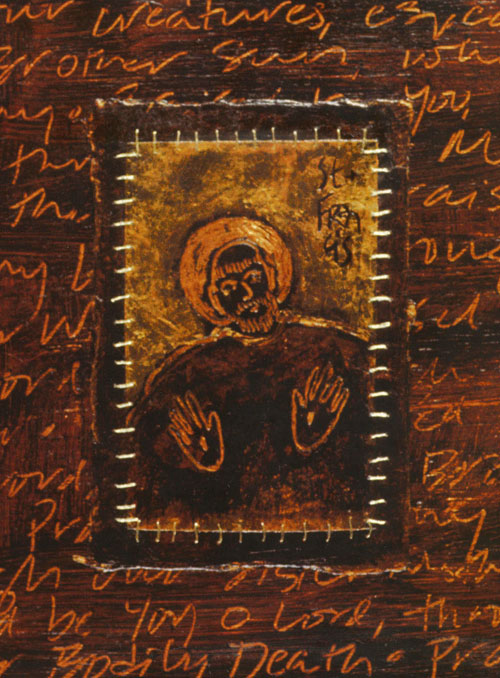
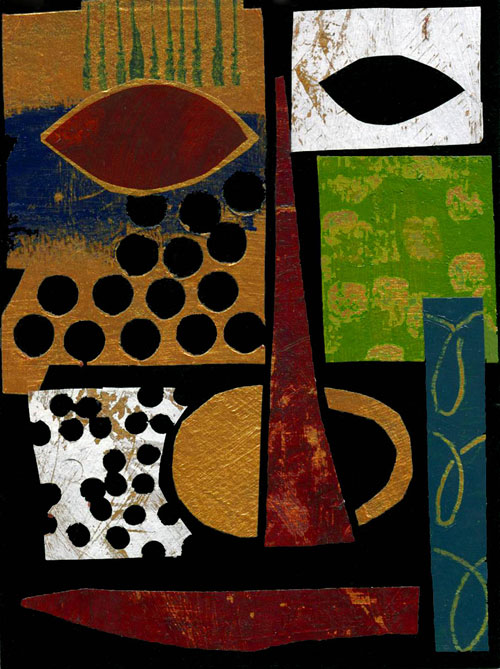
Saint Francis © Jan L. Richardson

Happy Feast of St. Francis! As I mentioned on the Feast of St. Clare, the hospitality of Franciscans has been a pivotal gift in my life, and I owe them much for helping to preserve my vocation and to sustain me when I made a flying leap into ministry beyond the local church. In particular, it was my Franciscan friend Brother David who helped to inspire that leap and gave me a place to land. I had met him when I was serving as a pastor. Shortly afterward, he established a Center for Art and Contemplation at the retreat center where he worked and where, thanks to the good graces of the Franciscans and not a few other folks, I would become artist-in-residence for some years.

David and his brothers at San Pedro Center gave flesh to the wonders and challenges of Franciscan life and to the spirit of St. Francis. Born in Italy in the 12th century, Francis gave up the riches of his family in order to embrace a life of radical devotion to God and to God’s creatures. He took as spouse the one whom he called Lady Poverty, and a community began to gather around him; they became known as the friars minor (“lesser brothers”). Their rhythm of life included preaching missions (Francis traveled widely, journeying even to Egypt), periods of fasting and prayer, and service to those who lived on and beyond the margins of the society, notably those living with leprosy. It was during a period of fasting and prayer prior to the Feast of Michaelmas that Francis, secluded on a mountain with Brother Leo, received the stigmata—the wounds of Christ.

We know St. Francis in large part for The Canticle of the Creatures, which he began during a time of intense illness. Of his desire to write the canticle, he said to his brothers, “I wish to compose a new hymn about the Lord’s creatures, of which we make daily use, without which we cannot live, and with which the human race greatly offends its Creator.” His praises include, famously, “Sir Brother Sun” and “Sister Moon and the stars” as well as “Brother Wind,” “Sister Water,” and “Brother Fire.” He counted mortality among God’s familiar and familial creatures; on his deathbed, Francis added verses that included the line, “Praised be You, my Lord, through our Sister Bodily Death, from whom no one living can escape.”

Francis left behind a handful of other writings that testify to his deep and simple love of God. With World Communion Sunday coming up tomorrow, it seems fitting to include this portion from A Letter to the Entire Order, which Francis wrote in 1225-1226:

Let everyone be struck with fear,
let the whole world tremble,
and let the heavens exult
when Christ, the Son of the living God,
is present on the altar in the hands of a priest!
O wonderful loftiness and stupendous dignity!
O sublime humility!
O humble sublimity!
The Lord of the universe,
God and the Son of God,
so humbles Himself
that for our salvation
He hides Himself
under an ordinary piece of bread!
Brothers, look at the humility of God,
and pour out your hearts before Him!
Humble yourselves
that you may be exalted by Him!
Hold back nothing of yourselves for yourselves,
that He Who gives Himself totally to you
may receive you totally!

And in the Earlier Rule that Francis wrote for his community, he pleaded,

Therefore,
let us desire nothing else,
let us want nothing else,
let nothing else please us and cause us delight
except our Creator, Redeemer and Savior,
the only true God,
Who is the fullness of good….

Therefore,
let nothing hinder us,
nothing separate us,
nothing come between us.

On this day of celebration, and all the days to come, may it be so. Happy Feast!

(Quotations from Francis of Assisi: The Saint, ed. by Regis Armstrong, O.F.M. Cap., et al.)

Artwork: detail from “St. Francis” © Jan L. Richardson. To use this image, please visit this page at janrichardsonimages.com. Thank you!

The Best Supper

October 3, 2008


The Best Supper © Jan L. Richardson

This Sunday is World Communion Sunday. Established by the Presbyterian Church (USA) in 1936 and originally called World Wide Communion Sunday, this day beckons us to be mindful that when we gather at the table, we celebrate not only with those present but also with sisters and brothers around the world.

The artwork above is a piece called The Best Supper. Inspired by the image of Wisdom’s Feast in Proverbs 9, this piece evokes the myriad meals that have fed me in body and soul. As I created this image, I was visited by memories of so many of the tables where I have found hospitality. Those memories are embedded among the pieces of this collage. Circling the table once again, I capture glimpses of those with whom I shared those sacred meals. I remember how we savored every scrap, how we lingered long after the last bite was consumed.

Table Blessing

To your table
you bid us come.
You have set the places,
you have poured the wine,
and there is always room,
you say,
for one more.

And so we come.
From the streets
and from the alleys
we come.

From the deserts
and from the hills
we come.

From the ravages of poverty
and from the palaces of privilege
we come.

Running,
limping,
carried,
we come.

We are bloodied with our wars,
we are wearied with our wounds,
we carry our dead within us,
and we reckon with their ghosts.

We hold the seeds of healing,
we dream of a new creation,
we know the things
that make for peace,
and we struggle to give them wings.

And yet, to your table
we come.
Hungering for your bread,
we come;
thirsting for your wine,
we come;
singing your song
in every language,
speaking your name
in every tongue,
in conflict and in communion,
in discord and in desire,
we come,
O God of Wisdom,
we come

Prayer © Jan L. Richardson from In Wisdom’s Path: Discovering the Sacred in Every Season.


Update:
Thanks to everyone who has requested permission to use this blessing or “The Best Supper” artwork. For worship services and related settings, you are welcome to use the blessing without requesting permission; all that’s needed is to include a line with this info:

© Jan L. Richardson. janrichardson.com

To use “The Best Supper” image, please visit this page at janrichardsonimages.com. Your use of janrichardsonimages.com helps make the ministry of The Painted Prayerbook possible. Thank you!

Prints of The Best Supper and other images are available by visiting the Art Prints page at janrichardson.com. We have greeting cards, too!