Archive for the ‘blessings’ Category

Easter 6: Love and Revelation

May 22, 2011

Image: Love and RevelationImage: Love and Revelation
© Jan Richardson

Reading from the Gospels, Easter 6, Year A: John 14:15-21

On a day more than six hundred years ago, in the English town of Norwich, a woman walked into a cell attached to the parish church. She intended to stay there for the rest of her life. The original name of the woman is unknown, and the cell where she would live as an anchoress—a woman devoted to a life of contemplation and solitude—no longer remains. It is likely that she took her name from the church in whose cell she lived: the Church of St. Julian.

Nearly everything we know about Julian of Norwich comes from a manuscript that she composed in her cell. In it she tells of how, at the age of thirty and a half, she became desperately ill. Just as she thought herself at the point of death, her pain suddenly departed. As Julian continued to pray, she was visited by a series of sixteen visions or revelations—what she called “showings”—in which she came to experience and know God’s love for her.

Julian recorded her visions in a short text, and then, after nearly two decades, she expanded on them in a longer text that incorporates the insights that she gained through years of reflecting on and praying with the visions. Together Julian’s texts became the book known as Showings, or Revelations of Divine Love.

In the final chapter of Showings, as Julian comes to the end of the remarkable work in which she has revealed to us a God whose endless mystery encompasses a deep desire to know and love us in all our human particularity, she writes,

And from the time that it was revealed, I desired to know in what was our Lord’s meaning. And fifteen years after and more, I was answered in spiritual understanding, and it was said: What, do you wish to know your Lord’s meaning in this thing? Know it well, love was his meaning. Who reveals it to you? Love. What did he reveal to you? Love. Why does he reveal it to you? For love. Remain in this, and you will know more of the same. But you will never know different, without end.

From her anchorhold, with her stunning simplicity, Julian echoes and embodies what her beloved Jesus says to his friends in this week’s gospel passage. At the table where he gathers with his disciples on the night before his death, he persists in telling them what he wants them—needs them—to know about who he is, what he has done, what he will yet do, what he is calling them to do after he is physically gone. In this passage, Jesus becomes very clear about why he wants them to know these things, and what underlies and encompasses and is the reason for their knowing.

“They who have my commandments and keep them,” Jesus says, “are those who love me; and those who love me will be loved by my Father, and I will love them and reveal myself to them.”

The knowledge that Jesus shares with his followers is not for the purpose of giving them worldly power. It is not designed to make them feel important, or to initiate them into secrets meant for a select few, or to make their lives easier. He does not intend for them to use the knowledge as a weapon to threaten or diminish others. What Jesus reveals to his friends—his friends at the table that night, his friend in the cell at the Church of St. Julian, his friends throughout the ages—he does for one reason:

For love.

Jesus speaks of love and revelation in the same breath. He wants his friends to understand that loving and knowing are of a piece, that loving draws us deeper into knowing and being known by the one whom we love. Here on the threshold of his death, Jesus cannot go until he assures them that he will not leave them bereft but will, in fact, continue to love and help them. He cannot leave until he tells them that by their loving, they will remain in relationship with him; through their shared love, he will yet reveal himself to them and be known by them.

What knowledge does your loving lead you to? As you stretch yourself into loving others, what becomes revealed to you—of them, of yourself, of God? How has love challenged or changed what you know? How are you opening yourself to its presence in your life?

Blessing That Knows Your Name

Chances are
there will come a day
when you will forget
every last word
of this blessing.

It does not matter.

Let this blessing
slip through
your fingers.
Let it roll from
the smooth plane
of your palm.
Let each line
disappear
and every syllable
fall away.
Let this blessing
return
to where all
blessings begin.

Let it leave you
until all that remains
is the place where
it pierced you—
whether like fire
or like breath
you could not say,
only that you heard
your name as it entered,
then heard its own
as it blew away.

—Jan Richardson

P.S. For a previous reflection on this passage, click the image or title below:

Easter 6: Side Orders

_____________________


Using Jan’s artwork
To use the image Love and Revelation, please visit this page at janrichardsonimages.com.

Using Jan’s words
For worship services and related settings, you are welcome to use Jan’s blessings or other words from this blog without requesting permission. All that’s needed is to acknowledge the source. Please include this info in a credit line: “© Jan Richardson from The Painted Prayerbook. paintedprayerbook.com.” For other uses, visit Copyright Permissions.

Easter 5: Many Rooms

May 15, 2011

Many RoomsImage: Many Rooms
© Jan Richardson

Reading from the Gospels, Easter 5, Year A: John 14.1-14

Many years ago, a recurring dream began to take hold of my nighttime brain. The details shift and change each time it visits, but the essence of the dream remains the same: I am wandering through shops—not a mall, but a series of connected stores. The stores are the kind that I love to browse through, the sort that I find in communities that value artistry. As I wander among the stores that spill into one another, I savor what I see: richly hued artwork, finely crafted jewelry, beautiful pottery that calls out for me to touch it.

In the dream, no matter the changing details, I always find a bookstore. Often it’s a used bookstore, crammed with volumes and with more shelves around each turn. Once the bookstore contained a case of gorgeous hand-bound books, displayed like artwork. I marveled at the colors, textures, and designs, knowing as I touched the books, I want to do this, to create books like these.

Along with the persistent presence of a bookstore, one other detail of the dream never changes: it always begins with my walking down a familiar street. I turn a corner and suddenly find myself among the shops, thinking, Of course—that’s where they were! These treasures were in my neighborhood the whole time, waiting for me to find them.

And you know the way to the place where I am going, Jesus says to his disciples on the night before his death. Here at the table where they share their final meal before his crucifixion, there are many things Jesus wants to tell them. His hunger for them to know—which we see again and again in the gospel texts in this Easter season—becomes particularly acute as Jesus gathers with them just hours before his death. And so he will go on to tell them about the Holy Spirit whom he will send, and how this Spirit will be in them. Jesus will tell them that he is the true vine in which they will abide. He will tell them—command them—to love one another, and how the world will hate them. He will tell them that their sorrow will turn to joy. Jesus is desperate for them to know these things, and more.

But when he tells them, before all this, of the place he is preparing for them—the house with many dwelling places—Jesus tells them that they already know the way. When Thomas—ever the good questioner—asks him how they can know the way, Jesus reminds them that he himself is the way. If they know him, they know the way, and the One who sent him to prepare the way for them.

This text has me wondering if following in this way has less to do with striving and working at it, in the frenetic fashion we sometimes do, than with letting ourselves recognize what we already know; less to do with wrapping our brains around points of belief that grow so contentious than with opening our eyes to the door that has always been there in our soul, our heart, waiting for us to see it and walk through it and find the spacious dwelling place that has been there all along. To be sure, following Christ our Way takes work and effort and focus and sacrifice. Yet I find myself thinking of the poem by the Sufi poet Rumi in which he writes of how he has been living on the “lip of insanity,” as he puts it, knocking incessantly on a door. Finally the door opens, and he realizes, “I’ve been knocking from the inside!”

Here at the table, Jesus wants to make clear that although the place he describes is a someday place, a promised home that he is preparing, it is at the same time a dwelling that his followers can have a glimpse of in this world, a space that even now takes form in our midst. An abiding-place fashioned by—and fashioned of—the Christ who dwells in God, and is a dwelling place for God, and offers his own self to us as both a habitation and a way. A way that we find by opening the door that is already within us.

In this season, where are you making your home? Where are you dwelling? Is there a place in your life where you are pushing and pouring out your energy—something you are trying to wrap your brain around to understand it or to change it—when the way might lie instead in releasing, in finding the doorway that appears in letting go?

Blessing with Many Rooms

As you step inside
this blessing,
we wish to tell you
it is large enough
for you to lie down in.

Or (though it may not look it,
small as it is upon this page)
you can curl up
in this blessing
with a cup of tea
and a good book
beside the window—
here, just behind you—
that faces east.

Likewise it is true,
though you might not have
paused long enough
to notice,
that this blessing
is big enough
for a table—
quite a sizeable one
can be accommodated—
where your guests
will want to linger
far into the night.

And if they desire to stay,
you will find that
through this door—
you did not see it before?—
there are rooms in plenty
where they can
lay their heads
and stretch out with abandon
in their dreaming sleep.

One room,
many rooms—
in this blessing
it is all the same.

The point is that
there is space
enough:

enough to make
a life, a home;
enough to make
a world;

enough to make
your way toward
the One who has made
this way for you.

—Jan Richardson

2025 update: “Blessing with Many Rooms” appears in my new book How the Stars Get in Your Bones: A Book of Blessings.

P.S. For a previous reflection on this passage, click the image or title below:

Easter 5: A Place to Dwell

[To use the “Many Rooms” image, please visit this page at janrichardsonimages.com. Your use of janrichardsonimages.com helps make the ministry of The Painted Prayerbook possible. Thank you!]
The Best Supper

October 3, 2008


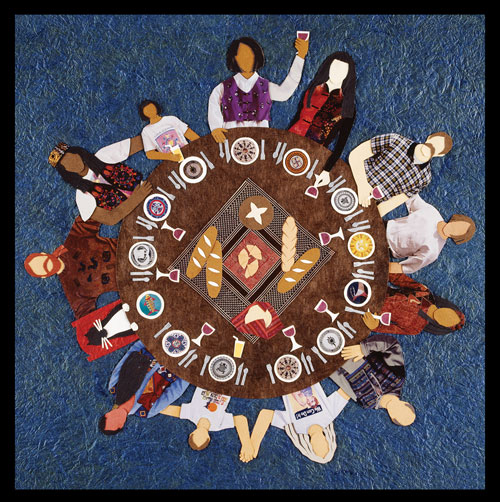
The Best Supper © Jan L. Richardson

This Sunday is World Communion Sunday. Established by the Presbyterian Church (USA) in 1936 and originally called World Wide Communion Sunday, this day beckons us to be mindful that when we gather at the table, we celebrate not only with those present but also with sisters and brothers around the world.

The artwork above is a piece called The Best Supper. Inspired by the image of Wisdom’s Feast in Proverbs 9, this piece evokes the myriad meals that have fed me in body and soul. As I created this image, I was visited by memories of so many of the tables where I have found hospitality. Those memories are embedded among the pieces of this collage. Circling the table once again, I capture glimpses of those with whom I shared those sacred meals. I remember how we savored every scrap, how we lingered long after the last bite was consumed.

Table Blessing

To your table
you bid us come.
You have set the places,
you have poured the wine,
and there is always room,
you say,
for one more.

And so we come.
From the streets
and from the alleys
we come.

From the deserts
and from the hills
we come.

From the ravages of poverty
and from the palaces of privilege
we come.

Running,
limping,
carried,
we come.

We are bloodied with our wars,
we are wearied with our wounds,
we carry our dead within us,
and we reckon with their ghosts.

We hold the seeds of healing,
we dream of a new creation,
we know the things
that make for peace,
and we struggle to give them wings.

And yet, to your table
we come.
Hungering for your bread,
we come;
thirsting for your wine,
we come;
singing your song
in every language,
speaking your name
in every tongue,
in conflict and in communion,
in discord and in desire,
we come,
O God of Wisdom,
we come

Prayer © Jan L. Richardson from In Wisdom’s Path: Discovering the Sacred in Every Season.


Update:
Thanks to everyone who has requested permission to use this blessing or “The Best Supper” artwork. For worship services and related settings, you are welcome to use the blessing without requesting permission; all that’s needed is to include a line with this info:

© Jan L. Richardson. janrichardson.com

To use “The Best Supper” image, please visit this page at janrichardsonimages.com. Your use of janrichardsonimages.com helps make the ministry of The Painted Prayerbook possible. Thank you!

Prints of The Best Supper and other images are available by visiting the Art Prints page at janrichardson.com. We have greeting cards, too!