Archive for the ‘sacred time’ Category

Happy Equinox!

September 22, 2008


© Jan L. Richardson ◊The Painted Prayerbook◊

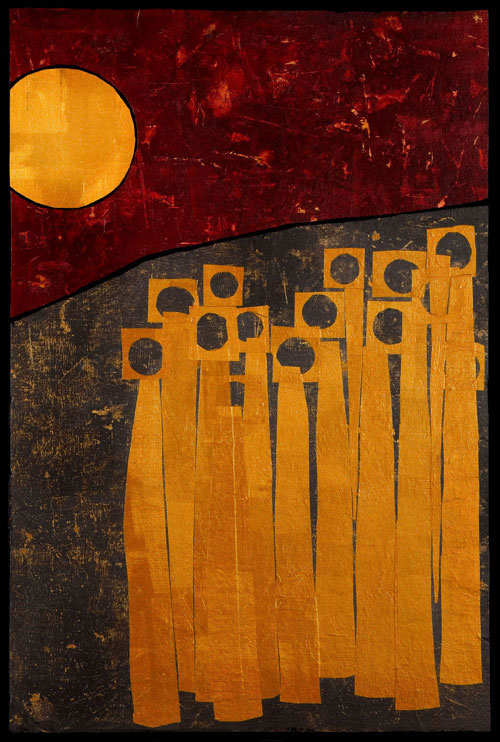
Happy equinox to you! Here in the Northern Hemisphere, we’re marking the autumnal equinox; happy vernal equinox to everyone in the southern half of the globe. Though I tend to think of the whole day as the equinox, it actually happens at a particular moment, specifically, the point when the sun is directly above the earth’s equator. Today that occurred at 3:44 PM GMT.

Darkness and daylight come in nearly equal measure on this day. It’s a good occasion to think about balance and how we find that in our lives. In a nice bit of timing, I’ve just wrapped up a season that involved lots of traveling. The trips were great, providing a good measure of work and retreat and play, often involving some of my favorite folks in this world. Still, I’m glad to be heading into a season in which I’ll be home more than I’m away. It’s time to hunker down and get back to work on a new book that’s due next year, and to attend to other things that only get done when I’m home for a stretch of time.

A while back I realized that it’s not balance I’m looking for in my life—at least not the kind of balance that implies a stasis and sameness to my days. That gets boring right quick. I tend to think more in terms of finding a rhythm of life that sustains me in the work (and the rest) to which I’m called. Some seasons are more intense than others, as with my summer of traveling; it’s great, but it’s not a pace I can keep through the year. Yet I can’t go for too long of a stretch of being at home, either; the walls start to close in.

Finding the rhythm that fits for me is part of my ongoing work. It can be a real challenge since the rhythm I need changes from season to season. But on this equinoctial occasion, I celebrate the gifts that come with each season, and the freedom to find the rhythms that bring wholeness to these days.

In the Carmina Gadelica, the collection of prayers gathered by Alexander Carmichael in Scotland in the 19th century, we find a prayer called “Jesus the encompasser” that strikes me as a good fit for this day. It reads, in part:

My Christ! my Christ! my shield, my encircler,
Each day, each night, each light, each dark;
My Christ! my Christ! my shield, my encircler,
Each day, each night, each light, each dark.

Be near me, uphold me, my treasure, my triumph,
In my lying, in my standing, in my watching, in my sleeping.
Jesu, Son of Mary! my helper, my encircler,
Jesu, Son of David! my strength everlasting;
Jesu, Son of Mary! my helper, my encircler,
Jesu, Son of David! my strength everlasting.

By day and by dark, blessings to you.

Feast of Saint Clare

August 11, 2008


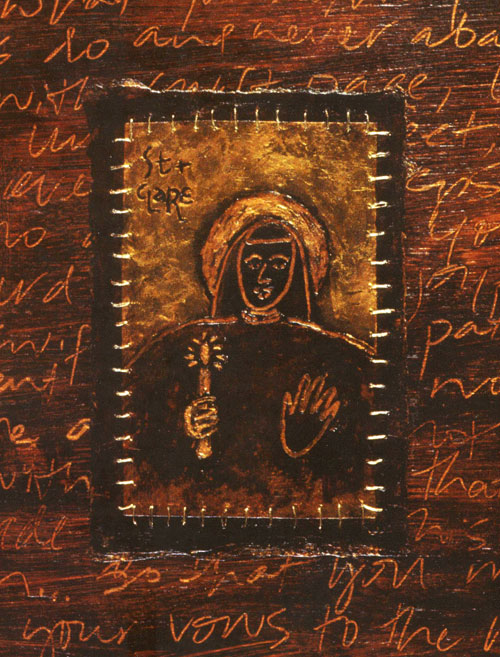
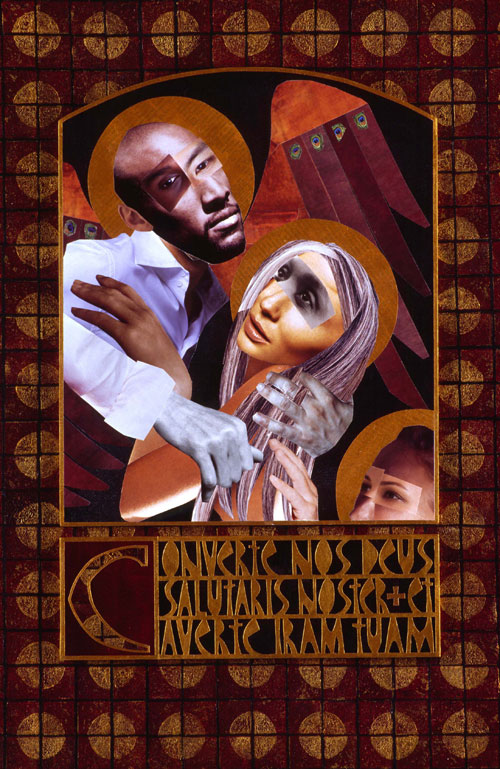
Saint Clare © Jan L. Richardson

When I became the Artist in Residence at a Catholic retreat center more than a decade ago, it was due in large measure to the hospitality of the Franciscan community that administered the center. I harbor a deep fondness for Franciscans as a result, and so today is a particular day of celebration. It’s the Feast of Saint Clare, the friend and colleague of Saint Francis who became a remarkable leader in her own right.

Born in Assisi, Italy, around 1194, Clare was the third of five children born to the well-to-do Favorone family. The story is told that as Clare’s mother Ortulana anxiously prayed for her child’s safe birth, a voice called to her, “O lady, do not be afraid, for you will joyfully bring forth a clear light that will illumine the world.” When she gave birth to a healthy daughter, Ortulana and her husband named her Chiara or Clare: the clear one, the bright one.

In his book Clare of Assisi: Early Documents, Regis Armstrong relates a story about Clare that took place on Palm Sunday in 1212. He writes that “when all the young ladies of the town customarily dressed in their finest and proudly processed to the Bishop for a palm branch…Clare remained in her place, prompting him to come to her.” Although some ascribed her reticence to shyness, Armstrong suggests that this was “a symbolic gesture suggesting her renunciation of the social conventions of the time with all the vanity and appeal to wealth with which they were imbued and the Bishop’s awareness and reverence of the movement of God within her.” That same Sunday, Clare, who had befriended a radical young preacher named Francis, secretly went to Our Lady of Angels, the Portiuncula, where she made a commitment to Francis and his spiritual brothers to embrace their life of devotion and poverty.

Clare lived in several monasteries, moving more than once to avoid pressure from her family, who had sought to arrange a marriage for her. Other women later joined her, including her mother, and Clare became the leader of the Poor Ladies of San Damiano, later to be known as the Poor Clares. Clare and her sisters shared Francis’s passion for poverty, humility, and charity to all, particularly those on the margins of the affluent society in which Clare and Francis had grown up.

In a time when women’s monastic communities received various forms of protection from the church, including financial support, Clare insisted that her community have the right to poverty, trusting that the goodwill of others would provide for their needs. The church authorities resisted Clare on this point, but she refused to relent. Finally, on August 10, 1253, Clare received an approved copy of the Rule she had written for her community. Bearing the seal of Pope Innocent IV, the document ensured that the charism of poverty would remain the privilege of the community that Clare had founded. Clare died the next day.

Although tradition attached to Clare the identity of la pianticella (the little plant) of St. Francis, she embodied her own distinct vision, one that continued to shape Franciscan life after Francis’s death. Clare’s few surviving writings reveal a deep commitment to a God-centered life, a life in which she sought to give up all that would hinder intimacy with God.

In Clare’s “Second Letter to Blessed Agnes of Prague,” she offers this blessing:

What you hold, may you [always] hold.
What you do, may you [always] do and never abandon.
But with swift pace, light step,
unswerving feet,
so that even your steps stir up no dust,
may you go forward
securely, joyfully, and swiftly,
on the path of prudent happiness,
not believing anything,
not agreeing with anything
that would dissuade you from this resolution
or that would place a stumbling block for you on the way,
so that you may offer your vows to the Most High
in the pursuit of that perfection
to which the Spirit of the Lord has called you.

And so may this be our blessing for this day. Happy Feast of Saint Clare!

Artwork: detail from “Saint Clare” © Jan L. Richardson. To use this image, please visit this page at janrichardsonimages.com. Thank you!

Clare’s blessing is taken from Regis Armstrong’s book Clare of Assisi: Early Documents.

Feast of Mary Magdalene

July 22, 2008


Magdalene Ascending: The Divine Hours
© Jan L. Richardson

Happy Feast of Mary Magdalene! In the rhythm of the Christian year, this is the day when we especially remember and celebrate the friend and disciple of Jesus who, along with other women, provided support for his ministry. For proclaiming the news of Christ’s resurrection, the Magdalene became known as the “Apostle to the Apostles.”

The Bible offers few details about her life—only Luke mentions her prior to her crucial role at Jesus’ death and resurrection. But having sparse information about her life leaves lots of room to spin some great stories. In the Middle Ages, a cycle of legends emerged that elaborated upon the Magdalene’s leadership in the early Christian movement. As a preacher chick, I’m particularly fond of the legend that involves Mary Magdalene moving to France and becoming a famous preacher; she is also said to have released prisoners from a French jail.

The legends tell, too, that Mary Magdalene spent the final years of her life as a hermit in the wilderness, clad only in her long hair. At the canonical hours, angels would come and swoop her up to heaven to share in the liturgy, then return her to the wilderness until they came to swoop her up again. The above image depicts that legend; titled Magdalene Ascending: The Divine Hours, it comes from the series The Hours of Mary Magdalene, which you can visit here (click on the images for enlarged views). Inspired by depictions of Mary Magdalene in medieval Books of Hours and in other artwork from the Middle Ages, the series draws from the legends of the Magdalene as well as biblical accounts that offer intriguing hints about her life.

Think of the images as greeting cards from me to you on this day. A blessed feast to you!

Happy Ordinary Time!

May 24, 2008


© Jan L. Richardson ◊The Painted Prayerbook◊

So, did you sense the shift when we moved into the new season? Did you hit the after-Pentecost sales and send out your “Merry Ordinary Time” cards? No? It tends to sneak up on us, doesn’t it, this new and subtle season of the Christian year. We have spent the past six months swimming in the Big Stories that Advent, Christmas, Epiphany, Lent, Easter, and Pentecost provided for us. These holy days and seasons have offered something approaching an embarrassment of riches with the themes they have brought us: birth, incarnation, the wilderness, suffering, death, resurrection, the life of the community, and the work of the Holy Spirit. It’s been a good and grounding groove.

And now for something completely different.

Ordinary Time officially began with the ending of Pentecost, and with Trinity Sunday now behind us, the new season is upon us in earnest. Stretching out for the next six months, Ordinary Time invites and challenges us to move into a mode that is shaped by something other than the “high seasons” that the past half-year has offered us. I sometimes find this new rhythm a little disorienting at first. Living in Florida, where the natural seasons are present (really, we do have them) but subtle, I rely on the liturgical year to help me tell time. Without the big markers I’ve been living with for the past six months, the days and weeks sometimes seem like they’ve lost their cohesion, that they’re oozing out into a nearly interminable horizon that holds few occasions for liturgical celebration. Plus, it’s a really long stretch of looking at green paraments every Sunday.

This season, however, beckons us to find the sacred in its subtlety. In the introduction to her book The Time Between: Cycles and Rhythms in Ordinary Time, Wendy M. Wright reminds us that the “ordinary” in “Ordinary Time” does not mean “boring, uneventful, undistinguished, everyday.” Rather, it “comes from the word ordinal, to count.” With its being a seemingly in-between time, however, Wright observes that this season holds us in a different way than do the seasons “when the beauty of the faith is etched in high relief.” She writes,

I like to think of the entire spectrum of the liturgical cycle of Ordinary Time with all its varied rhythms—of Sunday observance, daily prayer, the sanctoral cycle, the tapestry of stories that dramatize the call and response of Jesus and the first disciples, the seasons of our own discipleship throughout the life cycle, the ritual practice of the great Christian rites, the dynamics of our inner faith lives—as one greater movement of desire to be face-to-face, heart-to-heart with God. The deep grammar of the church year’s Ordinary Time is perhaps uttered most keenly in our ceaseless longing. By it we are propelled into the future. We pine for it as past. We trace the surface of the present with anxious fingertips. Call our desire awareness, mindfulness, mysticism, aesthetic sensitivity, faithfulness, or whatever. It is the fundamental movement of the Christian life.

Given the intensity of the stories that have accompanied us during the months between Advent and Pentecost, one might be tempted to think that Ordinary Time gives us something of a rest. It offers us a different rhythm, to be certain, but as we move into this season, the lectionary doesn’t let us off the hook. The Gospel lection for this Sunday, Matthew 6.24-34, challenges us with questions that lie at the heart of Christian life: Whom will we serve? Where will we place our trust and our energy?

To pose these questions, Jesus turns, in his typical incarnational way, to a couple of earthy examples at hand: the birds of the air and the lilies of the field. Urging his disciples not to devote themselves to worry and anxiety, he borrows the well-fed birds and well-clad lilies as signs of how God cares for God’s creatures.

I have to say that living without worry seems pretty easy to do if you’re a creature who can get by on worms and water. For the rest of us, giving up anxiety often seems more of a challenge. I’ve been pondering this Gospel passage in the midst of hearing news of the mounting death count from the earthquake in China and the cyclone in Myanmar. And I’ve been contemplating Jesus’ words with an awareness, too, of the daily terrors and suffering that shape the lives of so many on this planet. How is it, I wonder, that God has provided, is providing, will provide for their needs? What do Jesus’ images of birds and lilies look like in places that seem devoid of beauty and care?

I was reflecting on this with a couple of friends at lunch today. We each know how little we have in the way of answers to these kinds of questions, other than a sense that somehow God is present in the rubble, literal or otherwise, that disasters leave behind. One of my friends, a Benedictine, reminded us of St. Benedict’s words in chapter 4 of his Rule. After he has provided his monks with a lengthy list of what he calls “The Tools for Good Works,” Benedict wraps up this chapter by writing, “And finally, never lose hope in God’s mercy” (Rule of Benedict 4.74).

Wrestling with this week’s lection, I find myself wondering not so much how to keep myself from worrying but wondering instead how I might be called to relieve someone else’s worry, to be part of the way that God provides clothing and shelter and solace for someone. How do I live as someone who not only hopes for God’s mercy, for myself and others, but participates in that hope by becoming a sign and a vessel of God’s mercy in this world? As someone whose ministry involves raising my entire income, and who lives with the ordinary causes of worry that so many of us deal with, I’m not unacquainted with anxiety. At the same time, I’m aware of how the presence of persistent worry and anxiety may be a sign that I’ve become too absorbed by my own concerns, too consumed with my own needs, and that I need to allow God to draw my attention beyond myself to attend to those who need something that I can offer. It’s a way of trying to do what Jesus, at the beginning and ending of this Gospel lection, challenges us to do: to choose whom we will serve, and to focus first on the kingdom of God, that all other things in our lives may fall into their rightful places.

As we set out into this season of Ordinary Time, where is your energy going? What—and whom—are you serving? What worries, anxieties, needs, and desires are shaping your days? How might you invite God to transform your anxiety into acts of hope, mercy, and love in this world?

Deep blessings to you in these ordinary days.

Trinity Sunday: A Spiral-Shaped God

May 12, 2008


A Spiral-Shaped God © Jan L. Richardson

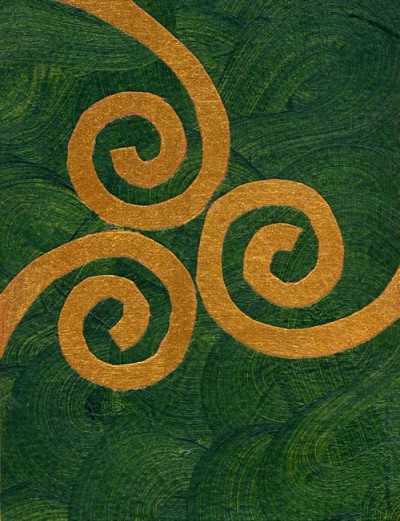
Some years ago, at a retreat center in Ontario, I led a retreat in which we explored some of the riches that come to us from Celtic Christian traditions. When I saw that our meeting room had a smooth linoleum floor, an idea stirred. After tracking down several rolls of masking tape, I returned to the gathering space and got to work. When I finished a couple hours later, the center of our space held a circle with a triple spiral inside, large enough to use for walking prayer and meditation.

The symbol of the triple spiral is particularly prevalent in Celtic lands, where, in Christian times, it came to signify the Trinity. Evoking the energy, interconnection, and mystery of the triune God, the triple spiral graces such works as the remarkable insular Gospel books of the early medieval period, including the Book of Durrow and the Book of Kells.

On Trinity Sunday, we both celebrate God’s triune nature and also acknowledge the great mystery that it holds. Throughout the centuries, theologians have sought to define just how it is that God, Christ, and the Holy Spirit dwell together and with all of creation. Symbols of the Trinity abound, evidence of our desire to describe a being that comprises a community within itself. Attempts to convey the nature of the Trinity in images have occasionally produced some curious artwork, as in this image from a medieval Book of Hours that depicts three fellows sharing a single crown, and this image, added to a medieval English Psalter, that shows Abraham adoring a three-headed Trinity.

In their commentary on Trinity Sunday, the authors of Handbook of the Christian Year counsel us that rather than approaching this day with an emphasis on “the Trinity as an abstract concept, idea, or doctrine,” and seeking to explain or define it, it rather “seems more in keeping with the character of worship and of the Christian Year to treat Trinity Sunday as a day in which we praise and adore the infinitely complex and unfathomable mystery of God’s being to which we point when we speak of the Holy Trinity.” They go on to write,

Because our celebration of the Easter cycle is based upon the mighty acts of the triune God, and because we are entering upon the Sunday-to-Sunday half of the year when the emphasis is wholeheartedly upon each Sunday as the Lord’s Day, whose celebration is also based upon the mighty acts of the triune God, it is appropriate that we pause on this transitional Sunday to give ourselves over to the adoration and praise of the being—as distinct from the acts—of the triune God.

It is sometimes difficult, of course, to separate the doing of the Trinity from the being of the Trinity, for it is part of the nature of the Trinity to be in action, to work in relationship within itself and in cooperation with creation. This is one of the reasons that the Celtic symbol triple spiral speaks to my imagination: it evokes the God who both exists in a dynamic wholeness within itself yet also reaches out (or is it in?) to embrace us.

Historically, Celtic Christians offered no systematic theology by which they sought to define the nature and work of Trinity, but evidence of their experience of the triune God abounds. Beyond their artistic and symbolic depictions of the Trinity, they left a remarkable body of prayers and poetry that offer us an incarnate experience of the Trinity. In their poems and prayers, Celtic Christians moved from the abstract to the actual; for them, the triune deity was not a theological concept but rather was deeply embedded in daily life. In the Celtic imagination, God, Christ, and Spirit are intertwined with one another and with all of creation.

The Carmina Gadelica, a collection of prayers, poems, and blessings that Alexander Carmichael gathered in the Scottish islands and highlands in the 19th century, offers a feast of examples of this rich relationship with the Trinity, as in this prayer for the baptism of a child:

The little drop of the Father
On thy little forehead, beloved one.

The little drop of the Son
On thy little forehead, beloved one.

The little drop of the Spirit
On thy little forehead, beloved one.

To aid thee from the fays,
To guard thee from the host;

To aid thee from the gnome,
To shield thee from the spectre;

To keep thee for the Three,
To shield thee, to surround thee;

To save thee for the Three,
To fill thee with the graces;

The little drop of the Three
To lave thee with the graces.

With an intent both poetic and practical, this baptismal prayer serves as a graceful commentary on, and response to, the gospel reading for Trinity Sunday. In Matthew 28.16-20, we read the words that are, according to Matthew, Jesus’ final words to his disciples. In this passage that we often call the Great Commission, Jesus tells them to “Go therefore and make disciples of all nations, baptizing them in the name of the Father and of the Son and of the Holy Spirit, and teaching them to obey everything that I have commanded you.” Jesus’ words here are about the closest thing we have to an articulation of the Trinity in the scriptures. Jesus never uses the term “Trinity,” and he offers nothing like a doctrine of its nature. His words here, however, perhaps provide doctrine enough: he lets us know that Father, Son, and Holy Spirit exist in an inextricable relationship that propels us to be in relationship with the world, to live in service and to cultivate community. “And remember,” Jesus tells them at the last, “I am with you always, to the end of the age.” I am with you, he says: that being thing again, invariably bound together with the doing of the Trinity, an endless spiral of action and existence in which it dwells, and calls us to dwell as well.

In the Celtic triple spiral, there is a space where the three spirals connect. It is both a place of meeting and of sheer mystery. Its vast, vibrant emptiness reminds me that, in this life, we will never know all the names of God. Even as the Trinity evokes, it conceals. We will never exhaust the images we use to describe the One who holds us and sends us, who enfolds us and impels us in our eternal turning.

This week, as we travel toward Trinity Sunday, I’ll be holding that image of the triple spiral and the community in whose company I walked its path: inward, outward, journeying ever around the mystery at its center. Those walking companions remind me of how we are to be a living sign of the Trinity who dwells in eternal, intertwined relationship within itself and with all creation. As individuals and as communities, we are beckoned to times of spiraling inward, to attend to our own souls. We are propelled, in turn, into times of spiraling outward, to attend to the world beyond us. In all our turnings, the presence of God persists. With you always, Jesus said.

How do you experience the God who exists as a community and invites us to intertwined lives? How does this God become incarnate in the rhythm of your days?

Blessings on your spiral-shaped path.

[To use this image, please visit this page at janrichardsonimages.com. Your use of janrichardsonimages.com helps make the ministry of The Painted Prayerbook possible. Thank you!]

A Postscript to Pentecost

May 11, 2008

Happy Pentecost to you! On this occasion of Pentecost’s unusual confluence with Mother’s Day, I’ve found myself thinking about the frequency with which Mary, the mother of Jesus, appears front and center in artful depictions of Pentecost. In the first chapter of Acts, the author makes a point of noting that “certain women, including Mary the mother of Jesus,” were among those who gathered in the upper room, devoting themselves to prayer. The text implies her prayerful presence at Pentecost, and artists across the centuries highlighted her among the gathered assembly. Because of her presence and leadership among the disciples, along with her role as the mother of Christ, Mary became known as Queen of the Apostles as well as Mother of the Church.

The artful images of the Pentecostal Mary illuminate an intriguing resonance with the story of the Annunciation. In Luke’s gospel, we read of how the angel Gabriel tells Mary that the Holy Spirit will come upon her, and the power of the Most High will overshadow her. As with the Annunciation, paintings of Pentecost, such as this one in the St Albans Psalter, typically depict a woman open to the Spirit who appears—as so often in Christian iconography—in the form of a dove.

In much the same way that many medieval artists portrayed Mary reading at the Annunciation, they often depicted her in a similar fashion at Pentecost, as in this page from a 15th-century French Book of Hours. Another French Book of Hours depicts Mary kneeling at a prie-dieu as she reads, a motif that often appeared in artwork of the Annunciation.

As a blissfully incurable lover of books, I take great delight in these images of the literary, Pentecostal Mary who remained steeped in the Word throughout her life. These images also challenge me to ponder how I’m opening myself to the God who comes to us as both Word and Spirit. What do they stir in you?

On this day and all the days to come, may the Spirit breathe through the mothers and others who care for the children of the world.

(Artwork: Annunciation to Mary [detail] from The Advent Hours © Jan L. Richardson.)

Pentecost: Fire and Breath

May 5, 2008


Fire and Breath © Jan L. Richardson

In my junior year of high school, I landed in the hospital several times because one of my lungs kept collapsing. It wasn’t due to an injury; each collapse was spontaneous, owing to a genetic predisposition not uncommon among tall, skinny girls. (It often comes accessorized with a mild heart murmur, something I didn’t know until a doctor picked it up in a routine exam a few years ago.) Normally a really healthy kid, I was concerned about the inordinate level of excitement it stirred in my doctor’s office. After he had his nurses come and listen to my chest, my doctor explained that I’d have to go to the hospital to get my lung reinflated. I imagined something like a bicycle pump, a quick procedure that would have me out in time to take a major test the next day. Instead, I spent the next five days getting intimately acquainted with a chest tube and the oddities of morphine.

The trip to the hospital provided only a temporary fix for my lung. When a partial collapse the next month was followed by a complete collapse the month after that, I knew the next step would be more drastic. The chest tube was put back in, and this time, they poured tetracycline down it. A recently developed alternative to surgery, tetracycline served to form scar tissue to keep the lung intact and prevent it from collapsing again.

Painkillers and local anesthesia only do so much to dull the sensation of acid flowing over your innards. Mostly I remember unbelievable pressure on my chest, the sensation that I could not breathe, would never do it again, that my body would not remember how. But in the wake of the fire came breath: breath that came without assistance, breath that sustained itself and did not seep out. In time I came to understand the experience as a gift, one marked by the presence of God, who did not inflict it upon me but used it as an occasion of transformation, an experience of initiation. With the fire and the breath came knowledge: I would never be in my body in the same way. It altered how I experienced my own body, and it changed how I would engage people whose bodies are vulnerable. A good gift for a girl who would grow up to be a pastor.

That initiation of fire and breath has been much on my mind as the day of Pentecost approaches. A defining day in the life of the early church, Pentecost finds its roots in the Jewish tradition, where it is called Shavuot or the Festival of Weeks. Falling fifty days after Passover, Shavuot is a harvest festival and also commemorates the giving of the Torah at Mount Sinai. Acts 2.1-21 tells us it is on this festival day that the followers of Jesus are “all together in one place” when the Spirit appears. It arrives as a rushing wind, filling them, in-spiring them, causing them to draw breath and speak. The scene at Pentecost offers a brilliant display of how in Greek, as in Hebrew, the word for Spirit, wind, and breath is the same: pneuma (In Hebrew, ruach).

Along with the wind comes fire, a symbol that stirs our collective memory of the God whose transforming presence has so often been marked by flames. Think of Moses and the burning bush, the column of fire that led the people of Israel through the wilderness, the temple fire that consumed the sacrificial offerings. “For the Lord your God is a devouring fire,” Deuteronomy 4.24 tells us. In contemporary culture, we most often experience fire as a contained, controlled, gentle force. Yet the fires of Pentecost are not the tame flames of birthday candles or a cozy winter’s hearth; the fires of Pentecost are a sign of the God who resists our every attempt to domesticate the divine and to control how the holy will work.

For the followers of Jesus, the day of Pentecost becomes an occasion of profound initiation. With the gift of spirit and flame, the community that Jesus had formed is now fired, prepared, propelled into a new stage of its journey. Like a vessel in the furnace of a kiln, the followers of Jesus receive the transformation they need. They are no longer a group of believers but rather a catalyzed community, a body that, enlivened by the Spirit, will endure and continue the work of Christ.

As those followers knew, we can’t always plan our moments of initiation. If we cannot control God, it follows that we cannot control the ways that God beckons or, sometimes, seemingly flings us across a new threshold. We can work to make ourselves available when it happens, but we don’t always get to choose our initiations.

In her book Reinventing Eve, Kim Chernin describes initiation this way:

Initiation is not a predictable process. It moves forward fitfully, through moments of clear seeing, dramatic episodes of feeling, subtle intuitions, vague contemplative states. Dreams arrive, bringing guidance we frequently cannot accept. Years pass, during which we know that we are involved in something that cannot easily be named. We wake to a sense of confusion, know that we are in dangerous conflict, cannot define the nature of what troubles us. All change is like this. It circles around, leads us a merry chase, starts us out it seems all over again from where we were in the first place. And then suddenly, when we least expect it, something opens a door, discovers a threshold, shoves us across.

At Pentecost, initiation occurred not only at the individual level (“and a tongue rested on each of them”) but also at the corporate level. The outpouring of the Spirit upon the whole community reminds us that we are not on an individual journey but a shared one. God calls us, compels us, to attend to the Spirit in one another.

The celebration of Pentecost beckons us to keep breathing. It challenges us to keep ourselves open to the Spirit who seeks us. The Spirit that, in the beginning, brooded over the chaos and brought forth creation; the Spirit that drenched the community with fire and breath on the day of Pentecost: this same Spirit desires to dwell within us and among us. Amidst the brokenness and chaos and pain that sometimes come with being in community, the Spirit searches for places to breathe in us, to transform us, to knit us together more deeply and wholly as the body of Christ, and to send us forth into the world.

As we approach Pentecost, what occasions of initiation do you remember? Sought or unbidden, how did those experiences alter you, transform you, change who you are in this world? How did they deepen your understanding of yourself, your community, and how God desires to breathe through you? How do you continue to open yourself to the work of the Spirit in you and in those around you?

Blessings to you in these days of celebration. May we keep breathing. May we blaze.

[To use this artwork, please visit this page at janrichardsonimages.com. Your use of janrichardsonimages.com helps make the ministry of The Painted Prayerbook possible. Thank you!]

Ascension/Easter 7: A Blessing at Bethany

April 30, 2008


Ascension © Jan L. Richardson

Reading from the Gospels, Ascension Day: Luke 24.44-53

These days I’m at work on a new book that’s something of a sequel to the first book I wrote (if you don’t count the book about animals that I wrote and illustrated when I was about eight, in which my drawing of a horse looks very much like my drawing of a dog). Working on this sequel has set me to thinking about who I was when I was writing the first book. I began that book, Sacred Journeys, during my final year in seminary, stayed in Atlanta an extra year to work on it, and finally completed it a year and a half after moving back to Florida to take my first pastoral appointment.

The span of time I spent on that first book included one of the happiest years of my life—my final year in Atlanta—and one of the most difficult years of my life—my first year in Orlando. In Atlanta I had an amazing community. Based largely within the seminary I attended, these friends nourished and stretched and sustained me. They were part of my daily rhythm of life. They mediated the presence of Christ to me.

Leaving the community I had found in Atlanta was a source of deep grief. I knew no one when I moved to Orlando. Though I was clear this was where I needed to be, this clarity provided an incomplete comfort. I remember trying to figure out how to appear competent as a pastor and carry grief at the same time. During that first year, I received an anonymous letter (and if you’re a pastor, you know how much we love getting those letters from people who feel strongly enough to write but not strongly enough to put their name to it) from someone who suggested both that I share more about myself in my sermons and also that I use more humor. “Honey,” I thought at that point in my journey, “it’s one or the other.”

The sorrow ran its course. Time and focused work did their usual healing, and I found a new community in Orlando. Different from the one I had in Atlanta, but nourishing, creative, and amazing in its own ways: a community that reminds me of the infinite forms that the body of Christ can take in this world.

In the midst of remembering the loss of community, and the finding of one, I’ve been pondering the gospel lection for Ascension Day. Having lingered for forty days (a good biblical number) following his resurrection, during which he engaged in such acts as eating and wound-showing to demonstrate that he wasn’t a ghost, Jesus prepares to take his final leave of those who have been his companions on his earthly path. He shares his final words with them—crucial words, words of call and of promise. And then, Luke tells us, Jesus leads them “as far as Bethany,” where he will depart from them.

I am struck by Luke’s mention of Bethany as the site of Jesus’ ascension. The gospels mention Bethany a number of times. It is a place to which Jesus withdraws on more than one occasion, and we know the town most memorably as the home of Mary, Martha, and Lazarus, who are particular friends of Jesus. As the site of the raising of Lazarus and two accounts of Jesus’ receiving the gift of a woman’s anointing, Bethany stands as a place of healing, restoration of life, hospitality, and friendship. Likewise, at Bethany the fullness of Jesus’ divinity and his humanity come into sharp focus: in his raising of Lazarus, Jesus had displayed his power over death, and in his friendship with Mary, Martha, and Lazarus, he revealed himself as someone who took solace and delight in their human company.

For Jesus’ companions who witness his ascension, Bethany conjures memories that Jesus means for them to draw upon as they begin to live without him. Bethany was a place where hospitality, friendship, and the miraculous intertwined in the community around Jesus. The fact that he chooses it as his place of departure suggests that he intends for them to remember that these gifts will remain with them—and not only these gifts, but also his own spirit.

In depicting Jesus’ ascension, medieval artists often painted Jesus with only his feet showing (one can almost see his toes wiggling), just barely visible as he departs, as in the St Albans Psalter or this thirteenth-century German Psalter. They wanted to emphasize his bodily departure from the earth. Yet, as Gail Ramshaw points out in Treasures Old and New, such a depiction does not suggest that “Christ has gone away from the church. The church fathers,” she goes on to write, “taught just the opposite: that as Christ went to God, his body became available to all the church.” And not only available to the church, but also enfleshed within it and by it, a point these same medieval artists emphasize by their attention to those who remain as Jesus leaves. Though Jesus’ departure poses the risk of profound disruption among his followers, his ascension becomes an opportunity for the community not merely to reorganize and refashion itself but to become the very body of Christ in the world.

Luke writes that it is as Jesus is blessing the disciples that he begins to leave them. He does not raise his voice in a lamentation over his departure, he does not offer any further words of wisdom and instruction, he does not fling last-minute advice their way. He blesses them. Where the disciples might have been justly distraught, Luke tells us that instead they worshiped Jesus “and returned to Jerusalem with great joy; and they were continually in the temple blessing God.” Jesus’ disciples recognize that his leaving is part of his blessing. Having called them into relationship with him and one another, having lived and journeyed with them, he frees them to live into their ongoing call. They, in turn, respond to Jesus’ blessing by offering blessings of their own, in the temple and beyond. They respond to his blessing by becoming his body.

We may grieve—and rightly so—the changes and leave-takings that come with being in community. This relationship stuff is risky business. Yet Jesus’ ascension reminds us there is something deeper at work in such times, something that not only carries us through the changes but also uses them to transform us and to bless the body of Christ. In the midst of every loss and change, the presence of Christ persists, shaping his community anew and calling us to blessing and joy.

Where have you found a blessing in the midst of loss? How have you experienced—and offered—the body of Christ among the changes in your life? Having received the blessing of Christ, how do you offer a blessing in return?

May you journey, along with those first disciples, with great joy and blessing.

[To use this artwork, please visit this page at janrichardsonimages.com. Your use of janrichardsonimages.com helps make the ministry of The Painted Prayerbook possible. Thank you!]

Feast of Saint Patrick

March 17, 2008

stpatrick.jpg
Saint Patrick: Deer’s Cry © Jan L. Richardson

It seems auspicious that Holy Week this year begins with the feast of St. Patrick. Though his feast falls during Lent by happenstance, Patrick offers a powerful example of someone who, in every season, accepted the challenge that Lent poses us: to stretch beyond the familiar borders of the world we know, and to meet God there.

The story of Patrick is deeply entwined with the story of Ireland, so much so that it was only in recent years that I learned that Patrick’s story didn’t begin there. The boy who would become a saint was born in Britain at the end of the fourth century. As a youth he was kidnapped and taken to Ireland as a slave, where he tended flocks and began to spend his time in prayer. In a work titled “Patrick’s Declaration on the Great Works of God,” also known as the Confessio, Patrick writes that as he prayed among the flocks, “more and more, the love of God and the fear of him grew [in me], and [my] faith was increased and [my] spirit was quickened….” After six years, Patrick escaped from captivity and returned to Britain and to his parents, who, he tells us, “begged me—after all those great tribulations I had been through—that I should go nowhere, nor ever leave them.” Yet Patrick goes on to write,

…it was there, I speak the truth, that ‘I saw a vision of the night’: a man named Victoricus—’like one’ from Ireland—coming with innumerable letters. He gave me one of them and I began to read what was in it: ‘The voice of the Irish.’ And at that very moment as I was reading out the letter’s opening, I thought I heard the voice of those around the wood of Foclut, which is close to the western sea. It was ‘as if they were shouting with one voice’: ‘O holy boy, we beg you to come again and walk among us.’ And I was ‘broken hearted’ and could not read anything more. And at that moment I woke up. Thank God, after many years the Lord granted them what they called out for.

Patrick eventually went back to Ireland, returning as a bishop to the land that had been the place of his bondage. For Patrick and his fifth-century contemporaries, Ireland was the edge of the known world. In returning there, he considered himself to be living out Christ’s call to take the Gospel to the ends of the earth. He writes, “We are [now] witnesses to the fact that the gospel has been preached out to beyond where any man lives.” Though Patrick was not the first Christian to set foot in Ireland, he was among the earliest, and his tireless, wide-ranging ministry was pivotal in the formation and organization of the church in that land.

Like all good saints, Patrick has attracted good legends. One story relates that as he and his companions made their way to Tara to see Loegaire, the High King of Ireland, the king’s men tried to ambush them. Patrick sang a prayer, known as a lorica (”breastplate”—a prayer of encompassing and protection), and he and his companions took on the appearance of deer, thereby eluding their attackers. The prayer, which became known as Patrick’s Breastplate or Deer’s Cry, most likely dates to at least two centuries later. It endures, however, as one of the most beautiful and powerful prayers of the Christian tradition, and it conveys something of the spirit of Patrick that continues to permeate Ireland and the world beyond. The prayer reads, in part,

Christ with me, Christ before me, Christ behind me;
Christ within me, Christ beneath me, Christ above me;
Christ to right of me, Christ to left of me;
Christ in my lying, Christ in my sitting, Christ in my rising…

(This excerpt, along with the quotes from Patrick’s Confessio,
come from Celtic Spirituality, translated and introduced
by Oliver Davies.)

Enter “Deer’s Cry” into your search engine and you’ll find a variety of translations of the entire prayer. My favorite translation is by Malachi McCormick of the Stone Street Press. In a charming edition which, like all his books, is calligraphed, illustrated, and hand-bound by his own Irish self, Malachi offers his English translation alongside the old Irish text. I happened upon Malachi’s Deer’s Cry as a seminary student many moons ago and was immediately taken by his elegant and painstaking work. His wondrous books provided the initial inspiration when I founded Wanton Gospeller Press several years ago, and one of my great delights in the wake of that has come in exchanging correspondence with Malachi. I invite you to celebrate St. Patrick’s Day by visiting Malachi’s site at Stone Street Press, purchasing a copy of Deer’s Cry, and picking up a few other books while you’re at it.

A blessed Feast of St. Patrick to you, and may God encompass you with protection on this and all days.

Bonus round: My sweetheart, Garrison Doles, has an amazing song inspired by the life of St. Patrick. It incorporates the ancient prayer of encompassing known as “St. Patrick’s Breastplate” or “Deer’s Cry.” Click this audio player to hear “Patrick on the Water” (from Gary’s CD House of Prayer).

[To use the “St. Patrick: Deer’s Cry” image, please visit this page at janrichardsonimages.com. Your use of janrichardsonimages.com helps make the ministry of The Painted Prayerbook possible. Thank you!]

Palm Sunday: Where the Way Leads

March 14, 2008

Image: Where the Way Leads © Jan Richardson

At the opening of her book To Dance with God, Gertrud Mueller Nelson tells the story of an afternoon she spent absorbed in a project at her sewing machine. Her daughter Annika, three years old at the time, dug into the basket of scraps that sat at her mother’s feet. Annika pulled out several long, bright strips of discarded fabric, gathered them up, and slipped away. Gertrud writes than when she went to find Annika, “I tracked her whereabouts to the back garden where I found her sitting in the grass with a long pole. She was affixing the scraps to the top of the pole with great sticky wads of tape. ‘I’m making a banner for a procession,’ she said. ‘I need a procession so that God will come down and dance with us.’ With that she solemnly lifted her banner to flutter in the wind and slowly she began to dance.”

This week we celebrate Palm Sunday, remembering the day when the crowds of Jerusalem offered a procession to celebrate the one who came to live, and walk, and work, and dance among us. Matthew gives us the Gospel lection for Palm Sunday this year. Matthew 21.1-11 tells the familiar story of how Jesus sends two disciples ahead to the village to bring back a donkey for Jesus. (An art historical note here: Matthew’s claim that Jesus rode a donkey and a colt, which probably stemmed from a not-entirely-precise reading of the Isaiah prophecy that he quotes, produced some unusual medieval depictions of Jesus riding two animals at the same time. Not saying he couldn’t have done it, but I think he already had enough going on that he would have avoided that particular balancing act.) Matthew goes on to tell of the crowds: they line the road with cloaks and branches, they go ahead of Jesus, they follow after him, they shout Hosanna to the Son of David! Blessed is the one who comes in the name of the Lord! Hosanna in the highest heaven! And to those in Jerusalem who ask, “Who is this?” these same crowds say, “This is the prophet Jesus from Nazareth in Galilee.”

It is a scene of jubilation, this procession in honor of the prophet. For those who know the rest of the story, however, there is an eerie note to the cries of the crowd. The way of palms will lead to the way of the passion, a path marked by shouts of accusation and a collective demand for Jesus’ death, a path traced in blood.

Amid the hosannas of the festive crowd, I keep hearing a voice that echoes from the other end of Jesus’ story. It belongs to John the Baptist. It is a lone voice, a ragged, fiery, locust-and-honey-drenched voice, a voice that raised its cry long before the crowds began to do so. Early in his Gospel, Matthew tells us of John, and he turns to the prophet Isaiah for words to describe him:

This is the one of whom the prophet Isaiah spoke when he said,
“The voice of one crying out in the wilderness:
‘Prepare the way of the Lord, make his paths straight.'”
(Matthew 3.3, quoting Isaiah 40.3, NRSV)

John had indeed prepared the way for his kinsman Jesus, whom he recognized long before anyone else, even, as Luke tells us, leaping for joy in the womb when his pregnant mother Elizabeth heard the pregnant Mary’s voice. By the time that Matthew tells of a cloak-and-branch-strewn road, John is gone, dead at Herod’s command. What would the Baptist have thought of where this way, so well prepared, was taking Jesus? A prophet steeped in the stories of his prophetic forebears, John would have been well acquainted with the evils that can be visited upon a prophet. Yet he would have known, too, that evil never has the final word.

In the same Isaiah passage that Matthew quotes to describe John the Baptist, the prophet goes on to say this:

A voice says, “Cry out!”
And I said, “What shall I cry?”
All people are grass,
their constancy is like the flower
of the field.
The grass withers, the flower fades,
when the breath of the Lord
blows upon it;
surely the people are grass.
The grass withers, the flower fades;
but the word of our God will
stand forever. (Isaiah 40.6-8)

The word endures. The Word endures. We who stand among the Palm Sunday crowds know that the Word will soon be beaten, mocked, and killed. We know, too, that that is not the end of the tale.

But we have not yet moved on to that part of the tale. This week’s Gospel lection beckons us to linger alongside the road, to lift our voices in celebration, and to ask ourselves a few questions. I find myself wondering, what is the way that I am preparing for Christ? Am I clearing a path by which he has access to my life? Am I keeping my eyes open to the variety of guises that Christ continues to wear in our world? Taking a cue from Annika, what am I lifting up, that God might come down and dance with me?

On the cusp of Palm Sunday, on the threshold of this Week of Weeks: blessings to you, and a pair of dancing shoes.

[To use the image “Where the Way Leads,” please visit this page at janrichardsonimages.com. Your use of janrichardsonimages.com helps make the ministry of The Painted Prayerbook possible. Thank you!]