Archive for the ‘sacred time’ Category

Epiphany 1: Ceremony (with a Side of Cake)

January 10, 2008

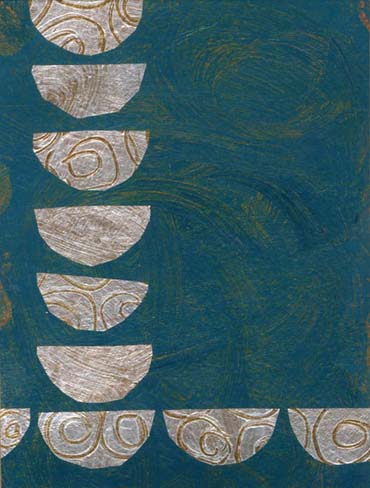
blog2008-01-10.jpg
Ceremony © Jan L. Richardson

Reading from the Gospels, Baptism of the Lord, Year A: Matthew 3.13-17

Today I had lunch with a friend who’s down from Minnesota (he claims he’s here for meetings, but I think he’s really just thawing out). David is a Franciscan friar who used to live and work at the San Pedro Center, a retreat and conference center owned by the Catholic Diocese of Orlando. I met David when I was serving in my first pastoral appointment, in a congregation just up the road from Disney World; he’s the one who later opened the door (God bless him) to my becoming the Artist in Residence at San Pedro.

We had made plans to meet at San Pedro today, and I arrived in time to take a short walk on the beautiful grounds. It had been some time since I’d been to this place that had once been such an intimate part of my life; I had even lived there for a wondrous year at the outset of my stint as Artist in Residence. As I walked its landscape today, I found myself thinking that it’s interesting to have lived long enough to have a sense that the arc of my life contains several lifetimes. The Jan who once lived at San Pedro felt like a very long-ago self. She was just beginning the journey to figure out what a life devoted to the intersection of art and writing and faith might look like. And she had a few other Big Life Things to figure out besides. It was intriguing to walk alongside her for a few moments today, to remember the remarkable door she was walking through a decade ago, and to see her, and that landscape, through the eyes of the present Jan.

There wasn’t much ritual involved when I moved to San Pedro (although there was a pair of sandhill cranes standing welcome in the driveway when we pulled the moving truck into the entrance, which felt like some kind of blessing). Years later, though, when I moved out of my position as the Artist in Residence and took up my new role with The Wellspring Studio, it felt like an occasion that needed some ceremonial action. The transition had been a lengthy and convoluted process, in part because it took a while to do the institutional sorting-through of the form that my new ministry would take (that’s another blog post entirely!). With all that past, and quite sufficiently sorted through, it was time to celebrate, and to remember.

One afternoon I gathered at San Pedro with three friends who have been sustaining companions throughout the sometimes complicated and sometimes wondrous (and sometimes both) turnings of my path within and beyond San Pedro. I shared some reflections with them about what I had found in that place, and who I had become because of it. I talked about how I had imagined having some Big Ritual to mark what a huge transition had taken place for me in leaving San Pedro, and what a deep transformation had occurred within me over the course of my years there. But as the day of celebration had approached, I’d realized that I didn’t need a Big Ritual. Having already put copious amounts of energy into getting to this point in my life, I found that I needed a ritual that would be simple. Gathering together, telling some stories, and being in that place: that would be ceremony enough.

And, of course, we had cake.

I’ve been thinking about beginnings and endings and the marking of them as I’ve reflected on the Gospel text that the lectionary invites us to ponder this week. In Matthew 3.13-17, we encounter the story of John’s baptism of Jesus in the Jordan. It’s the first time we see the adult Jesus in Matthew’s Gospel. As he approaches the river, he is beginning to cross the threshold into his public ministry. Though John sees clearly that there seems to be no cause for Jesus to go through the ritual and confessional cleansing of baptism, there is a deeper need that drives Jesus to seek this sacramental act, this initiation. Jesus understands the power that ritual possesses to mark a beginning, the symbolic way that it blesses and prepares us to move into a new terrain. A new lifetime.

How do you mark the beginnings and endings of the lifetimes that unfold within your life? How would you describe the different selves you’ve been across the years? Did you know when you were passing from one phase of your life into another? Have you gone, or are going through, or are anticipating some change that could benefit from some ritual attention? How might it be to set aside some time, alone or with friends, in order to remember, and to mark the passage, and to name who you have been and who you are becoming?

Whether your ceremonial self enters into a ritual space that is simple or involved, I highly recommend the inclusion of cake.

A blessing upon all your beginnings and endings and beginnings again.

[To use the “Ceremony” image, please visit this page at janrichardsonimages.com. For all my artwork for the Baptism of the Lord, please see this page. Your use of janrichardsonimages.com helps make the ministry of The Painted Prayerbook possible. Thank you!]
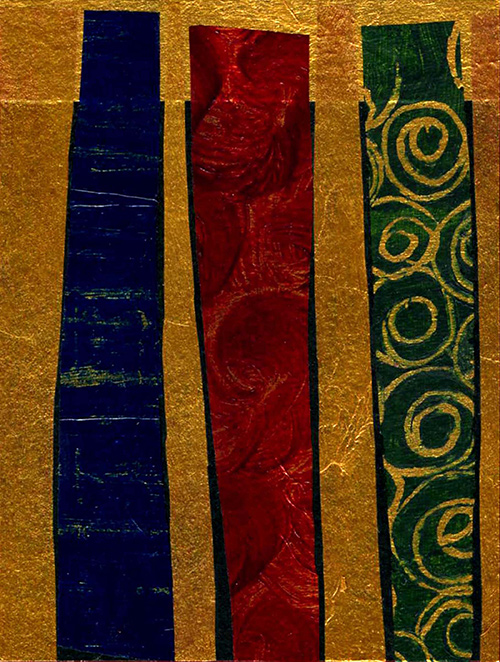
The Feast of the Epiphany: Magi and Mystery

January 6, 2008

Image: Magi and Mystery © Jan Richardson

Merry Epiphany to you! I preached at First United Methodist Church of Winter Park this morning; here’s an approximation of what I shared.

Magi and Mystery
Matthew 2.1-12

We’ve seen them everywhere over the holidays: three regal men, sometimes depicted with camels, bearing gifts that they have traveled hundreds of miles to offer to Jesus. Although their story, which appears in the Gospel of Matthew, is distinct from the nativity story in Luke’s Gospel, and although it’s likely that they didn’t reach Mary, Joseph, and Jesus until Jesus was a couple of years old, these wise travelers are almost always depicted along with the shepherds and others who inhabit the story of the birth of Christ. Christmas cards and nativity sets vividly bring together the stories that Matthew and Luke offer. In the manger scene in my parents’ home, the wise men join not only the shepherds and the traditional cow and donkey who welcome Christ into the world; owing to my mom’s great sense of whimsy, they stand also alongside such creatures as a dinosaur, a moose, and a giraffe. Kind of a “Noah’s Ark meets the Nativity” sort of thing.

We have these really familiar images of these wise men who come to welcome the Christ and lavish him with gifts, but the truth is that Matthew’s Gospel tells us very little about them. Matthew refers to them as “magi,” a word that means wise men or astrologers. We’re not certain where they came from; possibly Persia, about a thousand miles away, where there was a class of priestly folk who were referred to as magi. We’re not sure how many of them there were. Because they offered three gifts, tradition has often assumed there were three wise men (one gift per wise man, please!), but estimates across the centuries have ranged from two to twelve. We don’t even know their names, though legend has called them Gaspar, Melchior, and Balthasar.

The wise men are sometimes referred to as the three kings, a designation that comes not from Matthew’s Gospel but from passages in the Hebrew scriptures that refer to kings who come bearing gifts for a great new ruler.

All this is to say that the magi are shrouded in mystery. In the midst of Matthew’s relative lack of information, we do know these things: they possessed the ability to read the heavens, they felt compelled to follow a star, they traveled a vast distance to welcome and pay homage to Jesus, and they brought him amazing presents.

I’m intrigued by the fact that Matthew, who is so fuzzy on certain details regarding the magi, is very specific about the gifts they brought. This suggests that the gifts are part of Matthew’s whole point in telling the tale of Jesus’ birth. The first hearers and readers of Matthew’s story would have understood the significance of the wise men’s offerings, but, as we ponder the story two millennia later, it’s good to remind ourselves of what these gifts would have meant.

In Jesus’ day, the first gift, gold, had lots of the same connotations that it does for us. It’s precious. It’s lavish. It’s a gift fit for a king. In the Bible, gold is sometimes mentioned in the same breath as royalty. Isaiah and the Psalms refer to kings who bring gold to honor a great ruler. For the wise men, the gift of gold was a way of acknowledging Jesus as a king.

It is, perhaps, a little harder for us to grasp the value of frankincense and myrrh. Both frankincense and myrrh come from the aromatic resin of trees. More bluntly put, they are dried tree sap. What a gift for a child! But in Jesus’ time, they were costly, myrrh especially so. Frankincense was typically used in religious rituals. In Exodus 30, God tells Moses to make an incense that includes frankincense, for use in the tent of meeting, where God meets with the priests; God tells Moses, “It shall be for you most holy.” The wise men’s gift of frankincense symbolizes that God has come in the person of Christ, that Christ himself has become the place of meeting between divinity and humanity.

Myrrh seems like perhaps the strangest gift of all. In Jesus’ time, it was especially associated with funerals and was used in the process of preparing a body for burial. In the New Testament, the only mentions of myrrh, besides today’s reading, are in the gospels of Mark and John, in connection with Jesus’ crucifixion and death. This seems a curious gift for a young child, and I have to wonder if this gift haunted Jesus a bit. Though it carries some foreshadowing of what will happen to Jesus, I think the magi intended it not as a morbid gift but rather as a reminder to Jesus that, even for him, earthly life is brief, and we are called to use it well.

On this day of Epiphany, as we set off into the new year, I want to invite us to think of the wise men’s gifts to Jesus as gifts for us as well. These gifts, rich with symbolism, have invitations for us who seek to follow Christ, who are the body of Christ. I want to suggest that within these gifts, so rich with significance and symbolism, are questions that can accompany us into this new year.

The gift of gold, the gift that recognized Jesus was as a king, invites us to consider the question: Who were you born to be? This is perhaps the most crucial and most complicated question of our lives. Some of the most interesting people I know are those who, well along in their journey, are actively discerning who God has called them to be. When I was in seminary, half of my classmates were what we call “second career students,” folks who had been doing some other work in the world before discerning a call that involved theological training. I entered seminary straight out of college, very wet behind the ears, and it was a wonderfully rich experience to be in classes with folks in their 40s, 50s, and 60s. They were a great reminder that this process of becoming who we were born to be is a lifelong adventure. That’s true even for those of us who carry a strong sense of what we’re called to do. I tend to be really focused—I sometimes think of it as Attention Surplus Disorder—and have always had some sense of what I’ve wanted to do. What I wanted to do went through some changes before I discerned a call to ordained ministry, but I can see the common thread linking those vocations I was interested in. Even now, in a vocation that has taken me deeply into who I believe I was born to be, I’m still growing into my understanding of that call.

The gift of frankincense, the gift that recognized Jesus as the one who is a meeting place of humanity and divinity, invites us to ponder the question: How do you want to encounter God? This kind of question is at the core of the Connect theme that we’re living with at First Church. As we set out into this new year, how might you seek to stay connected with God, within and beyond this congregation?

The gift of myrrh, the gift that recognized that even for Jesus, earthly life is brief, a twinkling of an eye, invites us to reflect on the question, What is your relationship with time? How do you enter into your days in a way that helps you discern who you are and helps you seek God? Annie Dillard writes that “how we spend our days is, after all, how we spend our lives.” She also writes, “Live every day as if it were your last and then someday you’ll be right.”

So, a trinity of questions for this new year:

Who were you born to be?

How do you want to encounter God?

What is your relationship with time?

Carrying the crucial questions can be uncomfortable. It’s not always easy to live with mystery, but I’ve found that a good question can carry me a long way. It invites me to rely on God to show me the path, rather than thinking I should always rely on myself to know everything and do everything.

The magi didn’t show up with maps; they brought gifts that helped Jesus know who he was. Like the wise men, who had to travel by another road when they left Jesus, we may find ourselves on some strange and unfamiliar and mapless paths when we seek to follow Christ. But in his company, we will, like those wise travelers, find our way home.

[To use the image “Magi and Mystery,” please visit this page at janrichardsonimages.com. Your use of janrichardsonimages.com helps make the ministry of The Painted Prayerbook possible. Thank you!]