Archive for the ‘sacred time’ Category

Trinity Sunday: Blessing of the Ordinary

June 12, 2011


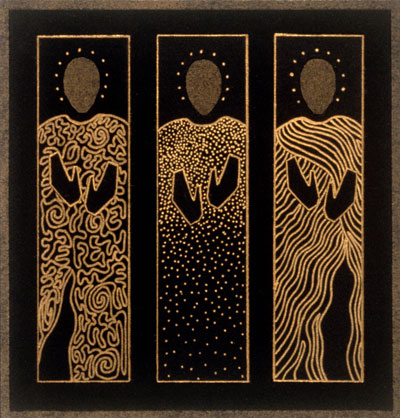
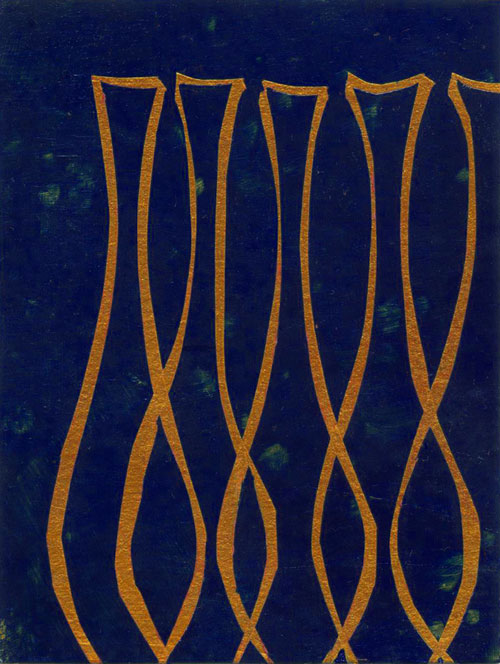
A Spiral-Shaped God © Jan L. Richardson

Reading from the Gospels, Trinity Sunday (June 19): Matthew 28.16-20

Each year when Trinity Sunday rolls around, ushering us into the season of the year known as Ordinary Time, my memory travels back to a Trinity Sunday many years ago. It was my last Sunday living in Atlanta, where I had gone to seminary and was now finishing a bonus year spent working on my first book and lingering with the seminary community. In a few days I would move back to Florida to take my first pastoral appointment.

On that final, bittersweet Atlanta Sunday, I went with my boyfriend to Oakhurst Baptist Church, where one of the pastors preached a powerful sermon about entering into the rhythms of Ordinary Time. At the close of the sermon, she invited us into a ritual of laying on of hands as a way of seeking a blessing as we crossed into the new season. Several teams of church members, three in each team, moved to various places in the church. Folks who wished could go to one of the teams, asking them to pray for something in particular or simply to offer a blessing.

Standing at the threshold not only of  a new season but also of a dramatic life change as I prepared to move from Atlanta, where I had a close and wonderfully engaging community, to Orlando, where I knew virtually no one, I thought I could use a blessing. Approaching one of the teams that included a seminary friend of mine, I quietly told them about my upcoming move. And the team—a trinity of women, as it happened—laid their hands and their words on me in a sacramental gesture of blessing.

It would take a long time for me to find and reestablish some ordinary rhythms in my life. But on that Trinity Sunday, graced by the women who offered a blessing for me and for my ministry that lay ahead, I found sustenance that helped me cross the threshold into the new season and into the new life that waited for me.

As we move from the times and seasons that have been so marked by a sense of story and meaning—Advent, Christmas, Epiphany, Lent, Easter, Pentecost—into the long season of year that bids us celebrate the commonplace and to seek the God who dwells within the daily, what sort of blessing might you need? What words or gestures of sacrament and grace do you need to sustain you as you enter into this part of the year? How do you look for the presence of the God who lingers amid the ordinary and seemingly mundane? What rhythms of living do you yearn for as you stretch into the season that awaits you?

Blessing the Ordinary

Let these words
lay themselves
like a blessing
upon your head,
your shoulders

as if,
like hands,
they could pass on
to you
what you most need
for this day

as if they could
anoint you
not merely for
the path ahead

but for this
ordinary moment
that opens itself
to you—

opens itself
like another hand
that unfurls itself,
that reaches out
to gather up
these words
in the bowl
of its palm.

You may think
this blessing
lives within
these words

but I tell you
it lives
in the opening
and in the reaching;

it lives
in the ache
where this blessing
begins;

it lives
in the hollow
made by the place
where the hands
of this blessing
meet.

Spiraling back around: For a previous reflection on Trinity Sunday, see Trinity Sunday: A Spiral-Shaped God.

[To use the “Spiral-Shaped God” image, please visit this page at janrichardsonimages.com. Your use of janrichardsonimages.com helps make the ministry of The Painted Prayerbook possible. Thank you!]
Pentecost: One Searing Word

June 5, 2011


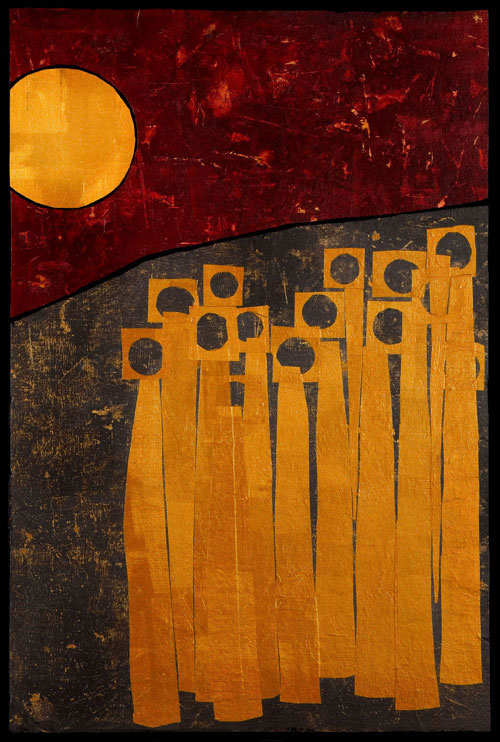
Pentecost © Jan L. Richardson

Reading from the Book of Acts, Day of Pentecost (June 12): Acts 2.1-21

Nearly thirteen weeks have passed since the day we stood on the threshold of Lent, our foreheads streaked with ashes. We have traveled through a wilderness season of reflection and preparation as we journeyed toward the cross. We have entered into a season of resurrection in these weeks since the wonders of Easter Day. We have watched Jesus take his leave, blessing those whom he has called to continue his work and become his body in this world.

Now, as the Day of Pentecost approaches, we find ourselves at the other end of the arc that began on the weeks-ago Ash Wednesday. “Know that you are dust, and to dust you shall return,” many of us heard on that day. A crucial reminder, to be sure: to know what we are made of, where we are from, to where we shall return. Yet all these weeks later, at the end of wilderness and death and resurrection, the day of Pentecost comes to show us that there is still more to know, and a purpose for knowing that lies beyond our individual lives.

Throughout this Easter season, the gospel readings have placed a persistent emphasis on knowing. To those who heard the Ash Wednesday admonition to know that you are dust, Jesus’ intentionality in telling his followers what he needs them to know comes as a striking complement to the words that ushered us into Lent. Although knowing our earthy origins is crucial in our life with Christ, the past weeks have proven there are other things he needs for us to know as well about who he is, what he has done, and what he is calling us to do.

Yet simply knowing, of course, is not enough. On the day of Pentecost, as the Spirit descends upon the gathered assembly, we see with dramatic clarity how the knowing that Christ gives us is not for ourselves alone: it is for the life of the community and the life of the world. As on Pentecost, when those who spoke in the Spirit did not recognize what they were saying but could be understood by others in the crowd, our knowing and understanding are always incomplete without the presence of community.

The incompleteness of our knowing comes as its own reminder of what dusty disciples we are. Made of common earth, fashioned of ordinary matter, we are called to a humus-born humility that cautions us against acting like we have all the answers and know all of God’s designs for creation. Yet the story of Pentecost bids us to remember what the Spirit can do with dust. Pentecost reminds us that the Spirit draws us together and gives us to one another so that we may hear and see and know with greater clarity. This day challenges us to open ourselves beyond the limits of our individual lives to the Spirit who sets us ablaze for the healing of the world.

In this Pentecost week, are you seeking the presence of others who will deepen your understanding? Where do you go to hear and see what you cannot hear and see on your own? When knowledge and wisdom come to you, how do you share them beyond yourself to help others flourish? Where are you turning your ears, your eyes, your heart, your mind to perceive the presence of the Spirit and the path to which it is drawing you?

Pentecost Blessing

On the day
when you are wearing
your certainty
like a cloak
and your sureness
goes before you
like a shield
or like a sword,

may the sound
of God’s name
spill from your lips
as you have never
heard it before.

May your knowing
be undone.
May mystery
confound your
understanding.

May the Divine
rain down
in strange syllables
yet with
an ancient familiarity,
a knowing borne
in the blood,
the ear,
the tongue,
bringing the clarity
that comes
not in stone
or in steel
but in fire,
in flame.

May there come
one searing word:
enough to bare you
to the bone,
enough to set
your heart ablaze,
enough to make you
whole again.

P.S. For a previous Pentecost reflection, click the image or title below:

Pentecost: Fire and Breath

[To use the “Pentecost” image, please visit this page at janrichardsonimages.com. Your use of janrichardsonimages.com helps make the ministry of The Painted Prayerbook possible. Thank you!]
Easter 2: The Illuminated Wound

April 24, 2011

Image: Into the Wound © Jan Richardson

Reading from the Gospels, Easter 2: John 20.19-31

“Have you believed because you have seen me?” Jesus asks Thomas as he, at Jesus’ invitation, reaches his hand into the wounds of the risen Christ. “Blessed are those,” Jesus goes on to say, “who have not seen and yet have come to believe.”

While Jesus accords special honor to those whose faith does not depend on sight, surely he does not mean that the gift of blessing is reserved solely for those who can make the leap of imagination toward belief. Christian history would indeed come to label Thomas with the moniker—something of an epithet—of “Doubting Thomas,” (though elsewhere, in John 11, Thomas displays remarkable courage and devotion to Jesus) and cast a suspicious and sometimes deadly eye on doubt. At the same time, through much of its history the Christian tradition has offered tools and gifts specifically designed to foster sight and thereby deepen belief.

Thomas would have found good company amongst many Christians in the Middle Ages, when there arose a form of devotion that gave particular attention to the wounds of Christ as an entry into prayer and contemplation. The writings of medieval mystics both helped give rise to this form of devotion as well as to articulate it. With an approach to both flesh and spirit that can be challenging for us to comprehend in our day, these mystics saw in Christ’s wounds, particularly the wound in his side, an array of meanings. In their prayerful imagining, Christ’s wound became, among other things, an opening through which he offers his life-giving sustenance as a mother shares her milk with her child; a womb-space that offers the possibility of rebirth; and a place of union between lover and beloved.

These ideas about Christ’s wounds made their way into images that medieval artists created for the purpose of devotion. We see this, for instance, in paintings that depict the wounded Christ and his mother. As Christ offers his wound to the viewer, Mary offers her breast with a nearly mirrored gesture that suggests the similarity of the sustenance they give. We see signs of this devotion also in a number of illuminated manuscripts that include life-sized renderings of Jesus’ side wound. Divorced from his body, the wound itself becomes an object of contemplation, making an intriguing portal into the page and doorway into prayer.

This kind of depiction of Jesus’ wound sometimes appears in illuminated prayer scrolls that were used by women in childbirth. The women placed the prayer scrolls around themselves as birth girdles, with the depiction of Christ’s wound serving not only as an object of contemplation but of hoped-for protection as well.  One can imagine the laboring women saw this wound-symbol as a confirmation that Jesus, who knew what it meant to suffer in bringing new life, offered sustenance to them as they did so. More than one writer has remarked on the striking similarity that the depiction of Jesus’ wound bears to female genitalia (noting also the similarity between vulva and vulnus, wound), prompting one to wonder if those who clung to Christ’s wounds in prayer noted the similarity of these portals by which new life enters. (But, as another writer has noted, how could they have missed noticing it?)

While such a vivid approach to the wounds of Christ may strike our 21st-century sensibilities as odd or gruesome, this form of contemplation was not seen as an end in itself. In the myriad ways that mystics and artists reflected on Christ’s body, it seems clear that they understood the flesh of Christ as a threshold: that his wounds were an entryway, a portal into God. As Sarah Beckwith describes it, the wounded body of Christ offered a rite of passage that held the possibility not only of a deeper relationship with him but also a redefinition of oneself.

Contemplating the wounds of Christ could also prompt medieval Christians to touch the wounds of the world. In his book on traditional religion in 15th- and 16th-century England, Eamon Duffy notes that “the wounds of Christ are the sufferings of the poor, the outcast, and the unfortunate.” He goes on to write that devotion to the wounds of Christ often translated into acts of charity. Such acts became a tending of the living, wounded, corporate body of Christ.

These imaginative approaches to Christ’s wounds, and the access they offered to medieval folk who sought intimate acquaintance with him, do not dismiss or justify the violence of the crucifixion story. Encountering these visual images, however, has challenged me to wonder what sort of doorway they offer to me, and to us, in these days that, as they ever have been, are so profoundly marked by violence.

I have come to see more clearly the ways that being in the world and loving one another—even from our most intact, integrated places, much less our less-intact ones—exposes us to wounding, to the giving and receiving of pain. Christ’s wounds exemplify this. They underscore the depth of his willingness to enter into our loving in all its hurt and hope and capacity for going horribly wrong. In wearing his wounds—even in his resurrection—he confronts us with our own and calls us to move through them into new life.

Christ beckons us not to seek out our wounding, because that will come readily enough in living humanly in the world, but rather to allow our wounds to draw us together for healing within and beyond the body of Christ, and for an end to the daily crucifixions that happen through all forms of violence. The crucified Christ challenges us to discern how our wounds will serve as doorways that lead us through our own pain and into a deeper relationship with the wounded world and with the Christ who is about the business of resurrection, for whom the wounds did not have the final word.

As Thomas reaches toward Christ, as he places his hand within the wound that Christ still bears, he is not merely grasping for concrete proof of the resurrection. He is entering into the very mystery of Christ, crossing into a new world that even now he can hardly see yet dares to move toward with the courage he has previously displayed.

As we move into this Easter season, how do we see the wounds of Christ in the wounds of the world? How might we be called to reach into those wounds—not to wallow in them, not to become overwhelmed by them, but to touch them and minister to them and help to turn them into doorways that draw us deeper into Christ?

In this season of resurrection, may you see the risen Christ all around you. May you be blessed in your seeing, and lean yourself into the new world that he offers to you.

P.S. For previous reflections on this passage, see Easter 2: Into the Wound and Easter 2: The Secret Room.

[To use the image “Into the Wound,” please visit this page at janrichardsonimages.com. Your use of janrichardsonimages.com helps make the ministry of The Painted Prayerbook possible. Thank you!]

Beckwith and Duffy references:

Sarah Beckwith, Christ’s Body: Identity, Culture, and Society in Late Medieval Writing (New York: Routledge, 1993), 60.

Eamon Duffy, The Stripping of the Altars: Traditional Religion in England c. 1400-c. 1580 (New Haven: Yale University Press, 1992), 248.

A portion of this reflection has been adapted from Garden of Hollows: Entering the Mysteries of Lent & Easter © Jan L. Richardson.

Easter Sunday: Risen

April 20, 2011

Image: Easter IIImage: Easter II © Jan Richardson

Reading from the Gospels, Easter Sunday:
John 20.1-18 or Matthew 28.1-10

Risen
For Easter Day

If you are looking
for a blessing,
do not linger
here.

Here
is only
emptiness,
a hollow,
a husk
where a blessing
used to be.

This blessing
was not content
in its confinement.

It could not abide
its isolation,
the unrelenting silence,
the pressing stench
of death.

So if it is
a blessing
you seek,
open your own
mouth.

Fill your lungs
with the air
this new
morning brings

and then
release it
with a cry.

Hear how the blessing
breaks forth
in your own voice,

how your own lips
form every word
you never dreamed
to say.

See how the blessing
circles back again,
wanting you to
repeat it,
but louder,

how it draws you,
pulls you,
sends you
to proclaim
its only word:

Risen.
Risen.
Risen.

—Jan Richardson

2016 update: “Seen” appears in my new book, Circle of Grace: A Book of Blessings for the Seasons.

P.S. For a previous reflection on Easter Sunday, see Easter Sunday: Out of the Garden. I am also offering daily reflections throughout Holy Week at the Sanctuary of Women blog and would be delighted to have your company there as well. And if you haven’t seen the videos that Garrison Doles and I recently released for Lent and Easter, I welcome you to check them out here: Listening at the Cross and The Hours of Mary Magdalene. Know that I’m holding you in prayer throughout this Holy Week, and I wish you a joyous Easter!

[To use the “Easter II” image, please visit this page at janrichardsonimages.com. Your use of janrichardsonimages.com helps make the ministry of The Painted Prayerbook possible. Thank you!]
Holy Saturday: The Art of Enduring

April 19, 2011

Image: Holy Saturday IIImage: Holy Saturday II © Jan Richardson

Reading from the Gospels, Holy Saturday:
Matthew 27.57-66 or John 19.38-42

The Art of Enduring
For Holy Saturday

This blessing
can wait as long
as you can.

Longer.

This blessing
began eons ago
and knows the art
of enduring.

This blessing
has passed
through ages
and generations,
witnessed the turning
of centuries,
weathered the spiraling
of history.

This blessing
is in no rush.

This blessing
will plant itself
by your door.

This blessing
will keep vigil
and chant prayers.

This blessing
will bring a friend
for company.

This blessing
will pack a lunch
and a thermos
of coffee.

This blessing
will bide
its sweet time

until it hears
the beginning
of breath,
the stirring
of limbs,
the stretching,
reaching,
rising

of what had lain
dead within you
and is ready
to return.

—Jan Richardson

2016 update: “The Art of Enduring” appears in my new book, Circle of Grace: A Book of Blessings for the Seasons.

For a previous reflection on Holy Saturday, see Holy Saturday: A Day Between. I’m also offering daily reflections throughout Holy Week at the Sanctuary of Women blog.

[To use the image “Holy Saturday II,” please visit this page at janrichardsonimages.com. Your use of janrichardsonimages.com helps make the ministry of The Painted Prayerbook possible. Thank you!]
Good Friday: What Abides

April 19, 2011

Image: Good Friday IIImage: Good Friday II © Jan L. Richardson

Reading from the Gospels, Good Friday:
John 18.1-19.42

What Abides
For Good Friday

You will know
this blessing
by how it
does not stay still,
by the way it
refuses to rest
in one place.

You will recognize it
by how it takes
first one form,
then another:

now running down
the face of the mother
who watches the breaking
of the child
she had borne,

now in the stance
of the woman
who followed him here
and will not leave him
bereft.

Now it twists in anguish
on the mouth of the friend
whom he loved;

now it bares itself
in the wound,
the cry,
the finishing and
final breath.

This blessing
is not in any one
of these alone.

It is what
binds them
together.

It is what dwells
in the space
between them,
though it be torn
and gaping.

It is what abides
in the tear
the rending makes.

—Jan Richardson

2016 update: “What Abides” appears in my new book, Circle of Grace: A Book of Blessings for the Seasons.

P.S. For a previous reflection on Good Friday, see Good Friday: In Which We Get Nailed. And blogging daily throughout Holy Week at the Sanctuary of Women blog.

[To use the “Good Friday II” image, please visit this page at janrichardsonimages.com. Your use of janrichardsonimages.com helps make the ministry of The Painted Prayerbook possible. Thank you!]
Holy Thursday: Take a Blessing

April 18, 2011

Image: Holy Thursday IIImage: Holy Thursday II © Jan Richardson

Reading from the Gospels, Holy/Maundy Thursday:
John 13.1-17, 31b-35

The story is told of St. Brigid, the beloved Celtic saint and leader of the early church in Ireland, that a man with leprosy came to her one day. Knowing the saint’s reputation for hospitality, the man says to Brigid, “For God’s sake, Brigid, give me a cow.” Brigid’s response suggests this man may have made a habit of such requests; though normally lavish with her generosity, Brigid tells the man to leave her alone. He persists.

Brigid asks the man how it might be if they prayed that God would heal him of his leprosy. “No,” the man tells her, “I get more this way than if I were clean.” Brigid, in her turn, persists with him, urging him to “take a blessing and be cleansed.” The man acknowledges he is indeed in much pain; he gives in and accepts the blessing and the gift of healing it brings. So great is his gratitude to Brigid—and to God—that he vows his devotion to Brigid and pledges to be her servant and woodman.

Sometimes it can be daunting to receive a blessing. As this man with leprosy recognized, a blessing requires something of us. It does not leave us unchanged. A blessing offers us a glimpse of the wholeness that God desires for us and for the world, and it beckons us to move in the direction of this wholeness. It calls us to let go of what hinders us, to cease clinging to the habits and ways of being that may have become comfortable but that keep us less than whole.

This can take some work.

Part of the challenge involved with a blessing is that receiving it actually places us for a time in the position of doing no work—of simply allowing it to come. For those who are accustomed to constantly doing and giving and serving, being asked to stop and receive can cause great discomfort. To receive a blessing, we have to give up some of our control. We cannot direct how the blessing will come, and we cannot define where the blessing will take us. We have to let it do its own work in us, beyond our ability to chart its course.

On the night that Jesus takes up his basin and towel and begins to wash the feet of his disciples, Simon Peter learns how difficult and how wondrous it can be to “take a blessing,” as Brigid put it. He resists, then allows himself to receive, the grace of it dripping from his toes.

This blessing will indeed require something of Simon Peter and of his fellow disciples. When Jesus has finished the washing, put on his robe, put away his towel and bowl, he turns to them and says, “Do you know what I have done to you?…If I, your Lord and Teacher, have washed your feet, you also ought to wash one another’s feet. For I have set you an example, that you also should do as I have done to you. Very truly, I tell you,” Jesus continues, “servants are not greater than their master, nor are messengers greater than the one who sent them. If you know these things, you are blessed if you do them.”

You are blessed if you do them.

A blessing is not finished until we let it do its work within us and then pass it along, an offering grounded in the love that Jesus goes on to speak of this night. Yet we cannot do this—as the disciples could not do this—until we first allow ourselves to simply receive the blessing as it is offered: as gift, as promise, as sign of a world made whole.

During this Holy Week, I am offering a series of blessings for Holy Thursday, Good Friday, Holy Saturday, and Easter Sunday. As we move through these days, may these blessings come as gift, as grace. In this week, may we take a blessing, and become one in turn.

Blessing You Cannot Turn Back
For Holy Thursday

As if you could
stop this blessing
from washing
over you.

As if you could
turn it back,
could return it
from your body
to the bowl,
from the bowl
to the pitcher,
from the pitcher
to the hand
that set this blessing
on its way.

As if you could
change the course
by which this blessing
flows.

As if you could
control how it
pours over you—
unbidden,
unsought,
unasked,

yet startling
in the way
it matches the need
you did not know
you had.

As if you could
become undrenched.

As if you could
resist gathering it up
in your two hands
and letting your body
follow the arc
this blessing makes.

—Jan Richardson

2016 update: “Blessing You Cannot Turn Back” appears in my new book Circle of Grace: A Book of Blessings for the Seasons.

P.S. For an earlier reflection for Holy Thursday, visit Holy Thursday: Feet and Food. I am also offering daily reflections at the Sanctuary of Women blog, where this week we’re traveling in the company of the women of Holy Week and Easter.

[To use the “Holy Thursday II” image, please visit this page at janrichardsonimages.com. Your use of janrichardsonimages.com helps make the ministry of The Painted Prayerbook possible. Thank you!]
The Hours of Mary Magdalene

April 13, 2011

Just in time for Holy Week, Gary and I have released a new video today that we’re excited to share with you. The Hours of Mary Magdalene features images from my mixed media series of the same name, combined with Gary’s enchanting song “Mary Magdalena” from his CD House of Prayer. The video draws from the life Mary Magdalene, whose story is so intertwined with the dying and rising of Christ. Called by Christ to be the first to proclaim the news of his resurrection, Mary Magdalene became known in the Middle Ages as the “apostle to the apostles.”

The video draws also from the fascinating body of legends about the Magdalene—stories that may be slim on facts but convey something of our centuries-old fascination with this woman who played a distinctive role as a follower of Christ. As a preacher chick, I’m especially fond of the legend in which Mary Magdalene moves to France and becomes a famous preacher. (I like to imagine her going for a cappuccino and a chocolate croissant after holding forth.) She is also said to have released prisoners from a French jail. In the video you’ll find glimpses of these and other legends, including one that tells that she spent her final years as a hermit in the wilderness, clad only in her long hair; at the canonical hours, angels would come and whoosh her up to heaven for the liturgy, then would whoosh her back down again.

The Magdalene series found much inspiration in Books of Hours, those exquisite illuminated prayerbooks that became so popular among medieval folk as a companion for prayer. You can find out more about the original series and the influences and legends behind it on the Magdalene page in my online gallery.

We have launched the video at the splendid Vimeo site; if you click the Vimeo logo in the player embedded above, it will take you directly to a larger version of the video. We have also released the video on YouTube, where you can view it here. To share the video in worship and related settings, you can find a high-resolution version by visiting The Hours of Mary Magdalene on the Jan Richardson Images website. As always, using the Jan Richardson Images site helps make possible the ministry that I offer at The Painted Prayerbook and beyond. And downloading the video will support Gary’s ministry as well!

As Holy Week approaches, Gary and I hope you will enjoy a few moments in the contemplative company of the Magdalene, and that she may inspire us all to tell forth the words we are called to speak. Blessings!

Listening at the Cross

March 31, 2011

One of the things I love about having Garrison Doles in my life is getting to collaborate with him in a variety of venues, from retreats to worship to workshops and beyond. I’m delighted to announce our latest collaboration, this time in the digital realm. We have just released a new video titled Listening at the Cross: The Seven Last Words of Christ, which intertwines my artwork and Gary’s music.

The images in the video come from the series I created for the book Listening at Golgotha, Peter Storey’s series of reflections on Christ’s words from the cross. Peter is a friend whose ministry has included serving as the bishop of the Methodist Church of Southern Africa and as the chaplain to Nelson Mandela during his years in prison. As one might imagine, this pastor who spent much of his ministry engaged in the struggle against apartheid has some distinctive insights into the crucifixion of Christ—as well as his resurrection.

Gary’s haunting song “This Crown of Thorns,” from his CD Draw Us Closer, accompanies the images. As always, working with his words and music draws me deeper into my own creative work, and it is a delight to offer you this marriage of song and image in this Lenten season. We pray that in these days, Listening at the Cross will invite you into an evocative space of quiet and contemplation as we journey with Christ not only to the cross but also to what lies beyond it.

In addition to launching the video on YouTube, we are also releasing it at the very cool Vimeo site, where you can view it here. To share the video in worship and related settings, you can find a high-resolution version by visiting Listening at the Cross on the Jan Richardson Images website. As always, using the Jan Richardson Images site helps make possible the ministry that I offer at The Painted Prayerbook and beyond. And downloading the video will support Gary’s ministry as well!

Know that we are grateful to be on the path with you, and we wish you many blessings in these Lenten days.

Baptism of Jesus: Following the Flow

January 4, 2011


Following the Flow © Jan L. Richardson

Reading from the Gospels, Baptism of Christ/Epiphany 1, Year A: Matthew 3.13-17

From Genesis to Revelation, water arcs through the Bible, courses through the scriptures, shapes the landscape of the sacred text, surfaces again and again in the story of the people of God. Nearly always it is a sign of God’s provision, God’s providence, God’s care for those whom God has claimed. By the time we see Jesus meeting John at the Jordan in this Sunday’s gospel lection, we have already been swimming in the stories: of God giving a stream to Eden, of Hagar receiving wellsprings in her desperate wilderness, of Moses striking the rock that gave water to a thirsty and wandering people. We have read the tale of Jacob meeting Rachel by a well, the psalmist’s words about still waters that comfort and restore, and the prophet’s proclamation of the God who “will pour water on the thirsty land, and streams on the dry ground.” Again and again, God’s provision breaks through and springs forth in the form of water.

And here, the first time Jesus takes the stage as an adult, we see him come to the Jordan. This is the river in which, generations before, priests bearing the ark of the covenant had stood, stopping the waters so that the entire, long-journeying children of Israel could pass through to the other side. This is the river that Elijah struck with his mantle so that he and Elisha could cross, moments before Elijah’s dramatic ascension amid the blazing horses and chariots of fire. It is Jordan that Elisha tells the leprous Naaman to wash himself in and be cleansed, Jordan that King David crosses with all of Israel as he prepares to fight the Arameans, Jordan that traces a path through Israel’s history. It is a mythic river that Jesus wades into, and we watch him become drenched in its very real waters as he receives John’s baptism.

As Jesus rises from this ancient river, he is the recipient of all the graces that water signifies, imbued with the layers of symbolism and story and blessing that these waters convey. Yet he is not only recipient of this; as the waters of baptism roll off him, Jesus is also sign: this drenched and dripping Messiah embodies and shows forth in fullness just how far God will go to provide for and restore God’s people.

Here at Jordan, I find my eye drawn to the yielding that takes place in this river. When Jesus first approaches him, John challenges this baptism-seeking savior: “I need to be baptized by you, and do you come to me?” he says to his cousin. “Let it be so now,” Jesus urges him, his words an echo of the “Let it be” that his mother offered to the angel long ago, on the day that the same Spirit descended upon her. And just like that, the locust-and-honey-eating Baptist of the wilderness, who only a few verses earlier was railing at the Pharisees and Sadduccees and speaking of vipers and axes, winnowing forks and fire, falls silent. Gives in. Yields to Jesus like a stone yielding to the river that washes over it.

Jesus, too, does his own yielding. He places himself in John’s hands, leans into the liminal space of the ritual, gives himself up to the river and what it offers, gives in to the path that lies ahead of him. It is not a passive action that Jesus undertakes here. This is not the gesture of a man resigned to his fate; he is not letting his circumstances wash over him. Christ does not take part in—or call us to—blind acceptance. The yielding that Jesus engages in—and John, too—requires a different kind of strength, a different set of muscles than those involved in straining and striving and struggling to move forward. This yielding calls forth a courage born of recognizing the path to which we are called, and ceasing to fight against it: to give ourselves to its flow, to let it work on us, as the river does with the stone.

As we move into this new year and this new liturgical season, what muscles are you using? In the midst of working and reaching and pushing, is there a place where God might be inviting you to yield, to give in, to give yourself up, so that the grace of God may wash over you? Is there a ritual, a sacramental act, a liminal space that you need to lean into? Who could you ask to meet you there; who could help you say, “Let it be”?

As we approach this Sunday’s celebration of the Baptism of Jesus, I invite you to spiral back around some earlier art and reflections for this day. Click on the image or the title below to find your way to them.

In these days, may you know when to push, and when to give in, and may the grace and the power of God drench you and bear you along. Blessings.

Epiphany 1: Baptized and Beloved

Epiphany 1: Take Me to the River

Epiphany 1: Ceremony (with a Side of Cake)

[To use the “Following the Flow” image, please visit this page at janrichardsonimages.com. Your use of janrichardsonimages.com helps make the ministry of The Painted Prayerbook possible. Thank you!]
Bonus round: As you ponder these things, click the player below to hear “Hymn of the Stone” by my husband, Garrison Doles, from his CD One Man.

P.S. NEW YEAR, NEW BOOK! As we move into this year, my new book, In the Sanctuary of Women, provides good companions for your path. In the spirit of Sacred Journeys, this book draws from the often hidden wellsprings of women’s wisdom in Jewish and Christian traditions, inviting us to engage the mysteries that lie at the heart of who we are. Not only for personal reflection, In the Sanctuary of Women also offers a space to engage with others, whether in an organized setting such as a book group or prayer circle, or with a friend across the country or across the table.

The companion website, sanctuaryofwomen.com, offers info on where to purchase the book, and inscribed copies are available by request. More than being just about the book,  the site is designed to foster conversation and community through features including a guide for reading groups and an interactive blog. I would love for you to stop by and to join with others in the conversations that are happening about how we can create sanctuary for and with one another in the coming year.