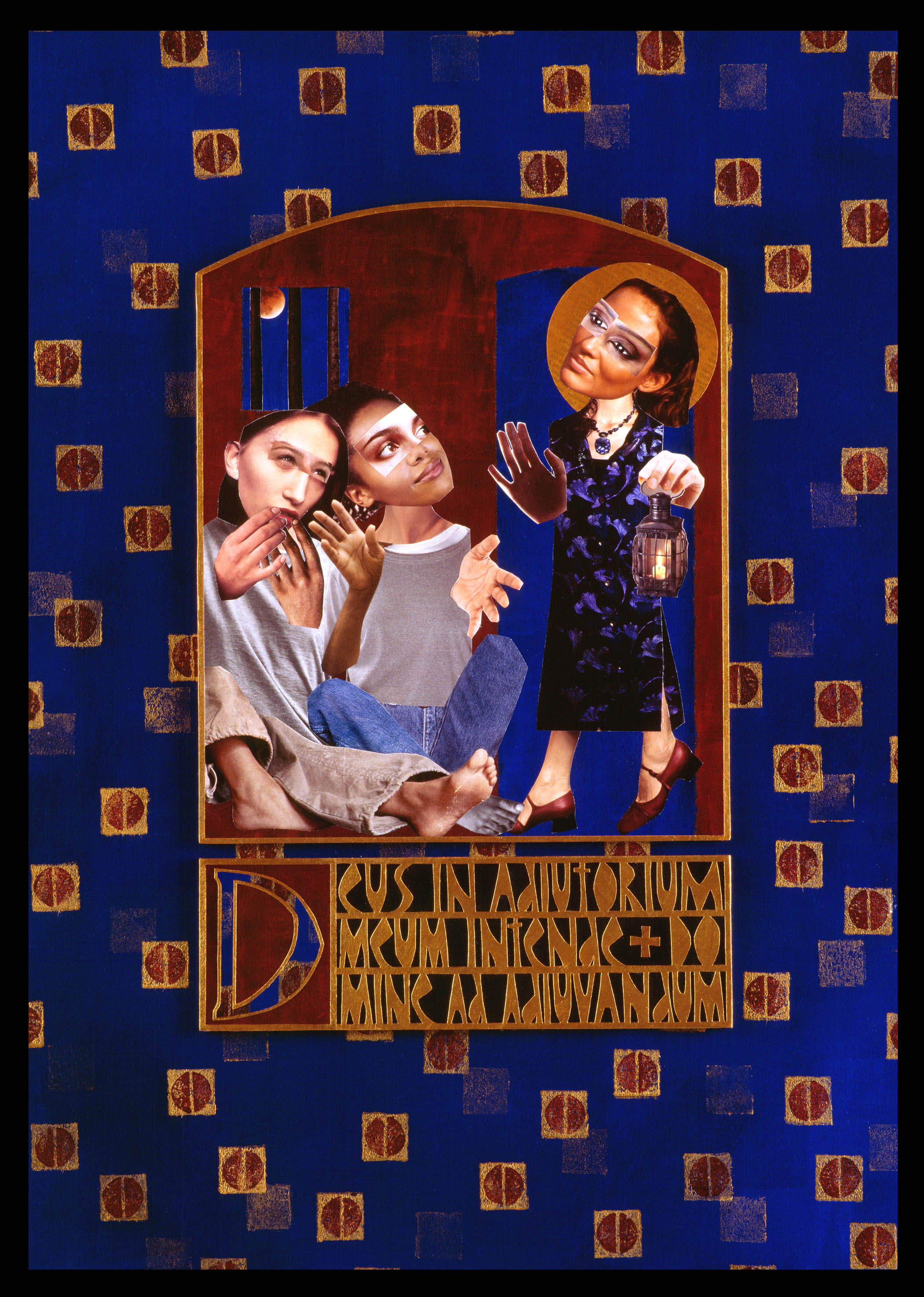
[To use the “Good Friday II” image, please visit this page at janrichardsonimages.com. Your use of janrichardsonimages.com helps make the ministry of The Painted Prayerbook possible. Thank you!]
The story is told of St. Brigid, the beloved Celtic saint and leader of the early church in Ireland, that a man with leprosy came to her one day. Knowing the saint’s reputation for hospitality, the man says to Brigid, “For God’s sake, Brigid, give me a cow.” Brigid’s response suggests this man may have made a habit of such requests; though normally lavish with her generosity, Brigid tells the man to leave her alone. He persists.
Brigid asks the man how it might be if they prayed that God would heal him of his leprosy. “No,” the man tells her, “I get more this way than if I were clean.” Brigid, in her turn, persists with him, urging him to “take a blessing and be cleansed.” The man acknowledges he is indeed in much pain; he gives in and accepts the blessing and the gift of healing it brings. So great is his gratitude to Brigid—and to God—that he vows his devotion to Brigid and pledges to be her servant and woodman.
Sometimes it can be daunting to receive a blessing. As this man with leprosy recognized, a blessing requires something of us. It does not leave us unchanged. A blessing offers us a glimpse of the wholeness that God desires for us and for the world, and it beckons us to move in the direction of this wholeness. It calls us to let go of what hinders us, to cease clinging to the habits and ways of being that may have become comfortable but that keep us less than whole.
This can take some work.
Part of the challenge involved with a blessing is that receiving it actually places us for a time in the position of doing no work—of simply allowing it to come. For those who are accustomed to constantly doing and giving and serving, being asked to stop and receive can cause great discomfort. To receive a blessing, we have to give up some of our control. We cannot direct how the blessing will come, and we cannot define where the blessing will take us. We have to let it do its own work in us, beyond our ability to chart its course.
On the night that Jesus takes up his basin and towel and begins to wash the feet of his disciples, Simon Peter learns how difficult and how wondrous it can be to “take a blessing,” as Brigid put it. He resists, then allows himself to receive, the grace of it dripping from his toes.
This blessing will indeed require something of Simon Peter and of his fellow disciples. When Jesus has finished the washing, put on his robe, put away his towel and bowl, he turns to them and says, “Do you know what I have done to you?…If I, your Lord and Teacher, have washed your feet, you also ought to wash one another’s feet. For I have set you an example, that you also should do as I have done to you. Very truly, I tell you,” Jesus continues, “servants are not greater than their master, nor are messengers greater than the one who sent them. If you know these things, you are blessed if you do them.”
You are blessed if you do them.
A blessing is not finished until we let it do its work within us and then pass it along, an offering grounded in the love that Jesus goes on to speak of this night. Yet we cannot do this—as the disciples could not do this—until we first allow ourselves to simply receive the blessing as it is offered: as gift, as promise, as sign of a world made whole.
During this Holy Week, I am offering a series of blessings for Holy Thursday, Good Friday, Holy Saturday, and Easter Sunday. As we move through these days, may these blessings come as gift, as grace. In this week, may we take a blessing, and become one in turn.
Blessing You Cannot Turn Back For Holy Thursday
As if you could
stop this blessing
from washing
over you.
As if you could
turn it back,
could return it
from your body
to the bowl,
from the bowl
to the pitcher,
from the pitcher
to the hand
that set this blessing
on its way.
As if you could
change the course
by which this blessing
flows.
As if you could
control how it
pours over you—
unbidden,
unsought,
unasked,
yet startling
in the way
it matches the need
you did not know
you had.
As if you could
become undrenched.
As if you could
resist gathering it up
in your two hands
and letting your body
follow the arc
this blessing makes.
P.S. For an earlier reflection for Holy Thursday, visit Holy Thursday: Feet and Food. I am also offering daily reflections at the Sanctuary of Women blog, where this week we’re traveling in the company of the women of Holy Week and Easter.
[To use the “Holy Thursday II” image, please visit this page at janrichardsonimages.com. Your use of janrichardsonimages.com helps make the ministry of The Painted Prayerbook possible. Thank you!]
Just in time for Holy Week, Gary and I have released a new video today that we’re excited to share with you. The Hours of Mary Magdalene features images from my mixed media series of the same name, combined with Gary’s enchanting song “Mary Magdalena” from his CD House of Prayer. The video draws from the life Mary Magdalene, whose story is so intertwined with the dying and rising of Christ. Called by Christ to be the first to proclaim the news of his resurrection, Mary Magdalene became known in the Middle Ages as the “apostle to the apostles.”
The video draws also from the fascinating body of legends about the Magdalene—stories that may be slim on facts but convey something of our centuries-old fascination with this woman who played a distinctive role as a follower of Christ. As a preacher chick, I’m especially fond of the legend in which Mary Magdalene moves to France and becomes a famous preacher. (I like to imagine her going for a cappuccino and a chocolate croissant after holding forth.) She is also said to have released prisoners from a French jail. In the video you’ll find glimpses of these and other legends, including one that tells that she spent her final years as a hermit in the wilderness, clad only in her long hair; at the canonical hours, angels would come and whoosh her up to heaven for the liturgy, then would whoosh her back down again.
The Magdalene series found much inspiration in Books of Hours, those exquisite illuminated prayerbooks that became so popular among medieval folk as a companion for prayer. You can find out more about the original series and the influences and legends behind it on the Magdalene page in my online gallery.
We have launched the video at the splendid Vimeo site; if you click the Vimeo logo in the player embedded above, it will take you directly to a larger version of the video. We have also released the video on YouTube, where you can view it here. To share the video in worship and related settings, you can find a high-resolution version by visiting The Hours of Mary Magdalene on the Jan Richardson Images website. As always, using the Jan Richardson Images site helps make possible the ministry that I offer at The Painted Prayerbook and beyond. And downloading the video will support Gary’s ministry as well!
As Holy Week approaches, Gary and I hope you will enjoy a few moments in the contemplative company of the Magdalene, and that she may inspire us all to tell forth the words we are called to speak. Blessings!
One of the things I love about having Garrison Doles in my life is getting to collaborate with him in a variety of venues, from retreats to worship to workshops and beyond. I’m delighted to announce our latest collaboration, this time in the digital realm. We have just released a new video titled Listening at the Cross: The Seven Last Words of Christ, which intertwines my artwork and Gary’s music.
The images in the video come from the series I created for the book Listening at Golgotha, Peter Storey’s series of reflections on Christ’s words from the cross. Peter is a friend whose ministry has included serving as the bishop of the Methodist Church of Southern Africa and as the chaplain to Nelson Mandela during his years in prison. As one might imagine, this pastor who spent much of his ministry engaged in the struggle against apartheid has some distinctive insights into the crucifixion of Christ—as well as his resurrection.
Gary’s haunting song “This Crown of Thorns,” from his CD Draw Us Closer, accompanies the images. As always, working with his words and music draws me deeper into my own creative work, and it is a delight to offer you this marriage of song and image in this Lenten season. We pray that in these days, Listening at the Cross will invite you into an evocative space of quiet and contemplation as we journey with Christ not only to the cross but also to what lies beyond it.
In addition to launching the video on YouTube, we are also releasing it at the very cool Vimeo site, where you can view it here. To share the video in worship and related settings, you can find a high-resolution version by visiting Listening at the Cross on the Jan Richardson Images website. As always, using the Jan Richardson Images site helps make possible the ministry that I offer at The Painted Prayerbook and beyond. And downloading the video will support Gary’s ministry as well!
Know that we are grateful to be on the path with you, and we wish you many blessings in these Lenten days.
Reading from the Gospels, Baptism of Christ/Epiphany 1, Year A: Matthew 3.13-17
From Genesis to Revelation, water arcs through the Bible, courses through the scriptures, shapes the landscape of the sacred text, surfaces again and again in the story of the people of God. Nearly always it is a sign of God’s provision, God’s providence, God’s care for those whom God has claimed. By the time we see Jesus meeting John at the Jordan in this Sunday’s gospel lection, we have already been swimming in the stories: of God giving a stream to Eden, of Hagar receiving wellsprings in her desperate wilderness, of Moses striking the rock that gave water to a thirsty and wandering people. We have read the tale of Jacob meeting Rachel by a well, the psalmist’s words about still waters that comfort and restore, and the prophet’s proclamation of the God who “will pour water on the thirsty land, and streams on the dry ground.” Again and again, God’s provision breaks through and springs forth in the form of water.
And here, the first time Jesus takes the stage as an adult, we see him come to the Jordan. This is the river in which, generations before, priests bearing the ark of the covenant had stood, stopping the waters so that the entire, long-journeying children of Israel could pass through to the other side. This is the river that Elijah struck with his mantle so that he and Elisha could cross, moments before Elijah’s dramatic ascension amid the blazing horses and chariots of fire. It is Jordan that Elisha tells the leprous Naaman to wash himself in and be cleansed, Jordan that King David crosses with all of Israel as he prepares to fight the Arameans, Jordan that traces a path through Israel’s history. It is a mythic river that Jesus wades into, and we watch him become drenched in its very real waters as he receives John’s baptism.
As Jesus rises from this ancient river, he is the recipient of all the graces that water signifies, imbued with the layers of symbolism and story and blessing that these waters convey. Yet he is not only recipient of this; as the waters of baptism roll off him, Jesus is also sign: this drenched and dripping Messiah embodies and shows forth in fullness just how far God will go to provide for and restore God’s people.
Here at Jordan, I find my eye drawn to the yielding that takes place in this river. When Jesus first approaches him, John challenges this baptism-seeking savior: “I need to be baptized by you, and do you come to me?” he says to his cousin. “Let it be so now,” Jesus urges him, his words an echo of the “Let it be” that his mother offered to the angel long ago, on the day that the same Spirit descended upon her. And just like that, the locust-and-honey-eating Baptist of the wilderness, who only a few verses earlier was railing at the Pharisees and Sadduccees and speaking of vipers and axes, winnowing forks and fire, falls silent. Gives in. Yields to Jesus like a stone yielding to the river that washes over it.
Jesus, too, does his own yielding. He places himself in John’s hands, leans into the liminal space of the ritual, gives himself up to the river and what it offers, gives in to the path that lies ahead of him. It is not a passive action that Jesus undertakes here. This is not the gesture of a man resigned to his fate; he is not letting his circumstances wash over him. Christ does not take part in—or call us to—blind acceptance. The yielding that Jesus engages in—and John, too—requires a different kind of strength, a different set of muscles than those involved in straining and striving and struggling to move forward. This yielding calls forth a courage born of recognizing the path to which we are called, and ceasing to fight against it: to give ourselves to its flow, to let it work on us, as the river does with the stone.
As we move into this new year and this new liturgical season, what muscles are you using? In the midst of working and reaching and pushing, is there a place where God might be inviting you to yield, to give in, to give yourself up, so that the grace of God may wash over you? Is there a ritual, a sacramental act, a liminal space that you need to lean into? Who could you ask to meet you there; who could help you say, “Let it be”?
As we approach this Sunday’s celebration of the Baptism of Jesus, I invite you to spiral back around some earlier art and reflections for this day. Click on the image or the title below to find your way to them.
In these days, may you know when to push, and when to give in, and may the grace and the power of God drench you and bear you along. Blessings.
[To use the “Following the Flow” image, please visit this page at janrichardsonimages.com. Your use of janrichardsonimages.com helps make the ministry of The Painted Prayerbook possible. Thank you!]
Bonus round: As you ponder these things, click the player below to hear “Hymn of the Stone” by my husband, Garrison Doles, from his CD One Man.
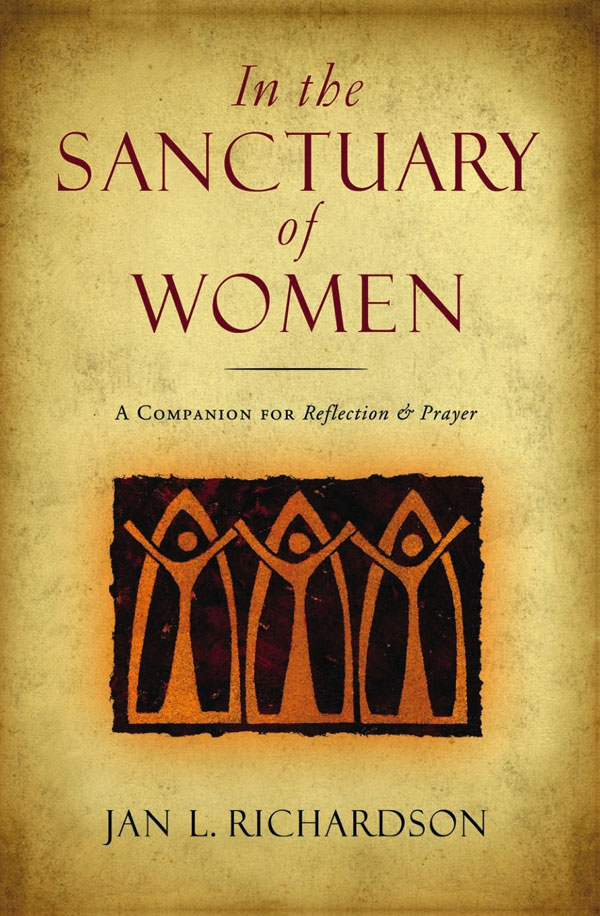
P.S. NEW YEAR, NEW BOOK! As we move into this year, my new book, In the Sanctuary of Women, provides good companions for your path. In the spirit of Sacred Journeys, this book draws from the often hidden wellsprings of women’s wisdom in Jewish and Christian traditions, inviting us to engage the mysteries that lie at the heart of who we are. Not only for personal reflection, In the Sanctuary of Women also offers a space to engage with others, whether in an organized setting such as a book group or prayer circle, or with a friend across the country or across the table.
The companion website, sanctuaryofwomen.com, offers info on where to purchase the book, and inscribed copies are available by request. More than being just about the book, the site is designed to foster conversation and community through features including a guide for reading groups and an interactive blog. I would love for you to stop by and to join with others in the conversations that are happening about how we can create sanctuary for and with one another in the coming year.
I love this time between Christmas Day and Epiphany. Although the prospect of moving beyond the holidays is always a bit poignant for me, I take comfort in knowing that the festival of Christmas lasts not for one day but for twelve, and there is still cause for celebration before we leave this season. This year in particular I am grateful for the opportunity to rest and reflect, and to do some dreaming as well as playing before I dive into the coming year.
In these blissfully quiet days, I have spent time curled up with a few books. One that I am especially savoring was a Christmas gift from my parents. Mapping the World: Stories of Geography, written by Caroline and Martine Laffon, is a beautifully produced book that traces some of the history of how we humans have sought to chart the universe, and our place within it, over millennia. With images of maps from ancient to contemporary times, the book reveals how maps are never neutral documents: they provide a glimpse of the beliefs, myths, legends, and sometimes prejudices of those who created them.
I have spent much time this year thinking about maps. In retreats, workshops, worship, and conversation, the question has surfaced again and again: In a world that we enter with no map in hand, no blueprint, no book of instructions, how do we find our way? In the Wellspring service, the contemplative worship gathering that Gary and I lead, we recently finished a five-part series titled “Mapping the Mysteries of Faith.” As we explored this theme and the questions that it stirred, the conversations we had at Wellspring were rich and refreshing. We didn’t leave with many answers—that’s not the point of the Wellspring service—but I found myself reminded once again of how crucial it is to have the company of wise travelers as we make our own maps.
With Epiphany on the horizon, I find myself thinking of the magi, those ancient travelers who went in search of the Christ. Wise to the heavens, they still possessed no map, no ready-made chart that laid out their course. As Matthew tells it, all that the magi had to illuminate their terrain and guide their way was a star. This was where their map began: with a burning light, with a step taken, with the company of others gazing in the same direction.
In that spirit, here’s a new poem. Composed while I was curled up among the books, it’s for Epiphany, and for you.
Where the Map Begins
This is not
any map you know.
Forget longitude.
Forget latitude.
Do not think
of distances
or of plotting
the most direct route.
Astrolabe, sextant, compass:
these will not help you here.
This is the map
that begins with a star.
This is the chart
that starts with fire,
with blazing,
with an ancient light
that has outlasted
generations, empires,
cultures, wars.
Look starward once,
then look away.
Close your eyes
and see how the map
begins to blossom
behind your lids,
how it constellates,
its lines stretching out
from where you stand.
You cannot see it all,
cannot divine the way
it will turn and spiral,
cannot perceive how
the road you walk
will lead you finally inside,
through the labyrinth
of your own heart
and belly
and lungs.
But step out
and you will know
what the wise who traveled
this path before you
knew:
the treasure in this map
is buried not at journey’s end
but at its beginning.
—Jan Richardson
As we travel through these Christmas days toward Epiphany and the coming year, where do you find yourself in your map? What are you giving your attention to? Are you looking in a direction that enables you to see possible paths? Is there a turn you need to take in your map? Where might you begin? Who can help?
As we travel toward Epiphany and beyond, blessings and good company to you.
[To use the image “An Ancient Light,” please visit this page at janrichardsonimages.com. Your use of janrichardsonimages.com helps make the ministry of The Painted Prayerbook possible. Thank you!]
The elves and I are busy in the studio, happily painting and plotting as we prepare for Advent to begin this Sunday. During the coming season, I’ll be posting new reflections and artwork over at The Advent Door instead of here at The Painted Prayerbook. I’ve already added a couple of entries there and would be delighted for you to stop by. I’m planning to post at The Advent Door several times each week and look forward to sharing the coming days with you. I have lots of other resources for Advent and Christmas; you can find out more here.
I am also thrilled to say that my new book, In the Sanctuary of Women, was published last month. You can find more info and place orders on the Books page at my main website, where inscribed copies are available by request. I have also launched a companion site for the book at sanctuaryofwomen.com. More than just a site about the book, sanctuaryofwomen.com is designed to foster conversation and community through such features as the Guide for Reading Groups and the Sanctuary blog. I’d love for you to visit!
And if you live in central Florida, please join us for a special holiday evening to celebrate the book’s publication. The gathering will be Friday, December 3, at 8 PM at First United Methodist Church of Winter Park (near Orlando). For further info, visit Sanctuary Celebration.
In this week in which we celebrate U.S. Thanksgiving, know that I am grateful for you. Many blessings to you as we cross into Advent.
We’re on the cusp of a splendid summer celebration: the Feast of Mary Magdalene falls tomorrow, July 22. So I’m taking a quick break from reading editor’s proofs and getting ready for my upcoming travels to wish you a most happy feast day.
The image above, which comes from my series The Hours of Mary Magdalene, depicts one of my favorite legends about the Magdalene. According to the medieval tale, Mary Magdalene—having moved to France and become a famous preacher—visits a prison and releases those who have been unjustly held captive there.
To help celebrate this woman whose story is so intriguingly intertwined with the life of Jesus, I’m sharing my sweetheart’s song “Mary Magdalena,” which you can hear by clicking the audio player below. It’s from his CD House of Prayer and is one of my very favorites.
Greetings from amidst the boxes! A month into my marriage, I’m finally getting serious about packing up the cozy studio apartment where I have lived for more than a decade. (It’s not just procrastination; I’ve had a few things going on!) I’m thrilled about having more space now that my sweetheart and I have moved into our new home, where I have a whole room that I’ll use as my studio/office. Yet I have loved living in the lovely, light-filled space of my wee apartment (300 square feet on a good day) and know there will be a certain poignance when I close the door here for the last time.
Sitting among the boxes during this afternoon of packing, taking a break with a cup of tea, I’m still thinking about the beginnings and threshold-crossings that I pondered here at The Painted Prayerbook a couple of weeks ago. As I wrap up (literally) the life that I’ve lived within these walls and carry my belongings and myself into a new space and a new season, we are crossing a threshold in the Christian calendar as well. In the rhythm of the Christian year, this Sunday is Trinity Sunday, which marks the beginning of the season that’s often called Ordinary Time. Ordinary Time is a loooong season that’s sometimes hard to get our liturgical brains around because there aren’t any major holy days that help us know where we are in the year and what we’re supposed to do. Yet this can be a rich time, because this season beckons us to ponder how and where we find the presence of the sacred in the ordinary dailiness of our lives.
For me, it’s a good time to be crossing into some new spaces both in the physical realm and in the terrain of my soul. Heading into this ordinary season (which, honestly, comes as something of a relief in the wake of the past months that have been wondrous but intense), I find myself wondering where I’ll meet the holy in the coming weeks and months. As I unpack these boxes and settle into the new rhythms that are emerging as Gary and I make a home together, how might the face of God reveal itself, challenging me to see in ways I haven’t seen before?
How about you? Where might God be hiding out in the midst of the moments—ordinary or otherwise—that will make up your life in the days to come?
As we move toward Trinity Sunday and into Ordinary Time, I invite you to visit my earlier reflection: Trinity Sunday: A Spiral-Shaped God. May you find many blessings amid the sacred ordinariness of the coming season.
Marrying, moving, making a home with my sweetheart: these days are full of new beginnings. As I move through the changes and transitions that this season offers, I am mindful, too, that the Christian calendar is telling us much the same thing: this is a time that beckons us to start anew.
We are approaching the end of the Easter season. This week gives us the Feast of the Ascension (which falls on May 13; many churches will celebrate it on the 16th), and next week we will celebrate Pentecost. For the followers of Jesus, these two events—Jesus’ physical departure from earth and the descent of the Holy Spirit at the festival of Pentecost—were pivotal ones in the life of their community. These events called them to wrestle with questions they had not had to face during Jesus’ life. How would they follow Jesus when he was no longer physically present? What did it mean to become the body of Christ in this world? Enlivened by the Spirit, what new beginning were they being called to make?
As for the early followers of Jesus, and for all those who have sought Christ across the ages, the feasts of the Ascension and Pentecost beckon us to consider how God continually invites and inspirits us to begin again. These days challenge us to discern and imagine anew the life to which God calls us, both individually and in community. As we move through the coming days, what new beginning—large or seemingly small—might God be drawing you toward? What do you need in order to cross this threshold? Who could help?
Things may continue to be a bit sporadic here at The Painted Prayerbook as I cross this new threshold, settle in, and gear up for the travels and projects scheduled for this summer, but I look forward to easing back into the swing of things in cyberspace and being in conversation with you here. In the meantime, I invite you to stop by my earlier reflections for the feasts of the Ascension and Pentecost. Clicking the images or the reflection titles below them will take you to the posts.
Peace to you as we celebrate these festive days, and a blessing upon your beginnings!
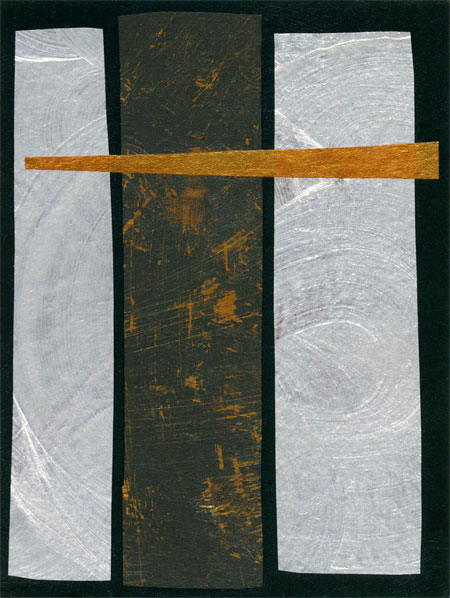 Image: Good Friday II © Jan L. Richardson