Archive for the ‘art’ Category

Epiphany 3: Fulfilled in Your Hearing

January 19, 2010


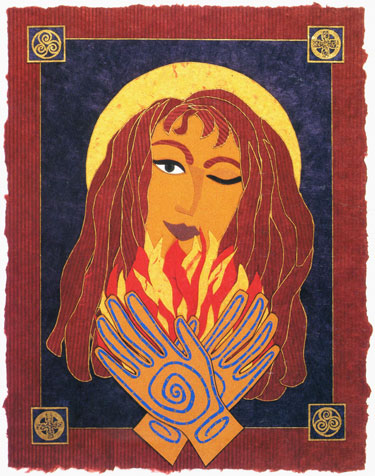
Fulfilled in Your Hearing © Jan L. Richardson

Reading from the Gospels, Epiphany 3, Year C (January 24): Luke 4.14-21

In doing research for my new book, two of the most intriguing women I encountered were Agnes Smith Lewis and Margaret Dunlop Gibson. Twin sisters born in Scotland in the 19th century, Agnes and Margaret were a formidable pair who became pioneering scholars and explorers in a time when this was a rare feat for women. Semitic languages and biblical studies became their particular passions, and in 1892 they traveled to Egypt to make their first visit to St. Catherine’s Monastery. Established in the sixth century at the foot of Mt. Sinai, the Greek Orthodox community is famed for the many treasures it holds from the early centuries of Christianity. Margaret and Agnes hoped to study some of the ancient manuscripts in the monastery’s library.

Agnes writes that among the ancient books placed into their hands by the librarian of St. Catherine’s was “a thick volume, whose leaves had evidently been unturned for centuries, as they could be separated only by manipulation with the fingers…” In some cases, they had to separate the leaves with a steam kettle.

Agnes recognized the book as a palimpsest, a manuscript whose text had been effaced and overlaid by a later text. Such a practice was common in times when vellum was scarce. Looking closer, she saw that the more recent text was, as she described, “a very entertaining account of the lives of women saints.” Thecla, Eugenia, Euphrosyne, Drusis, Barbara, Euphemia, Sophia, Justa, and others: women revered in Eastern Christianity, these were among the desert mothers, women of the early centuries of the church who gave up safety, security, convention, and finally their lives in order to follow Christ.

Looking closer still, beneath the stories of these women saints, Lewis recognized that the more ancient writing belonged to the gospels. The manuscript proved to be what was then the oldest Syriac version of the four gospels, dating to the fourth century. It was a stunning discovery.

Reading about the palimpsest, I found myself fascinated by the imagery present within its story. The pages of the manuscript, with their layers of text, make visible what happened in the lives of these women of the early church. By their devotion, by their dedication to preserving and proclaiming the gospel message, the desert mothers became living palimpsests, the story of Christ shimmering through the sacred text of their own lives, the Word of God fulfilled in them.

I have thought of these women and this story in pondering the gospel reading for this Sunday. Luke tells us that, fresh from his forty-day sojourn into the wilderness and filled with the power of the Spirit, Jesus begins to teach in the synagogues. Coming to Nazareth, the hometown boy stands and reads from the scroll of Isaiah. From his lips flow some of the most powerful words in all of scripture:

The Spirit of the Lord is upon me,
because he has anointed me
to bring good news to the poor.
He has sent me to proclaim
release to the captives
and recovery of sight to the blind,
to let the oppressed go free,
to proclaim the year of the Lord’s favor. (Luke 4.18-19)

Finishing his reading, Jesus rolls up the scroll, returns it to the attendant, and sits down. One can imagine him pausing for dramatic effect before he then says to his listeners, “Today this scripture has been fulfilled in your hearing.”

It is perhaps the shortest teaching the crowd has ever heard. Not to mention the most startling, and, as we will see in next week’s gospel lection, one that will turn deeply disturbing.

The text doesn’t say whether his mother, Mary, was there, but I can imagine her listening to Jesus, a small smile on her face as she takes in the words of his reading and teaching. She is the woman, after all, who had sung words much like these when she carried this child-now-man inside her: had sung of a God who scattered the proud and brought down the powerful, a God who lifted up the lowly and filled the hungry with good things. From the womb Jesus had been marked by radical words about this God who showed mercy from generation to generation and was about the business of turning the world right side up. Like his mother, whose song was an echo of one sung by her foremother Hannah, Jesus offered words with a history, lines that were rooted in an ancient hope.

Amongst the crowd, his mother is perhaps the only one unsurprised by the stunning message from the lips of this One who was so deeply imprinted with the liberating words of God. And not just imprinted with those words, not just a vessel of those words, but the Word itself, the Word made flesh, the One who incarnates the Word in his own being. On that day in the synagogue, Jesus comes among them as the sacred story of God embodied in fullness for all to read; the ancient, sacred texts cohering and taking form and coming to life in him, for the life of the world.

And we who are the body of Christ and followers of the Word: what will we do with these words about good news for the poor, release for the captives, sight for the blind, freedom for the oppressed, and the year of God’s favor? How do we, like those long-ago desert mothers, let these ancient words show through the lines of our own lives? How do we, like the Christ whom we follow, give flesh to these words? Amid the brokenness of the world—of which we have been reminded so vividly by the devastation in Haiti—how do we become bearers of these words that are so radical and so challenging in the hope to which they call us?

These are a few of the questions that I—a woman in love with the Word and with words and who cannot rightly extricate the latter from the former—am chewing on in these days. May these words—the words of Isaiah, the Word of Christ—challenge us, call us, enliven us and take flesh in us, for the life of the world. Blessings to you.

Note: Agnes Smith Lewis’s account of the finding of the palimpsest is from her book, available online, A Translation of the Four Gospels from the Syriac of the Sinaitic Palimpsest. Janet Soskice has recently published a lively and absorbing book about Agnes and her sister Margaret; I highly recommend The Sisters of Sinai: How Two Lady Adventurers Found the Hidden Gospels.

[To use the “Fulfilled in Your Hearing” image, please visit this page at janrichardsonimages.com. Your use of the Jan Richardson Images site helps make the ministry of The Painted Prayerbook possible. Thank you!]

A Couple More Things…

Coming Attractions: Now that the book is (mostly) finished, I’m moving back into a rhythm of offering periodic retreats and workshops. I’m looking forward to traveling to Minnesota, Virginia, and Washington State in the next few months and invite you to stop by my just-added Upcoming Events page to check out what’s ahead.

Prints & More Prints: All the images here at The Painted Prayerbook and also at The Advent Door are now available as art prints! Visit Jan Richardson Images, go to any image that you’d like, and scroll down to the section that says, “Order as an Art Print.”

Epiphany 2: Marriage and Miracles

January 12, 2010


When He Surprised Us with Wine © Jan L. Richardson

Reading from the Gospels, Epiphany 2, Year C (January 17): John 2.1-11

“So how are your wedding plans coming along?”

It’s a question I’ve been getting a lot as Gary and I look toward being married this April. Mostly the question has prompted laughter from me, as the past few months have been so wildly full that we’ve had little time to take care of any wedding planning except for a few of the major things: location, food, music. I’d like to think that with those things covered, what else could we need? Which puts me in mind of a young relative of mine who still gets ribbed for asking, at the outset of his engagement, “How complicated can it be to plan a wedding?” Having been an officiant or a bridesmaid at plenty of weddings, I know that designing even a simple celebration, as Gary and I are aiming to do, can be a real feat.

Still and all, I’m aware that even with as much as we still need to do to plan the festivities—and, now that January is here, we’re shifting into higher gear on that—there are plenty of other things to be sorted out as we plan and plot our marriage together. We’ll need to find a house, as I mentioned in a recent post. We’ll need to figure out how to make a home and a life together as two people who each require a good measure of solitude and space for our souls. I—who have lived on my own for nearly twenty years—will need to learn a different rhythm of living, not only with a husband but also with his teenaged son. And Gary and I will need to do all the work of establishing a household and creating a home as two people whose ministries involve the adventure of raising our own incomes.

As I look at all that needs to be done, both before the wedding and after it, I’m aware that we’re going to need a few miracles. So it’s been good to be keeping company with the story of the wedding at Cana of late. It’s a story, after all, that reminds us that marriage and miracles go together.

John’s account is familiar enough: Jesus and his disciples, along with Mary, Jesus’ mother, are invited to a wedding in Cana. The wine gives out—an occurrence which, I once heard someone point out, might not have happened if all those disciples hadn’t been there. Mary points out the lack of libations to Jesus. Initially resistant, Jesus relents and calls for the servants to fill six stone jars, used for the Jewish rites of purification, with water. When a sampling of the contents is taken to the chief steward, he is stunned and begins to praise the groom for saving the good wine until now, when many of the guests have become too drunk to notice.

John makes a point of letting us know that this is the first of Jesus’ miracles—“the first of his signs” (from the Greek semeion), as some translations put it. It’s John’s way of calling us to pay particular attention to what’s going on here. Jesus’ action at the wedding at Cana is not only a wonder in itself; it reveals much about who he is and what he has come to do. Jesus offers here a foretaste, if you will, of the wonders he will yet perform; his gesture is a harbinger of the bent toward plenitude that will mark his ministry. Again and again, in the chapters to come, we will witness Jesus’ persistence in entering places of lack—lack of health, of justice, of wisdom, of wholeness—and offering abundance in its place.

To a couple setting out on a life together—the couple at Cana, and the couple of which I am a part—Jesus’ wondrous act comes as a comfort and a sign of hope that those who undertake the journey of committing their lives to one another will be met with the abundance and provision they need.

But here’s the thing. As miraculous as Jesus’ provision is, and as hopeful as I find it, I wonder if he was up to something more here than just supplying what was lacking.

The older I get, the more aware I become of what particular and complex individuals we humans are. We are so deeply imprinted by our experiences, our genes, our personal and cultural history, our instincts and desires, our biases and patterns. This imprinting only becomes deeper as we go along. My dad calls this “Dr. Moreso’s Theory”: whatever our personality characteristics are, as we age they tend to become more so. Given this, I occasionally find it something of a wonder that any two of us can pass five minutes in the same room, let alone make a life together, sometimes for decades on end.

The fact that so many people choose, in the midst of this, to commit themselves to another person is a wonder and a delight. To choose to make a life with someone while also knowing some of the obstacles to such a life is a sign of profound hope. And lest anyone think by my ponderings about the challenges of marriage that I’m not actually looking forward to it, let me say that my wonderings about how my beloved and I are going to sort through some of those challenges are much outweighed by my anticipation and delight at the prospect of making a life together. My wonderings are grounded by my clarity, present nearly from the outset and borne out by eight years together (“Kinda rushing things, aren’t you?” one friend recently observed), that this is the person I feel called to go through life with. The presence of such love and clarity is a gift and a wonder.

And perhaps this is something of what Jesus was up to at that wedding: by his action, Jesus was not only providing a needed plenitude but also recognizing that it was already present. Encouraged by his mother, a woman who knew something of marriage and miracles, Jesus was offering a sign by which he acknowledged and celebrated the miracle already present when two people enter into a covenant with one another, with all the challenges and the blessings it will bring, most of which can hardly be seen at the outset.

Relational miracles aren’t reserved just for couples who have covenanted to make a life together, of course. In friendships, in families, in communities, in all the places where we honor the threads of connection and commit to engage the struggles and joys that come with them, the presence of wonder lurks, and the miraculous lies in wait for us to notice. When we do notice, when we see the plenitude present in our connections, it comes as a reminder of what we celebrate in this season of Epiphany: the life and work of God-with-us, who, in the person of Jesus, came to tangle himself up with us in the messy miracle of this shared life.

So in the midst of your relationships, in the web of your connections, how are you keeping your eyes open for signs and wonders these days? What sustains you when the signs are hard to see? As you pray or yearn or ache for needed miracles in your life or in the life of another, are there marvels that God is already up to? Might the miracle be coming in a different form than you expect, and can you let yourself see it? How might God be inviting you to participate in the working out of a wonder in the life of another? How do you keep yourself open to the surprising gifts—the sharp, sweet wine—that God is conniving to bring?

In these days, may we perceive the wonders at hand, be part of the miracles yet to come, and encounter unexpected delights along the way. Blessings to you.

[To use the “When He Surprised Us with Wine” image, please visit this page at janrichardsonimages.com. For my charcoal drawing of the wedding at Cana, which first appeared in The Christian Century magazine, please see this page. Your use of the Jan Richardson Images site helps make the ministry of The Painted Prayerbook possible. Thank you!]

Epiphany 1: Baptized and Beloved

January 3, 2010


Baptized and Beloved © Jan L. Richardson

Reading from the Gospels, Epiphany 1/Baptism of Jesus, Year C: Luke 3.15-17, 21-22

A few nights ago, I had a dream. In the dream, I was sitting by a lake. A woman came and sat down beside me. She looked like a woman on whom life had been especially hard. Turning to her, offering my hand, I told her my name and asked hers. “My name,” she said as she took my hand, “is Fayette.”

Fayette. It’s the name of a woman who has haunted me for years and whom I have never met in waking life. I first learned of her in a story told by Janet Wolf, who used to serve as the pastor of Hobson United Methodist Church in Nashville, Tennessee. Hobson UMC is a wildly diverse congregation that includes, as Janet has described it, “…people with power and PhDs and folks who have never gone past the third grade; folks with two houses and folks living on the streets; and, as one person who struggles with mental health declared, ‘those of us who are crazy and those who think they’re not.’”

Years ago, a woman named Fayette found her way to Hobson. Fayette lived with mental illness and lupus and without a home. She joined the new member class. The conversation about baptism—“this holy moment when we are named by God’s grace with such power it won’t come undone,” as Janet puts it—especially grabbed Fayette’s imagination. Janet tells of how, during the class, Fayette would ask again and again, “And when I’m baptized, I am…?” “The class,” Janet writes, “learned to respond, ‘Beloved, precious child of God, and beautiful to behold.’ ‘Oh, yes!’ she’d say, and then we could go back to our discussion.”

The day of Fayette’s baptism came. This is how Janet describes it:

Fayette went under, came up spluttering, and cried, ‘And now I am…?’ And we all sang, ‘Beloved, precious child of God, and beautiful to behold.’ ‘Oh, yes!’ she shouted as she danced all around the fellowship hall.

Two months later, Janet received a phone call.

Fayette had been beaten and raped and was at the county hospital. So I went. I could see her from a distance, pacing back and forth. When I got to the door, I heard, ‘I am beloved….’ She turned, saw me, and said, ‘I am beloved, precious child of God, and….’ Catching sight of herself in the mirror—hair sticking up, blood and tears streaking her face, dress torn, dirty, and rebuttoned askew, she started again, ‘I am beloved, precious child of God, and…’ She looked in the mirror again and declared, ‘…and God is still working on me. If you come back tomorrow, I’ll be so beautiful I’ll take your breath away!’

Beloved, the voice from heaven had proclaimed as the baptismal waters of the Jordan rolled off Jesus’ body. Beloved, the voice named him as he prepared to begin his public ministry. Beloved, spoken with such power that it would permeate Jesus’ entire life and teaching. Beloved, he would name those he met who were desperate for healing, for inclusion, for hope. Beloved, echoing through the ages, continuing to name those drenched in the waters of baptism. Beloved.  Child of God.

Fayette—beloved, precious child of God, and beautiful to behold—haunts me, blesses me, goes with me into this season. She challenges me to ask what it means that—like her, with her—I have been named by God’s grace with such power that it won’t come undone. As I remember the Baptism of Jesus, how will I reckon with the fact that I, that we, have shared in those waters—that in the sacrament of baptism and as members of the body of Christ, we, too, are named as beloved children of God? How will we live in such a way that others will know themselves as named by God, beloved by God—especially those who have been given cause to think they are less than loved, less than children of the One who created them?

In the coming days, may the waters of our baptism so cling to us that in their depths we see who we are, and from our depths reflect to others their true name: beloved, precious child of God, and beautiful to behold.

Blessings to you.

[Janet Wolf’s story is from The Upper Room Disciplines 1999 (Nashville: The Upper Room).]

[To use the “Baptized and Beloved” image, please visit this page at janrichardsonimages.com. For all my artwork for the Baptism of Jesus, please see this page. Annual subscriptions for unlimited downloads from janrichardsonimages.com are available at a special holiday discount through Epiphany (January 6). Visit subscribe for more info. Your support of JRI helps make the ministry of The Painted Prayerbook possible. Thank you!]

For previous reflections on the Baptism of Jesus, please see these posts:

Epiphany 1: Take Me to the River
Epiphany 1: Ceremony (with a Side of Cake)

Feast of the Epiphany: Blessing the House

December 31, 2009

Image: The Wise Ones © Jan Richardson

Reading from the Gospels, Epiphany, Years ABC: Matthew 2.1-12

In the rhythm of the liturgical year, the season of Christmas comes to an end with the Feast of the Epiphany on January 6. The word epiphany comes from the Greek word epiphaneia, meaning manifestation or appearance. In Western Christianity, we observe this day primarily as a commemoration of the wise men who journeyed to see Jesus. In the East, Epiphany is a major feast day that celebrates not only Christ’s manifestation to the world through his birth and to the magi in their visit but also the way in which he showed himself forth in his baptism and in his first recorded miracle, the changing of water to wine at the wedding at Cana.

In doing some reading about the Feast of the Epiphany recently, I’ve been intrigued by a custom that is often mentioned in connection with this day of celebration: the blessing and chalking of the house. Many versions of the ceremony that I’ve come across include these elements:

-The reciting of a blessing upon the house (or other dwelling) and those who inhabit it

-The blessing of a piece of chalk that is then used to write a formula above the entry of the house. The formula incorporates the current year with the initials of the wise men (whose names are not recorded in scripture but were given by tradition as Caspar [or Gaspar], Melchior, and Balthasar). This coming Epiphany, it would be written this way:

20 + C + M + B + 10

(Some folks note that “C M B” can also stand for “Christus Mansionem Benedicat,” which means “May Christ bless this dwelling.”)

-The sprinkling of the door with holy water

Although it seems to be an ancient practice, I haven’t found any explanation of the origin of the custom. I suspect that, like many rituals, it has several layers of meaning and that its origin has more than one source. Certainly it has much resonance with the visit of the wise men to the home of Jesus, Mary, and Joseph, and the manner in which they blessed it with their presence and their gifts.

So I’ve been thinking about house blessings as Epiphany approaches, especially since Gary and I will soon be in search of a house of our own. We’re engaged to be married next spring, and I’m daily praying that God will lead us to a (spacious) abode that will welcome two adults, each of whom needs a studio at home (and a copious measure of personal space), and Gary’s teenaged son. (Did I mention we’re looking for something spacious?)

At the same time that I’m thinking of (and praying for) a physical dwelling that we will inhabit and bless, I also find myself imagining the coming year as a house—a space in time that is opening itself to all of us. How will we inhabit the coming year? How will we enter it with mindfulness and with intention? How will we move through the rooms of the coming months in a way that brings blessing to this world?

With these questions in mind, I offer this blessing for you.

The Year as a House: A Blessing

Think of the year
as a house:
door flung wide
in welcome,
threshold swept
and waiting,
a graced spaciousness
opening and offering itself
to you.

Let it be blessed
in every room.
Let it be hallowed
in every corner.
Let every nook
be a refuge
and every object
set to holy use.

Let it be here
that safety will rest.
Let it be here
that health will make its home.
Let it be here
that peace will show its face.
Let it be here
that love will find its way.

Here
let the weary come
let the aching come
let the lost come
let the sorrowing come.

Here
let them find their rest
and let them find their soothing
and let them find their place
and let them find their delight.

And may it be
in this house of a year
that the seasons will spin in beauty,
and may it be
in these turning days
that time will spiral with joy.
And may it be
that its rooms will fill
with ordinary grace
and light spill from every window
to welcome the stranger home.

—Jan Richardson

Wherever you make your home, may it be blessed, and may you enter this Epiphany and the coming year in peace.

[For other Epiphany reflections, please visit my previous post. If you’re working with the lection from John’s gospel for this Sunday (Christmas 2), please see this reflection.]

[To use the “Wise Ones” image, which is from my book In Wisdom’s Path: Discovering the Sacred in Every Season, please visit this page at janrichardsonimages.com. For all my artwork for the Feast of the Epiphany, please see this page. Your use of janrichardsonimages.com helps make the ministry of The Painted Prayerbook possible. Thank you!]

On the Sickth Day of Christmas

December 30, 2009


Magi and Mystery © Jan L. Richardson

Reading from the Gospels, Epiphany, Years ABC: Matthew 2.1-12

I’ve spent the past few days dealing with an unexpected Christmas guest: a rare (for me) head cold. It’s one way to get a break, I suppose, but not the way that I’d planned to spend these lovely days between Christmas Day and Epiphany. I finally gave in and went to the doctor today and trust I’ll be back in the swing of things soon.

I had planned to post a new reflection for Epiphany early this week, and still have hopes of doing so before the week is out; we’ll see how that goes. In the meantime, I invite you to visit my previous Epiphany posts: Magi and Mystery, Inviting Epiphany, and Feast of the Epiphany: A Calendar of Kings.

To see all my artwork for the Feast of the Epiphany, please visit this page at janrichardsonimages.com.

On this sixth day of Christmas, I wish you peace and good health!

On the Fourth Day of Christmas

December 28, 2009


The Hour of Vespers: Flight to Egypt © Jan L. Richardson

With Advent being my busiest season of the entire year, it comes as something of a comfort to me that Christmas is not just a single day: in the rhythm of the liturgical year, Christmas lasts for twelve days. There’s some variation of opinion as to when the Twelve Days of Christmas begin; some say Christmas night, others begin the count on December 26. Regardless, the season of Christmas ends with the Feast of the Epiphany on January 6. No matter how you count it, the days of Christmas invite us not to be too hasty in bringing an end to our celebration of the Incarnation. For me, this celebration includes giving my incarnated self some rest and savoring the delights that the season yet offers to us.

The Twelve Days of Christmas include several feast days that help define the season. December 26 was the Feast of St. Stephen (featured in the carol “Good King Wenceslas”), the first Christian to die for bearing witness to the one who had come as Emmanuel, God with us. Yesterday was the feast of St. John. Today, December 28, is the Feast of the Holy Innocents—the male children slaughtered by the soldiers of King Herod, as told in Matthew 2.16-18. (The Eastern Orthodox Church observes this on December 29.) This grim feast day reminds us to acknowledge the shadow side of the Christmas season: amid our celebration of the Christ who came as the light of the world, the presence of evil persists. To truly celebrate the birth of Christ means working against the forces that perpetuate suffering.

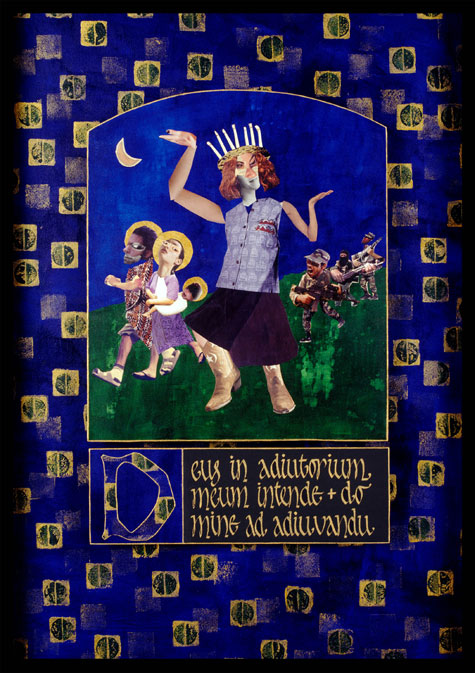
The Massacre of the Innocents appears often in medieval artwork, usually in gruesome detail and sometimes in connection with the Flight to Egypt (Mary, Joseph, and Jesus’ escape from the soldiers). The image above is from my Advent Hours series and depicts an intriguing variation on the story of the Flight to Egypt that incorporates St. Brigid, the famed Irish saint. Many ancient prayers and legends from Celtic lands refer to St. Brigid of Kildare as the foster-mother of Christ and the midwife at his birth. Even for the wonderworking Brigid, this would have been a great feat, as she was born in the fifth century. Yet in a culture in which the bond of fostering was often stronger than the bond of blood, this notion reveals something of the deep esteem that Brigid attracted, and it’s a way of describing how she helped to prepare a way for Christ as the Christian faith took root in Ireland. A particularly lovely legend tells that St. Brigid, upon seeing Herod’s soldiers enter the city to slaughter the young boys, quickly fashioned a wreath of candles. Placing it upon her head, she began to dance, distracting the soldiers and allowing the Holy Family to flee to safety.

On this feast day, Brigid’s legend and the story of the slaughter of the innocents calls me to consider what I’m doing, or need to do, to help protect those who suffer most in our world. As I rest for a bit in this Christmas season, as I linger with what the season continues to offer, how might this be a time of discernment and preparation for the work that lies ahead?

What’s stirring for you as we move through the Christmas season? What might this Twelve-Days-Feast have yet to offer you in the way of both delights and questions for your path ahead?

If you didn’t have occasion to visit The Advent Door during the past weeks, I invite you to stop by there as we move through these lingering days of Christmas. As we journey toward Epiphany, may you find in these days a continued celebration and the sustenance you need to walk in the way of Christ, the Word made flesh. Blessings and peace to you!

[To use this image, please visit this page at janrichardsonimages.com. Your use of janrichardsonimages.com helps make the ministry of The Painted Prayerbook possible. Thank you!]

Anticipating Advent

November 9, 2009

Advent11
Magnificat © Jan L. Richardson

Today has found me in the studio, working on some artwork for the cover of my new book. Amid the intensity of writing, I haven’t spent a lot of time in the studio in recent months, so it was lovely to clear off my drafting table today and play amongst the paints. As I wrap up the book and begin to contemplate the coming season of Advent, I’m looking forward to creating new art and reflections for my blog The Advent Door. I just published my first post of the year over there, with a few pre-Advent thoughts; I invite you to stop by. (And don’t miss the announcement there about the festive Advent discount on annual subscriptions at janrichardsonimages.com!)

Even though I’m someone who gives a lot of thought to Advent, I still often find that it catches me unprepared and that it seems altogether too short. Especially given what an intense year this has been with working on the book, I’m trying to get a jump on things and give some thought now to how I want to enter into the coming season. I don’t have a clear plan as of yet—and Advent tends to resist too much planning anyway—but I’m starting to envision some things that invite me to linger and savor and be: a good walk, a visit with a friend over a cup of tea, a stolen afternoon with a tasty book…

How do you hope to enter Advent this year? When we arrive at Christmas, what do you want to be able to look back on? What will help you stop and savor the coming season and open your eyes to the Christ who comes to us amongst these days?

As we anticipate Advent, may we also linger well with these present hours. Blessings to you.

For All the Saints

October 26, 2009

blog-A-Gathering-of-Spirits
A Gathering of Spirits © Jan L. Richardson

I am coming into the home stretch of my new book, thanks be to God, and am looking forward to finishing up all the final details in time to start blogging on a more regular basis in time for Advent (over at my other blog, The Advent Door). It’s lovely also to be getting ready to celebrate my favorite trinity of days in the whole year—Halloween, the Feast of All Saints, and the Feast of All Souls. For a long while, this trio of days has been a sacred time for me—what the Celtic folk call a “thin place” in the wheel of the year. As we approach the Feast of All Saints in this year that has been particularly intense with laboring on the book, I am especially mindful of and grateful for all the sources of help, encouragement, prayer, and good cheer I have received along the way from sainted folk on both sides of the veil.

As the Feast of All Saints draws near, I invite you to visit the reflection that I wrote last year by clicking here: Feast of All Saints: A Gathering of Spirits.

Also, if you’re working with Mark 12.28-34, the gospel lection for Proper 26B/Ordinary 31B/Pentecost + 22, I invite you to visit the reflection I offered last year for Matthew’s version of this story: Crossing the Country, Thinking of Love.

Many blessings to you in these sacred days.

Art for the Journey

October 4, 2009

blog-MotherRoot
Mother Root © Jan L. Richardson

Thanks so much to everyone who stopped by this past week  and to those who sent lovely words via a comment or an email. It was great to get to provide  support in word and image to folks preparing to celebrate World Communion Sunday. I’ve thought of all of you on this day that invites us to remember that each time we gather at the Communion table, we celebrate not just with our own community but also with sisters and brothers around the world and with the Communion of Saints across the ages. It’s a wide, wide table to which Christ invites us, with all its challenges and delights. I hope you had wondrous celebrations.

Although I’m blogging more sporadically these days while I work to finish my new book, I’d love to support you in whatever way I can, particularly with artful resources. Images are always available at janrichardsonimages.com. I designed this website to make my artwork easily accessible for use in worship, education, and related venues. If you’d like to use any of the artwork that you find here at The Painted Prayerbook, you can acquire it from the website. High-resolution files of single images are available for a nominal cost, or, with an annual subscription, you can have unlimited access to all the images (within the Guidelines for Use). Although I’m not creating new art for the lectionary readings right now (though I look forward to returning to this later in the fall), the cool thing about art, especially abstract art, is that it invites an array of interpretations. So of course you are most welcome, as always, to use an image even if it wasn’t designed for the specific scripture or theme that you’re pondering.

I welcome you also to stop by janrichardson.com, where you can find creative companions for your journey—or someone else’s—in the form of art prints, greeting cards, and books.

Your use of Jan Richardson Images and your purchases at janrichardson.com go directly to support my ministry, for which I raise my entire income. Your support is a crucial form of patronage that helps make it possible for me to continue in this ministry, including providing this blog, and I am tremendously grateful for those who sustain my work in this way. I invite you to find out more about being a patron at the Be a Patron page.

Thanks so much for visiting and for all the ways you share in my ministry, including the prayers and the words you send my way—they are tremendously heartening and are manna for my path. I wish you many blessings in these October days.

P.S. Advent’s not far away—if you’re planning ahead, I have lots of artwork for the season at janrichardsonimages.com (check out “Advent & Christmas” in the categories menu), and you can visit two years’ worth of art and reflections at my other blog, The Advent Door. I look forward to adding new work there as Advent unfolds this year.

Of Supper and Saints

September 29, 2009

Thanks for stopping by…I’m still alive and kicking and up to my eyeballs working on the book. But we have a festive weekend coming up, and I didn’t want to let it pass without making note of a couple festivities and inviting you to stop by the reflections that I offered on them last year. The entries may be reheated, but they’re still full of flavor, so come sit for a spell and have a savory taste…

blog2008-best-supper1

This Sunday, October 4, is World Communion Sunday. For my reflection from last year, visit The Best Supper.

blog2008-st-francis

This Sunday also brings us the Feast of St. Francis. I invite you to visit Feast of St. Francis for my earlier reflection on one of my favorite saints.

Many blessings to you in this week of celebration!